Cambodia formally filed a request on Tuesday for compulsory conciliation proceedings against Thailand under the United Nations Convention on the Law of the Sea, escalating a long-running maritime boundary dispute over an estimated $300 billion in offshore oil and gas reserves and ending decades of bilateral diplomacy that Cambodia now considers exhausted.
In a televised address from Phnom Penh, Prime Minister Hun Manet said Cambodia had delivered a formal notice to both Thailand and the U.N. Secretary-General to initiate the process under UNCLOS Annex V, the treaty's mechanism for inter-state disputes. "We have taken this step to protect Cambodia's sovereignty and maritime rights in accordance with international law," he said. "This is not unilateral action. It is an effort to resolve the dispute peacefully, through international law, and in good faith."
Cambodia has named Foreign Minister Prak Sokhonn as its agent for the proceedings and appointed Danish diplomat Peter Taksøe-Jensen and French academic Jean-Marc Thouvenin as conciliators. Thailand now has 21 days to nominate two conciliators of its own, after which a chairperson will be selected to complete the five-member commission. The process will be overseen by the U.N. Secretary-General.
The Overlapping Claims Area
The dispute concerns roughly 26,000 square kilometers in the Gulf of Thailand known as the Overlapping Claims Area, where the maritime boundaries asserted by the two countries diverge sharply because of conflicting interpretations of a 1907 boundary treaty between France, Cambodia's colonial power at the time, and Siam, present-day Thailand. Cambodia's preferred line runs in a way that cuts across the Thai island of Koh Kut. Thailand's preferred line discounts the existence of Cambodia's coastal islands.
The area is believed to hold nearly 12 trillion cubic feet of natural gas as well as significant volumes of oil in the Pattani Basin. Cumulative estimates of the resources at stake put the total value at roughly $300 billion. The reserves have not been developed because of the boundary dispute, and the urgency to settle the question has grown since the Iran war disrupted global oil markets earlier this year.
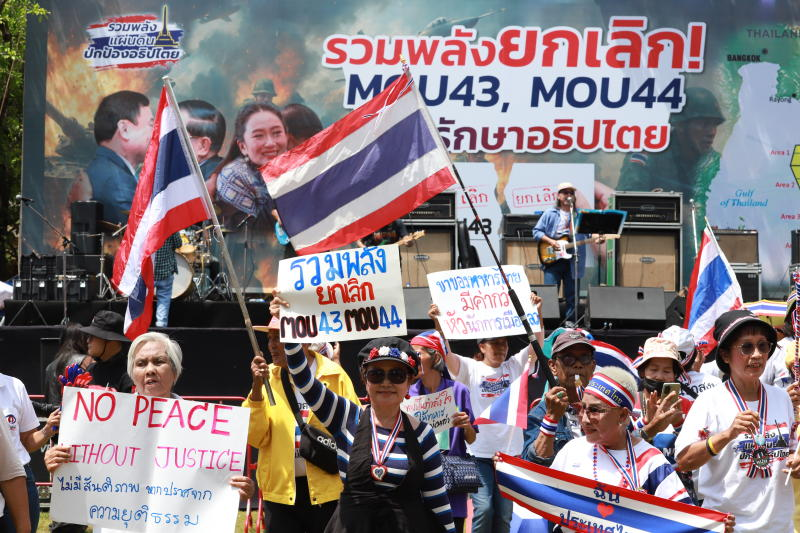
The 2001 memorandum of understanding between Bangkok and Phnom Penh had created what Hun Manet on Tuesday described as the only agreed bilateral framework for negotiating both the line itself and joint development of the resources beneath it. Talks under the framework produced little, however, and the Thai Cabinet voted on May 5 to terminate the agreement.
The Political Backdrop
The collapse of the 2001 framework cannot be separated from the political turbulence of the past year between the two countries. Two rounds of armed clashes along the 817-kilometer Cambodia-Thailand land border in 2025 killed nearly 150 people and displaced hundreds of thousands of civilians. A ceasefire negotiated in late December has largely held, with U.S. President Donald Trump credited with brokering the end of the first round.
The land border violence reshaped Thai domestic politics. Prime Minister Anutin Charnvirakul made cancellation of the 2001 maritime agreement a central plank of his February campaign and won the election on a wave of nationalist sentiment. The maritime framework's demise has been understood in Bangkok as a campaign promise fulfilled rather than a foreign policy crisis.
The history of bilateral border disputes between Cambodia and Thailand also informs the current standoff. The International Court of Justice in 1962 awarded Cambodia sovereignty over the Preah Vihear temple, a Hindu hilltop complex on the disputed land frontier. The decision has been a source of resentment in Thai political memory ever since and has reinforced a strong preference in Bangkok for handling disputes bilaterally rather than through international tribunals. Thailand has repeatedly rejected Cambodian efforts to escalate disputes to international bodies, including a separate attempt last year to take the land border conflict to the International Court of Justice.
The Compulsory Conciliation Process
Compulsory conciliation under UNCLOS is rare. Until now, it has been used only once in the treaty's history: the 2016-17 process between Australia and Timor-Leste, which produced a treaty in 2018 that resolved the maritime boundary in the Timor Sea after decades of failed bilateral talks. Hun Manet directly invoked that precedent on Tuesday, citing it as evidence that the mechanism can produce settlements where bilateral negotiations cannot.
Under the rules of the procedure, the five conciliators have twelve months to issue a report once the commission is constituted, with the deadline extendable to eighteen months. The findings are not legally binding on either party, but both states are obligated to consider the report in good faith. In the Timor Sea case, the conciliators held confidential parallel meetings with each side, set deadlines that both governments treated as politically binding, and deferred the most contested issues — such as pipeline routing — in order to reach agreement on the boundary itself.
Cambodia ratified UNCLOS in January, becoming the last Southeast Asian country to do so. The ratification opened the legal pathway to the conciliation request now filed.
Thailand's Response and the Land Border
Anutin told reporters in Bangkok that Cambodia's filing did not amount to a problem. He said he had not been formally notified of new issues arising from the May termination of the maritime memorandum and that Phnom Penh had been informed of Thailand's decision during the recent ASEAN summit. "Thailand has not yet determined when it will proceed further," he said. He has previously said Thailand would treat UNCLOS as a reference framework for any future bilateral negotiation.
The diplomatic exchange took place against the backdrop of fresh frictions along the land frontier. The Royal Thai Army said on Tuesday that armed Cambodian soldiers had attempted to block Thai troops from installing a razor-wire fence in the Chong Bok area of Ubon Ratchathani Province early in the morning. Five Cambodian troops initially crossed into the work zone before the contingent grew to roughly twenty personnel. A two-and-a-half-hour standoff ended without violence when the Cambodian forces withdrew, in what Thai officials described as a successful application of the joint communications protocol that both militaries adopted to prevent localized incidents from escalating.
Whether the Bangkok government formally participates in the UNCLOS commission, or merely allows the process to proceed without obstructing it, will be the next test. Australia at first contested the competence of the conciliators in the Timor Sea case before reversing course and engaging in good faith. Cambodia is openly hoping for a similar trajectory. Thailand, for now, has signaled nothing of the kind.
Author

We cover the world’s chaos so you don’t have to scroll twelve feeds to understand it.
Sign up for Atlas newsletters.
Stay up to date with curated collection of our top stories.