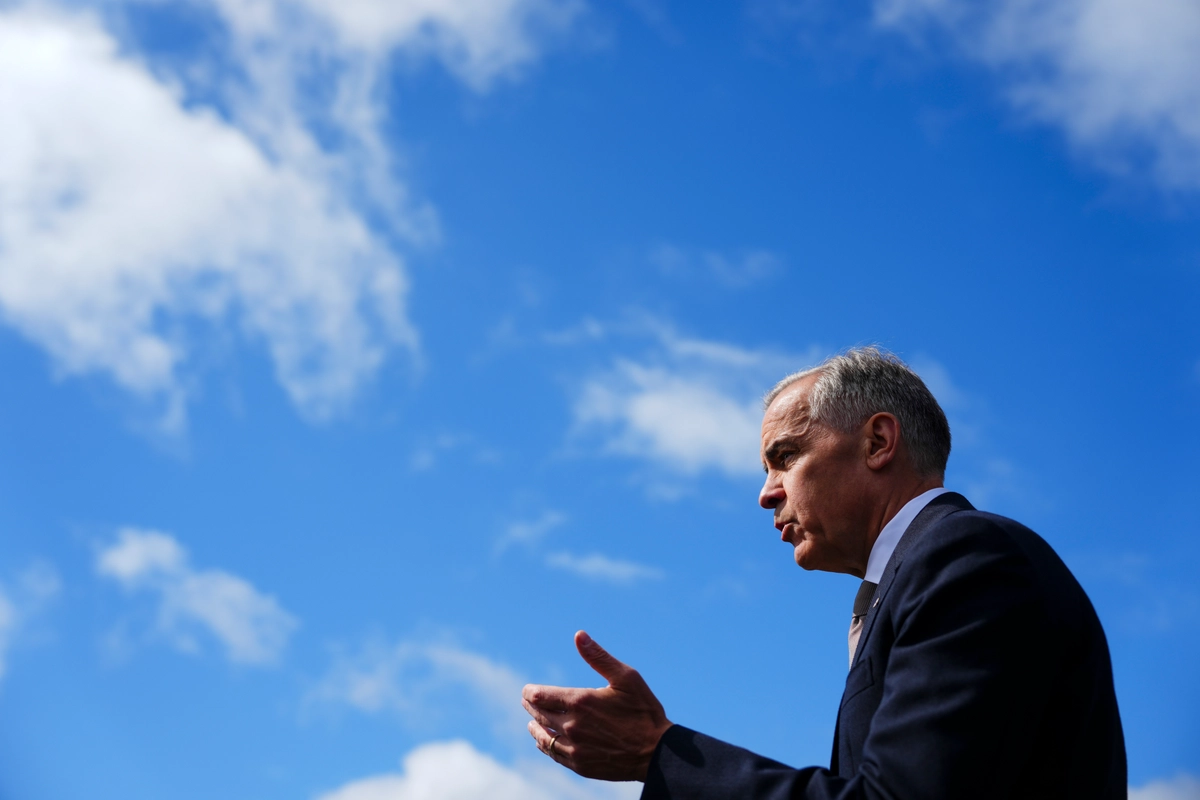
Prime Minister Mark Carney sharpened his criticism of Alberta's planned referendum on Monday, warning that the October vote risks repeating the mistakes of Brexit and calling the entire exercise "a very dangerous bluff."
Speaking at a press conference in Orleans, an Ottawa suburb, Carney said separation referendums are often pitched to voters as cost-free pressure tactics that can be reversed later, but rarely play out that way. "In these separation issues, it is often advanced that 'vote for this and it is a free option,' or 'vote for this, and we will strengthen our hand in a future negotiation,'" the prime minister said. "That is a very dangerous bluff."
He pointed directly to the 2016 British vote to leave the European Union, which he lived through as the governor of the Bank of England. "I saw firsthand what happened in the United Kingdom when the view was, 'Vote for this, it'll be soft, and then we'll negotiate, etc.,'" Carney said. "They're still 10 years later trying to undo what people didn't think they were voting for, but what they ended up having."
Asked whether he had attempted to dissuade Alberta Premier Danielle Smith from putting the question on the ballot, Carney offered a brief reply: "The premier doesn't always take my advice."
The October 19 Vote
Smith announced last Thursday that Alberta would hold a referendum on October 19 with the following 37-word question on the ballot: "Should Alberta remain a province of Canada or should the Government of Alberta commence the legal process required under the Canadian Constitution to hold a binding provincial referendum on whether or not Alberta should separate from Canada?"
The wording is not a direct vote on independence. It would only authorize the provincial government to begin the legal process toward a binding separation referendum at a later date — what critics in Ottawa have called a "referendum on a referendum."
Smith made the announcement after the Alberta Court of King's Bench blocked a citizen-led petition for a direct separation vote. Justice Shaina Leonard ruled that Elections Alberta had improperly approved the petition because the province had failed in its constitutional duty to consult with First Nations on a change that would directly affect treaty rights. The separatist group behind the petition, Stay Free Alberta, had collected 301,620 signatures, well above the 178,000-signature threshold equal to 10 percent of the last provincial election turnout. A competing pro-Canada group, Forever Canada, has gathered more than 400,000 signatures of its own.
The October vote would mark the first time in Canadian history that a province outside Quebec has put the question of separation directly to its voters.
Smith's Position and the Polls
Smith has said publicly that she would personally vote against separation and views Alberta's future as inside the Canadian federation. She has nonetheless defended the decision to hold the vote on the grounds that the court ruling had disenfranchised the hundreds of thousands of Albertans who had signed the original petition.
"Kicking the can down the road only prolongs an emotional and important debate," Smith wrote in an opinion piece published in the Calgary Herald. "Muzzling the voices of hundreds of thousands of Albertans who want to be heard is unjustifiable in a free and democratic society."
The available polling suggests separation has limited support. A survey released by the Angus Reid Institute on Monday found 60 percent of Albertans would vote "no" on the actual ballot question, with 35 percent voting "yes" to start the process. When the same respondents were asked the direct hypothetical of whether Alberta should leave Canada, support for remaining rose to 67 percent and support for leaving fell to 30 percent.
Responding to Carney directly on Monday, Smith said, "This is a decision for Albertans — not Ottawa. Albertans' frustrations have been fueled by the last 10 years of disastrous policies from Ottawa under his predecessor, Justin Trudeau." She added that "we should not dismiss the legitimate grievances of Albertans" but should instead work to address them.
Federal Review and the Clarity Act
Carney said his government is reviewing the proposed ballot question to determine whether it complies with Canadian law on referendums. The federal Clarity Act, passed in 2000 in the wake of the narrow 1995 Quebec independence referendum, gives Parliament the authority to determine whether a provincial referendum question on separation is sufficiently clear before it is put to voters.
"We have an obligation as a federal government to look at the question and decide whether it's consistent," Carney said. "That is underway. If there are questions about the clarity of the question, that will be a role for Parliament."
The prime minister also said he intends to campaign personally against separation over the 150 days remaining before the vote. "Canadians take care of each other," he said. "It's not perfect. We need to continue to work together, we are making progress. We're Canadian, we'll come together."
He pointed to the recent memorandum of understanding he signed with Smith on a new oil pipeline from Alberta to the British Columbia coast as evidence that Ottawa and the province can work constructively together. The deal sets Alberta's effective industrial carbon price at $130 per tonne by 2040 — lower than the previous federal proposal of $170 per tonne by 2030 — and could see construction begin in September 2027 and the pipeline completed by 2034.
Political Stakes Across the Aisle
The Alberta vote has begun to scramble Canada's broader political alignment. Conservative Party Leader Pierre Poilievre, who now represents an Alberta riding in the House of Commons, said he and his party will campaign in the province in support of remaining in Canada. "I'm a strong Canadian federalist, a proud Albertan and a proud Canadian," Poilievre told reporters last week.
Within Carney's own Liberal caucus, the response has been mixed. Calgary Liberal MP Corey Hogan accused Smith of turning her party's political problems into a "national crisis" by appeasing separatists. The "baffling, referendum-on-a-referendum question will do nothing to settle anything," Hogan said. Emergency Management Minister Eleanor Olszewski, also from Alberta, said being Canadian and Albertan were "intertwined" and described the situation as "heartbreaking."
Conservative MP Michelle Rempel Garner, who represents an Alberta riding, pushed back at Carney's choice of analogy. She said Carney "has no right to wag his finger" and warned him against repeating his role in what she described as the "Project Fear" campaign during Brexit. "What we need to do right now is that the Liberals need to project hope, not fear," she said.
The October vote arrives as Carney is also trying to lead a unified Canadian response to U.S. tariffs and the looming renegotiation of the U.S.-Mexico-Canada Agreement. The Alberta question is expected to dominate the final two weeks of Canada's parliamentary sitting before its summer recess.
Author

We cover the world’s chaos so you don’t have to scroll twelve feeds to understand it.
Sign up for Atlas newsletters.
Stay up to date with curated collection of our top stories.