The Department of War published 162 declassified files on unidentified anomalous phenomena Friday, the first official release under President Donald Trump's February order directing agencies across the federal government to make their UAP records public.
The cache went up at war.gov/UFO under the banner of a new program the administration is calling the Presidential Unsealing and Reporting System for UAP Encounters, or PURSUE. The files include FBI investigative reports, State Department cables, NASA Apollo mission imagery, military infrared video, and a number of unresolved military encounter reports going back to the 1940s.
"Whereas previous Administrations have failed to be transparent on this subject, with these new Documents and Videos, the people can decide for themselves, 'WHAT THE HELL IS GOING ON?'" Trump wrote on Truth Social. "Have Fun and Enjoy!"
War Secretary Pete Hegseth framed the release as a starting point rather than a finish line. "These files, hidden behind classifications, have long fueled justified speculation — and it's time the American people see it for themselves," he said in a statement. The department said it would post additional materials "every few weeks" as records are reviewed and declassified.
What's in the files
The files cover unresolved cases — incidents the government has not been able to definitively explain. The Pentagon was clear in its accompanying statement that being unresolved does not mean unexplained by extraterrestrial means. Many lack sufficient data. Some have partial conventional explanations.
A 1994 State Department cable from the U.S. Embassy in Tajikistan describes a passenger jet flight crew reporting a "bright light of enormous intensity" over Kazakhstan. The crew said they tracked the object for 40 minutes as it moved in circles, corkscrews, and 90-degree turns at high speed under heavy g-forces. When U.S. diplomats asked whether it could have been a meteor skipping the atmosphere, the pilot pushed back. The captain told the embassy he believed the object was "extraterrestrial and under intelligent control."
A military report from the Aegean Sea in October 2023 describes a UAP flying just above the surface of the ocean and executing 90-degree turns at roughly 80 miles per hour. A 2020 U.S. Air Force report describes UAP over the southern United States. U.S. Indo-Pacific Command logged a football-shaped body near Japan in 2024. There are reports from western U.S. airspace in September and December 2025, an Army report from North America in 2026, and material from operations in African airspace, the United Arab Emirates, Greece, Iraq, and Syria.
One of the more striking files is a recreation of an alleged ellipsoid, bronze-colored object reported by six law enforcement special agents over the course of two days in the western U.S. in September 2023. The witnesses described "orbs launching other orbs." The Pentagon's All-domain Anomaly Resolution Office, which handles federal UAP coordination, called that report "among the most compelling" in its collection.
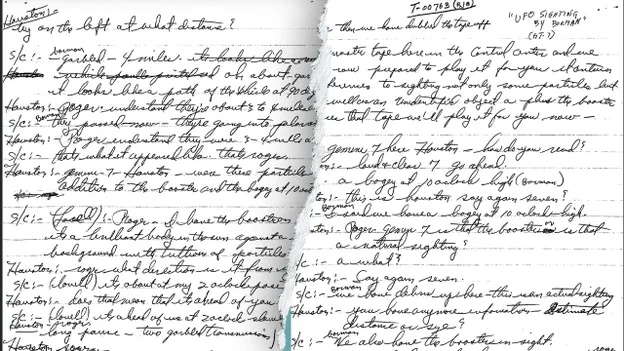
The release also pulls in NASA material from the Apollo program. A photo from Apollo 17 in 1972 shows three lights in a triangular formation above the lunar terrain. The Pentagon's caption states there is "no consensus about the nature of the anomaly," but a preliminary new analysis "indicated that it could be a 'physical object.'" An Apollo 17 transcript captures pilot Ronald Evans describing "very bright particles or fragments or something that go drifting by as we maneuver" — "jagged, angular fragments that are tumbling," likened to "the Fourth of July." Mission control responded simply, "Roger. Understand."
A 1969 Apollo 11 debriefing has Buzz Aldrin recounting a "fairly bright light source" the crew thought might be a laser, plus what he described as a "sizeable" object near the moon. Earlier files include a 1948 report from U.S. airmen in the Netherlands noting recurring "flying saucer" sightings and remarking that Swedish counterparts who had observed similar phenomena did not believe the objects came from "any presently known culture on earth."
Skeptics, critics, and the politics around timing
The release drew a quick split reaction. Disclosure advocates welcomed it as a meaningful step. Reps. Tim Burchett of Tennessee and Anna Paulina Luna of Florida, both of whom have publicly pushed for declassification, praised the rollout. Luna said an additional tranche is expected within roughly 30 days and added that 46 specific UAP videos identified by whistleblowers will be released later. "Transparency won't all happen at once, it will take some time," Burchett said.
Skepticism came from technical specialists and political critics alike, often for very different reasons. Sean Kirkpatrick, the former director of AARO, said before the release that the public should temper expectations. "Readers should not get their hopes up that there's going to be some document with photos, interviewing the aliens when they came down. Because that just doesn't exist." Kirkpatrick also addressed the eight-pointed star video from the Middle East in 2013 that drew immediate online attention, saying it is most likely a hot jet engine producing a diffraction pattern through an infrared sensor — not exotic technology.
UAP investigator Mick West said much of the new material is conceptually similar to what was disclosed during the Biden administration. "They're evidence of us not being able to identify a small white dot that's a long distance away," he said.
Harvard astrophysicist Avi Loeb took a middle position. "The files show that UAP are not simply a matter of speculation or public curiosity. The government has collected records," he said. The Apollo 12 and Apollo 17 lunar imagery was, in his view, "fascinating" but possibly attributable to asteroid impacts on the lunar surface.
Independent journalist Leslie Kean, who co-authored the 2017 New York Times report that effectively kicked off the modern wave of disclosure, said Friday's release shows substantial federal information remains classified. "I think we've already proven the existence of UAP, but that doesn't mean we've proven they're alien or extraterrestrial or that we know what they are."
The political criticism focused on timing. Former Republican Rep. Marjorie Taylor Greene, posting on X, called the rollout a distraction. "I really don't care about the UFO files. I just don't. I'm so sick of the 'look at the shiny object' propaganda." Rep. Thomas Massie made a similar critique in February when Trump first signed the directive, calling it "the ultimate weapon of mass distraction."
Joe Rogan made the same point on his podcast Thursday in an interview with Burchett. "What doesn't totally make sense is, why now disclosure?" Rogan said, suggesting it could be tied to public unease over the Iran war and the Hormuz crisis. Burchett rejected the framing: "I don't think he cares about trying to get everybody off-target by disclosing UFOs. I think he just wants to get it out there."
The longer arc of disclosure
Friday's release is the latest installment in a federal disclosure process that began under President Jimmy Carter in the late 1970s and has accelerated sharply since 2017, when the Times reported on a previously secret Pentagon program studying UAP. Congress established AARO in 2022 to coordinate the government's analytical work, and the office's first public report in 2024 documented hundreds of new UAP incidents while finding no evidence the U.S. government had ever confirmed a sighting of alien technology or recovered alien hardware.
Trump signed his February directive after months of public hints, including remarks at a Turning Point USA event in Phoenix earlier this spring where he told the crowd the review process was "well underway." He has not personally claimed knowledge of extraterrestrial life. Last month in the Oval Office, flanked by the Artemis II astronauts, he said: "I interviewed some pilots, very solid people, and they said they saw things that you wouldn't believe." He did not specify which pilots.
Vice President JD Vance said in March he is "obsessed" with the UFO files and intends to investigate Area 51 personally. NASA Administrator Jared Isaacman acknowledged the release on X, saying the agency would "remain candid about what we know to be true, what we have yet to understand, and all that remains to be discovered."
A YouGov poll in November found 56 percent of Americans believe aliens exist. Astrophysicist Neil deGrasse Tyson, writing in the Times this week, said he expected the release to be "anticlimactic" but called increased transparency "a good thing."
The PURSUE rollout will be measured incrementally. The Defense Department says it is reviewing tens of millions of records, many of them on paper, across dozens of agencies. The next batch is expected within weeks. The interpretive question — what, if anything, the files actually show — has been left, deliberately, to the reader.
Author

We cover the world’s chaos so you don’t have to scroll twelve feeds to understand it.
Sign up for Atlas newsletters.
Stay up to date with curated collection of our top stories.