Five Taliban officials landed in Brussels on Tuesday, spent a few hours across the table from European Union diplomats, and flew back out the same day on a route through Turkey. It was the first time the group had been received on EU soil since it took Kabul in 2021, and the reason was straightforward: Europe wants to send rejected Afghan asylum seekers home, and it cannot do that without the Taliban's cooperation.
The Meeting
The talks were held at a location the EU declined to name. Staff from the European Commission and 15 member states took part, with Sweden sharing the chair. Belgium, which hosts the EU's institutions, granted the delegation one-day visas after a security screening. The documents were valid for Belgium alone, not the broader Schengen area, and the group had no access to the rest of the bloc.
Because no EU government recognizes the Taliban, the session was kept off official premises and described as technical. The delegation was led by Abdul Qahar Balkhi, a spokesman for the Afghan Foreign Ministry, who called the visit historic and said it was the first time officials from the Islamic Emirate had met member states in Brussels.
Balkhi said the Afghan side pressed to restart consular services for Afghans living in Europe, set up a consular presence, and work toward what he called a dignified return process. The Commission laid out a narrower aim: returning Afghans who have committed serious crimes or are judged a security threat, along with the practical work of identifying them and issuing travel papers.
Why Europe Came to the Table
National capitals drove this. Last October, 20 member states signed a letter asking the Commission to coordinate returns talks with Kabul. Tuesday's meeting followed a Commission mission that traveled to Afghanistan in January, and the EU still keeps staff there.
The return figures explain the pressure. Of the 22,870 Afghans ordered to leave the bloc, only about 2 percent have actually gone, a figure cited by Belgian Migration Minister Anneleen Van Bossuyt, who helped write the October letter. In the first nine months of last year, 14,270 Afghans were told to leave; roughly 340 did. For migrants of all nationalities, fewer than three in ten of those ordered out of Europe end up leaving, a rate that has barely shifted.
Afghans remain one of the largest groups seeking asylum in the EU. Between 2013 and 2024 they filed close to a million applications, of which about half were granted. The talks come as governments across the continent harden their stance on migration, a shift that has tracked rising public frustration and gains for far-right parties. Brussels has recently moved to speed deportations, including plans for return hubs outside the bloc, tighter borders, and broader surveillance.
The Backlash
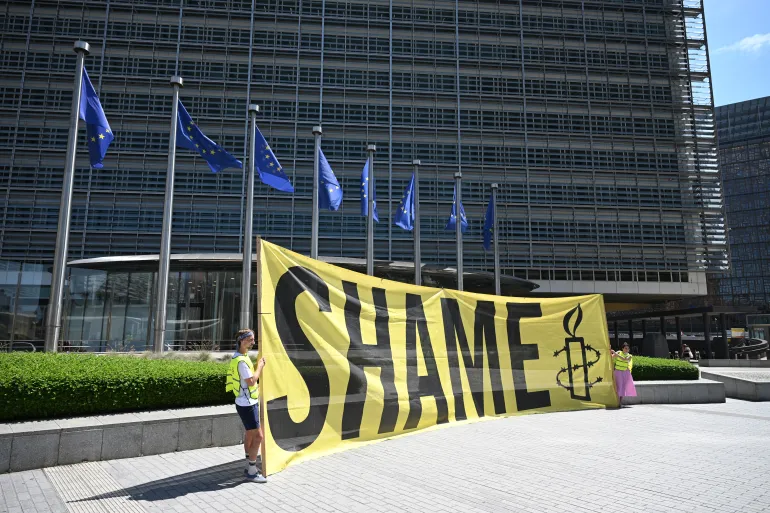
Outside the Commission's headquarters, Amnesty International held up a banner that read "Shame." Eve Geddie, who runs the group's European Institutions Office, called any EU effort to deport people to Afghanistan reckless and a breach of the bloc's legal obligations.
Fereshta Abbasi of Human Rights Watch said European governments cannot credibly condemn Taliban abuses and seek accountability while handing Afghans back to the same authorities. The Taliban's supreme leader and chief justice are both wanted by the International Criminal Court on charges of persecuting women and girls.
Malala Yousafzai, who was shot as a teenager by Pakistani Taliban militants for defying a ban on girls' education, said she was shaken and disturbed by the talks and warned Europe against legitimizing the government in Kabul. In the European Parliament, lawmakers from the Socialist and Green blocs denounced the meeting, one calling it a shameful chapter. The Parliament had already passed a non-binding resolution urging the Commission not to recognize or normalize the Taliban, and a clause that would have permitted readmission talks with unrecognized governments was cut from a recent migration law.
The Country They Would Return To
The objections rest on conditions inside Afghanistan. Since the Taliban returned to power in 2021, following the withdrawal of US-led forces, they have barred girls from school beyond the primary level, shut women out of nearly all paid work, and set rules dictating how women may dress in public.
The country is also in deep crisis. The United Nations estimates more than 17 million Afghans need aid, with food shortages, a collapsing economy, and sanctions compounding the strain. Over the past year, about 3 million Afghans have been pushed out of Iran and Pakistan, adding to the burden.
Some EU governments are not waiting on the Commission. Germany has deported Afghans with criminal records since 2024 and said this week it would increase removals of people it labels criminals and suspected terrorists, with three flights a month planned. The European Council on Refugees and Exiles maintains that Afghanistan cannot be treated as safe for return, citing the rights situation and the absence of meaningful legal protection.
What the Taliban Got
For Kabul, the room itself was the prize. The group has spent five years trying to chip away at its isolation, and a seat at a table in Brussels, even an unofficial one, moves it closer to the recognition it has sought. Belgian Foreign Minister Maxime Prévot said hosting the delegation conferred no legitimacy and did not amount to recognition.
Balkhi cast the visit as a step toward cooperation built on mutual respect. The Commission said the dialogue carries no political commitments. By Tuesday evening the visas had run their course, and the delegation was gone.
Author

We cover the world’s chaos so you don’t have to scroll twelve feeds to understand it.
Sign up for Atlas newsletters.
Stay up to date with curated collection of our top stories.