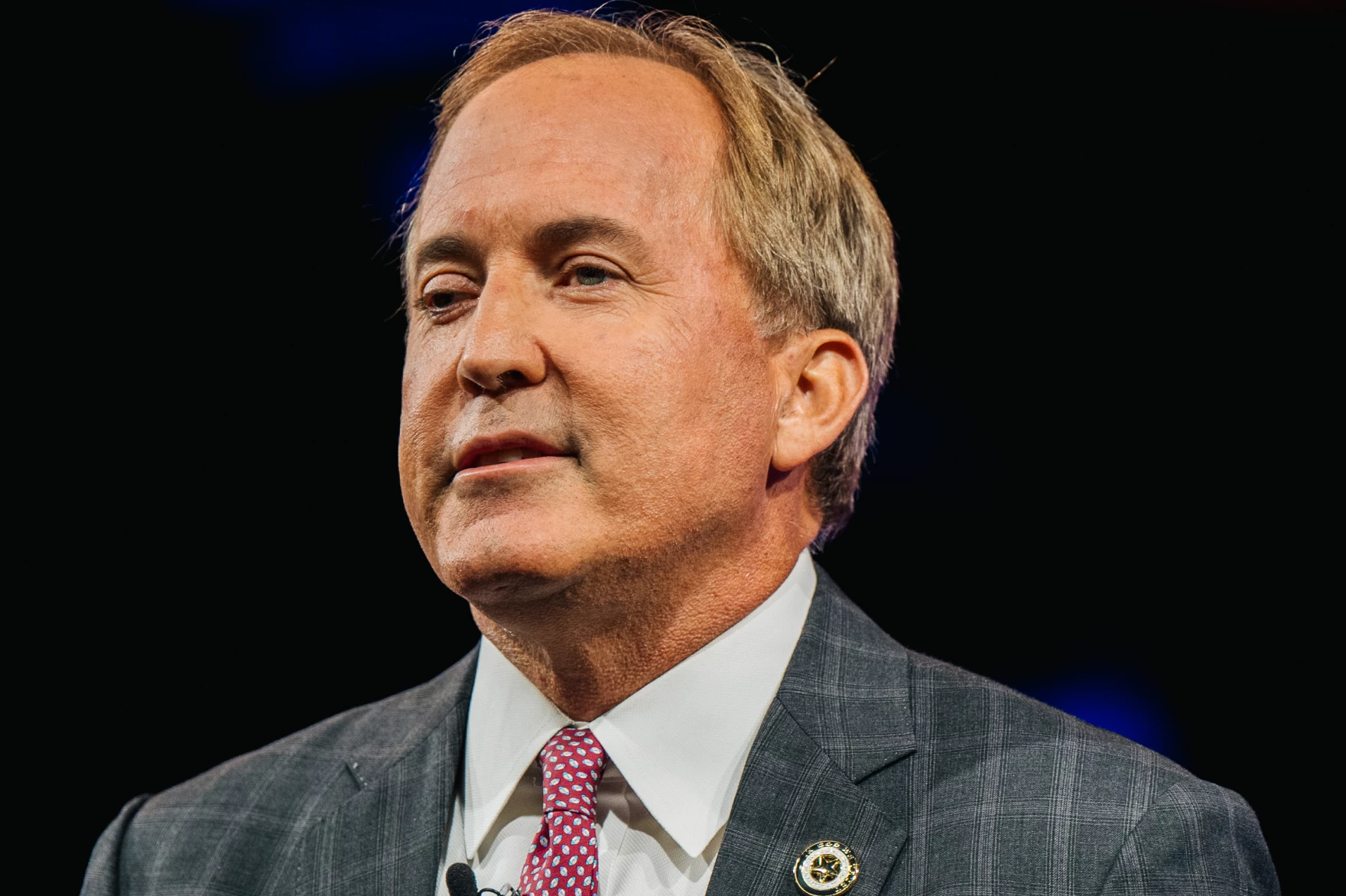
A federal judge has ordered Texas Attorney General Ken Paxton to drop his lawsuit against the Democratic fundraising platform ActBlue, ruling that he brought the case to retaliate against the platform for raising money for his opponent in this year's U.S. Senate race.
U.S. District Judge Richard Stearns, who sits in Boston and was appointed by Bill Clinton in 1993, issued a preliminary injunction on Thursday barring Paxton, his employees, and his agents from pursuing the Texas case or filing any new state enforcement action based on the same conduct. In a 15-page order, he found ActBlue likely to win its claim that the suit violated the First Amendment.
"The truth is plain and captured in Paxton's own declarations: The lawsuit was filed in retaliation for (and in an attempt to suppress) ActBlue's efforts to fund Talarico's campaign," Stearns wrote, referring to Democratic state Rep. James Talarico, who faces Paxton in November. The judge cited what he called Paxton's "well-known history of filing retaliatory lawsuits."
The timeline that undid the case
Much of the ruling turned on sequence. Paxton's office opened an investigation into ActBlue in December 2023, then let it sit largely untouched for about a year and a half. The dormancy ended, the judge noted, the day after Talarico announced in February that he had raised $2.5 million in 24 hours, roughly $2.2 million of it through ActBlue, following an appearance on Stephen Colbert's show.
The morning after that announcement, an investigator from Paxton's office made a small gift card donation through the platform, then ran additional test transactions. Five days after Talarico reported a first-quarter haul of $27 million to federal regulators, Paxton filed suit.
"The timing of events alone speaks volumes about Paxton's underlying motivation," Stearns wrote. He was skeptical of the state's claim that the case was prompted by a recent New York Times report on internal ActBlue memos, noting that Paxton's own lawyers conceded they had not fact-checked the article's claims.
That timeline mattered legally. Under a doctrine known as Younger abstention, federal judges typically stay out of active state cases, with a narrow exception for actions brought in bad faith to harass the target. Stearns found that exception clearly met, pointing to the revived investigation, Paxton's public statements, and what he described as the absence of any identified consumer harm.
What Paxton alleged
Paxton sued ActBlue on April 20 in Texas state court under the state's Deceptive Trade Practices Act, a consumer-protection statute he has used repeatedly against left-leaning groups. His office accused the platform of misleading Congress and the public by saying it had stopped accepting gift cards and foreign prepaid debit cards, then quietly resuming gift card donations.
Those payment methods, the suit argued, could let foreign nationals conceal their identities and make illegal contributions. Paxton sought civil penalties, which can run up to $10,000 per violation, and an order barring the platform from accepting gift card donations.
"It has blatantly ignored state law that prohibits deceptive practices, and it must pay for its illegal conduct," Paxton said when he filed the case. "Fair elections are the foundation of our democracy."
Stearns did not rule on whether ActBlue had broken any campaign finance law or accepted prohibited foreign money; those questions were not before him. But he rejected the consumer-protection framing, writing that the platform "does nothing more than facilitate political donations from private donors," activity he placed at the core of First Amendment protection. He also faulted Paxton's public conduct after filing, including a fundraising email that branded ActBlue "the Democrats' shadowy digital fundraising network" and tied the case to his Senate campaign.
ActBlue's response and a Fifth Amendment standoff
ActBlue, which is based in Massachusetts, brought its federal suit on May 1, calling Paxton's complaint "rife with false and inflammatory allegations" and arguing it was meant to punish the platform for backing his rival. The company said Paxton had misinformed the court, contending that its system had repeatedly rejected his investigators' gift card attempts despite claims in the lawsuit to the contrary.
Lawrence Oliver, ActBlue's chief legal officer, said the ruling "affirms that political fundraising is core to free speech and protected by the First Amendment," adding that the court "clearly chose the Constitution over partisan politics." Paxton's office did not respond to requests for comment.
The court fight unfolded alongside a parallel one in Congress. At a House Administration Committee hearing on fraudulent donations the day before the ruling, ActBlue chief executive Regina Wallace-Jones repeatedly invoked her Fifth Amendment rights, a stance she defended in a Washington Post op-ed as the only reasonable response to what she characterized as harassment rather than oversight. Senior ActBlue employees had similarly invoked the Fifth Amendment 146 times before a congressional panel in 2025.
A race, a rivalry, and a pattern
The dispute sits at the center of a marquee Senate contest. Paxton, the Republican nominee, and Talarico, the Democratic nominee, will meet in November, and Talarico has posted record fundraising numbers through the platform Paxton sought to restrain.
The episode also drew comparisons to Paxton's past conduct. Stearns likened the ActBlue case to the attorney general's investigation of the progressive watchdog Media Matters, which a federal appeals panel halted after finding uncontested evidence that Paxton had subpoenaed the group in retaliation for its reporting on Elon Musk and his platform, X.
Democrats, meanwhile, have pressed for scrutiny of WinRed, the Republicans' equivalent platform. Reps. Jamie Raskin, Robert Garcia, and Joseph Morelle have asked why Paxton pursued ActBlue while not acting on consumer complaints about WinRed, and an attempt to compel Paxton's testimony failed on a party-line vote. ActBlue, founded in 2004, says more than 28 million people have given through it, processing $1.78 billion last year alone. For now, the injunction freezes the Texas case while the platform's constitutional challenge proceeds, leaving the matter unresolved as the election nears.
Author

We cover the world’s chaos so you don’t have to scroll twelve feeds to understand it.
Sign up for Atlas newsletters.
Stay up to date with curated collection of our top stories.