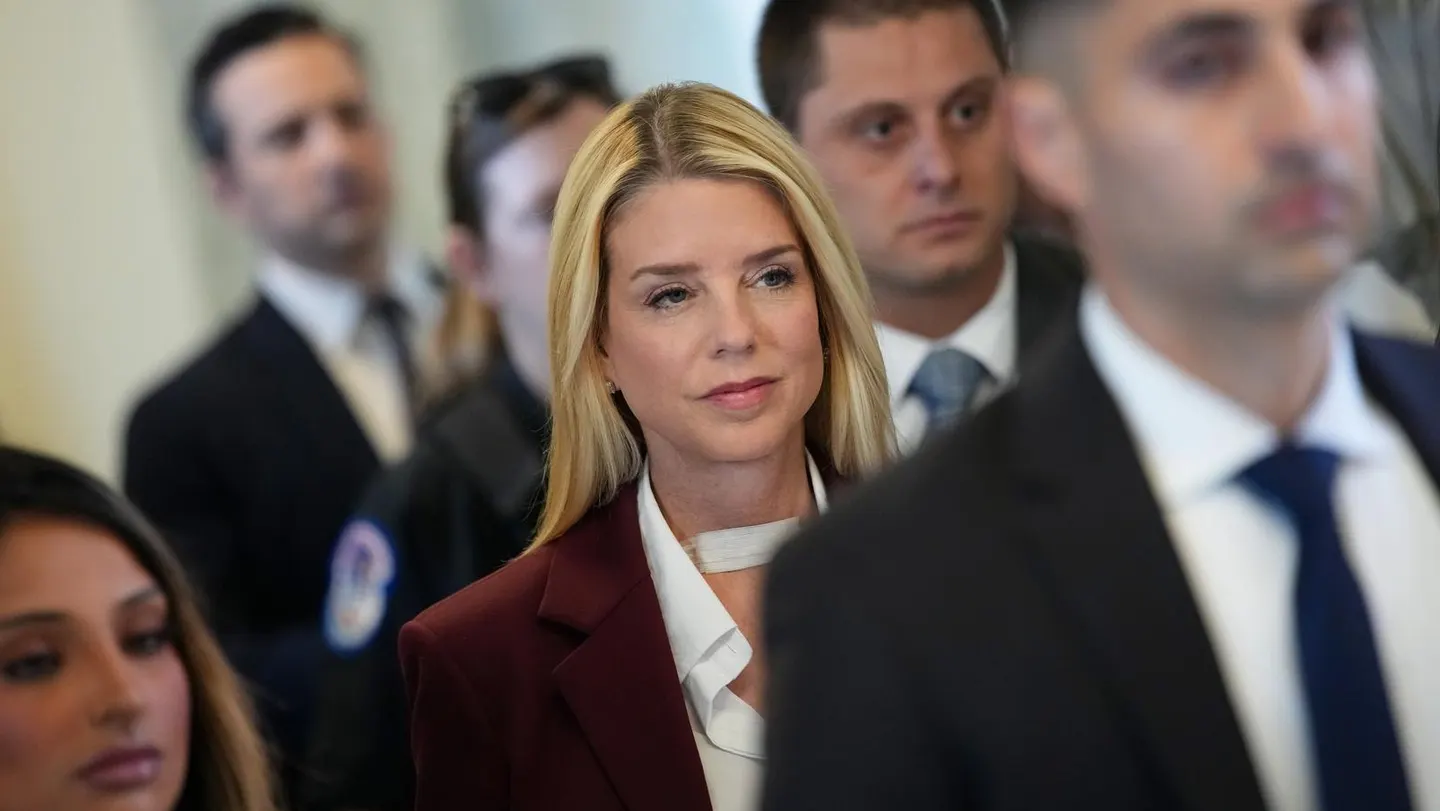
Former Attorney General Pam Bondi appeared before the House Oversight and Government Reform Committee on Friday in a transcribed closed-door interview about the Justice Department's handling of the Jeffrey Epstein files, defending the department's compliance with the Epstein Files Transparency Act while drawing accusations from Democrats that she had deflected questions about President Donald Trump and the conduct of the release.
In a prepared opening statement, Bondi said the department had "demonstrated an unprecedented commitment to transparency" and that, "to the best of my knowledge, the department produced everything required under the Epstein Files Transparency Act." She acknowledged that "there were redaction errors" in the materials but offered no detail on how they had occurred. She also offered sympathy to Epstein's victims, saying, "I am deeply sorry for what any victim has been through, especially as a result of that monster."
The interview, which took place on Capitol Hill, was transcribed but not videotaped, and Bondi was not placed under oath. A transcript will be released at a later date. The format drew sharp criticism from Democratic lawmakers and from several of Epstein's victims, who had pressed the committee to compel testimony under deposition rules and on camera.
Delegating to Blanche
The central pivot in Bondi's account, according to lawmakers in the room, was her assertion that she had not personally overseen the file release. "As the head of a large department with broad responsibilities, I did not lead every aspect of this effort or conduct that document review myself," she said in her opening statement. "I delegated oversight over this process to Deputy Attorney General Todd Blanche."
Blanche, Bondi's former deputy, has been serving as acting attorney general since Trump fired Bondi in April. Lawmakers said Bondi pointed to Blanche repeatedly in response to specific questions about redaction failures, document scope, and procedural decisions. Rep. Robert Garcia of California, the panel's ranking Democrat, said Bondi "deflected" to Blanche "over 30 times" during the interview and "continues to push back on the acting AG Todd Blanche" on what Democrats described as the central failures of the rollout.
Bondi pushed back later in the day in a post on X, calling the characterization "NOT TRUE." "I praised Acting AG Blanche's management of this Herculean task," she wrote. "I said his ethics are beyond reproach and that he is an incredible Attorney General."
The framing has political consequences. Democrats on the panel said they would now seek to question Blanche directly and, if he declines to appear voluntarily, will move to subpoena him. Garcia said FBI Director Kash Patel was "number two on the list."
The Trump Question
The most contested portion of the interview, according to multiple Democratic lawmakers, involved Bondi's communications with the president. Garcia told reporters during a break that he had asked Bondi "five times and five different questions about her conversations with President Trump, whether he directed her on the Epstein files, what he knew, what he asked her to redact or not, and she refused to answer any questions about President Trump."
Lawmakers said Justice Department officials sitting alongside Bondi during the interview intervened repeatedly to instruct her not to respond. Two attorneys attended on behalf of the department: Harmeet Dhillon, the assistant attorney general for civil rights, and Jonathan Guynn, a deputy assistant attorney general in the torts branch. Rep. Melanie Stansbury of New Mexico said Dhillon told the committee that Bondi was not required to answer because the interview was "voluntary" and not conducted under oath, and that the department had therefore not formally invoked executive privilege.
Dhillon, in a separate response, said she and Guynn had attended "for the agency" and that their participation was "customary." The Justice Department referred further comment to Bondi's social-media posts.
Bondi also separately disputed comments by Rep. James Walkinshaw of Virginia, who told reporters Bondi had testified she was "not certain of the extent of" Trump's knowledge of Epstein's alleged abuse. "MISREPRESENTATION by Walkinshaw," Bondi wrote on X. "What the world knows to be true is President Trump banned Epstein from Mar a Lago decades ago bc Epstein was a despicable creep!!"
Survivors and the Redaction Failures
A group of women identifying themselves as survivors of Epstein's abuse held a brief news conference outside the committee room before Bondi's interview. Several said they hoped for direct answers from the former attorney general and criticized the panel's decision not to videotape the interview. "It's incredibly vital that we see filmed interviews, not just the transcription, under oath and have it be publicly released quickly," said Danielle Bensky, a survivor.
The redaction failures have been the central public-facing complaint about the rollout. Several women whose abuse claims appeared in the released materials said their identifying information was visible and that explicit photographs were among the unredacted contents. "It boggles my mind that the Department of Justice released nude photos. The Department of Justice released pornography. That is unacceptable," Sharlene Rochard told reporters.
Maria Farmer, another survivor, issued a written statement during the interview saying Bondi's "continued evasion of questions about her grave mishandling of the release of the Epstein files was not surprising — it's a pattern of behavior." Farmer added that she first came forward to the FBI in 1996 and that "enough is enough."
Stansbury said Bondi had told the panel that the department had released 3 million of an estimated 6 million pages of Epstein-related material. Bondi did not address that figure publicly. Lawmakers also said Bondi had declined to answer questions about Ghislaine Maxwell's recent transfer to a lower-security prison facility, directing them to the Bureau of Prisons and to Blanche.
Next Steps
The Republican chairman of the committee, Rep. James Comer of Kentucky, said before the interview that lawmakers would focus on which documents had not been released and why. "We're going to try to determine whether or not there can be more documents legally turned over," Comer said. He told the survivors gathered on Capitol Hill that "if you lie to Congress, it's a felony" and pledged to follow up on questions that remained unanswered after the transcript is released.
Bondi's appearance does not appear to close the file on the Oversight Committee's investigation. With Garcia and other Democrats now pressing for Blanche and Patel to testify, the next test will be whether enough Republicans on the panel join Democrats to force the issue. Comer's office did not say Friday whether he would call either Blanche or Patel for testimony, nor whether he would resist a motion to subpoena.
Bondi was fired by Trump on April 2 amid criticism of her handling of the Epstein file rollout. She confirmed this week that she was diagnosed with thyroid cancer shortly after leaving the department and is undergoing treatment. Trump recently appointed her to an advisory committee on artificial intelligence policy.
Author

We cover the world’s chaos so you don’t have to scroll twelve feeds to understand it.
Sign up for Atlas newsletters.
Stay up to date with curated collection of our top stories.