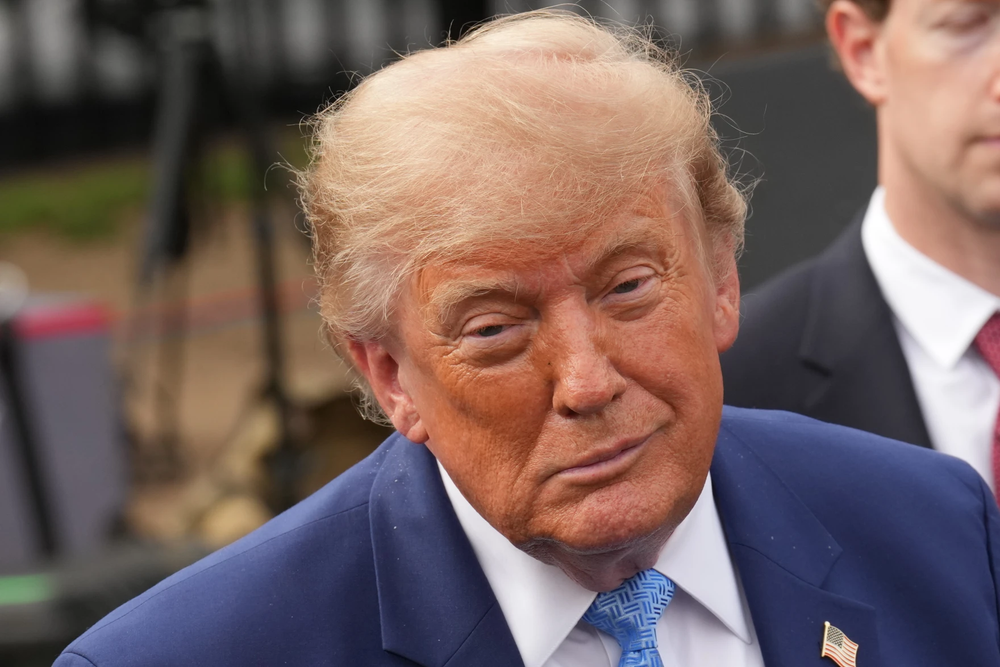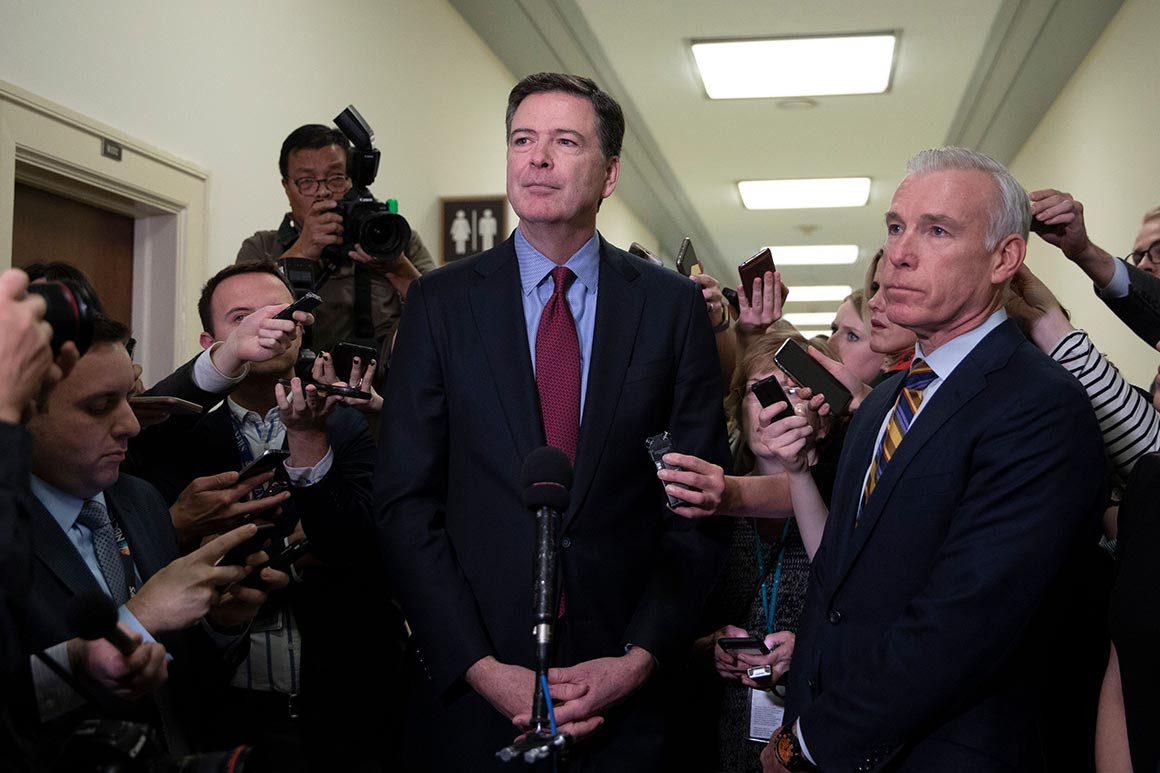
A federal grand jury in the Eastern District of North Carolina returned a two-count indictment Tuesday against former FBI Director James Comey, accusing him of threatening the life of President Donald Trump and transmitting that threat across state lines through a May 2025 Instagram post showing seashells arranged on a beach to spell out "86 47."
The indictment is the second criminal case the Trump Justice Department has filed against Comey in the span of seven months, and it lands in the middle of a sustained department-wide push under Acting Attorney General Todd Blanche to bring charges against figures the president has publicly identified as adversaries.
The charges, filed under 18 U.S.C. § 871(a) and 18 U.S.C. § 875(c), allege that Comey "knowingly and willfully" made a threat to take the life of and inflict bodily harm upon the president, and that he "consciously disregarded a substantial risk that his communication would be viewed as threatening violence." If convicted on both counts, Comey faces a maximum of ten years in federal prison.
Comey, in a video posted to his Substack within hours of the announcement, was defiant. "Well, they're back, this time about a picture of seashells on a North Carolina beach a year ago, and this won't be the end of it, but nothing has changed with me," he said. "I'm still innocent. I'm still not afraid. And I still believe in the independent federal judiciary, so let's go."
His attorney, Patrick Fitzgerald, said the defense would "contest these charges in the courtroom and look forward to vindicating Mr. Comey and the First Amendment."
The post at the center of the case
The Instagram post that triggered the prosecution was published on May 15, 2025, while Comey was on vacation in North Carolina. It showed an arrangement of seashells on a beach in the form of "86 47," with the caption: "Cool shell formation on my beach walk."
In American slang, "86" is most commonly used as a verb meaning to throw out, dismiss, refuse service, or otherwise remove. Merriam-Webster, the dictionary used by the Associated Press, lists those definitions and notes that "among the most recent senses adopted is a logical extension of the previous ones, with the meaning of 'to kill.'" The dictionary explicitly does not enter that secondary sense, citing its "relative recency and sparseness of use." Trump is the 47th president of the United States.
Comey deleted the post within hours after Trump allies, including Donald Trump Jr. and former White House aide Taylor Budowich, characterized it as a call for the president's assassination. "I didn't realize some folks associate those numbers with violence," Comey wrote in a follow-up post. "It never occurred to me but I oppose violence of any kind so I took the post down."
Trump, in a Fox News interview at the time, rejected that explanation. "He knew exactly what that meant. A child knows what that meant," Trump said. "If you're the FBI director and you don't know what that meant, that meant assassination. And it says it loud and clear."
The Secret Service interviewed Comey shortly after the post and the matter was effectively shelved. The Justice Department under then-Attorney General Pam Bondi did not pursue charges at the time. Bondi was removed earlier this month and replaced on an acting basis by Blanche, the deputy attorney general and Trump's former personal defense lawyer.
The legal hurdle
The central legal challenge for prosecutors will be proving intent under Supreme Court precedent that has steadily raised the bar for "true threat" cases since the Vietnam War era.
In Watts v. United States in 1969, the court reversed the conviction of an antiwar protester who had said at a rally that if drafted, "the first man I want to get in my sights" was President Lyndon B. Johnson. The justices held that the statement amounted to political hyperbole rather than a "true threat."
More recently, in Counterman v. Colorado in 2023, the court ruled that prosecutors must prove the defendant at minimum recklessly disregarded the risk that their words would be perceived as threatening. Blanche acknowledged the standard at his press conference Tuesday. "The question about intent matters, and we have to prove that," he said. "How do you prove intent? In any case, you prove intent with witnesses, with documents, with the defendant himself, to the extent it's appropriate. And that's how we'll prove intent in this case."
Free speech scholars have noted that the First Amendment protects political statements even when they involve intimidating language, but does not protect statements that constitute genuine threats to a specific person's life or safety. Where exactly that line falls in any given case is something the Supreme Court has declined to define with precision, leaving substantial discretion to prosecutors and trial judges.
The case has been assigned to U.S. District Judge Louise Flanagan, an appointee of President George W. Bush. The lead prosecutor is Assistant U.S. Attorney Matthew R. Petracca, working under U.S. Attorney W. Ellis Boyle for the Eastern District of North Carolina.
The first Comey case
The new charges arrive five months after the dismissal of the Justice Department's previous prosecution of Comey, which had been filed in the Eastern District of Virginia in September 2025. That case alleged that Comey lied to and obstructed Congress during 2020 testimony about authorized leaks to the press during the FBI's Russia investigation.
The Virginia indictment was secured by Lindsey Halligan, a former White House aide whom Trump had installed as interim U.S. attorney after pushing out the previous Trump-appointed U.S. attorney, Erik S. Siebert, who had concluded the evidence against Comey was insufficient. Career prosecutors in the office had also recommended against the indictment.
A federal judge dismissed the Virginia case in November after finding that Halligan's appointment had not complied with statutory requirements — she was not Senate-confirmed and had exceeded the time allotted for an interim U.S. attorney to serve. A second judge subsequently ruled that the Justice Department had violated Fourth Amendment protections in obtaining key evidence, blocking its use even if the case were refiled. The dismissal was also extended to a parallel case against New York Attorney General Letitia James. The department has filed appeals in both matters.
In a separate development, federal prosecutors in the Southern District of Florida are reportedly examining Comey as part of an unrelated grand jury inquiry. Blanche declined to comment on that investigation Tuesday.
The political backdrop
The Comey indictment is the latest in a fast-moving sequence of politically charged cases brought since Blanche took over the department earlier this month. The Justice Department has indicted the Southern Poverty Law Center on fraud charges, charged a former senior official at the National Institute of Allergy and Infectious Diseases with concealing federal records related to COVID-19 research, released a report alleging misconduct in prior prosecutions of anti-abortion activists, and on Monday charged the alleged White House Correspondents' Dinner shooter with attempting to assassinate the president.
Trump for years has called publicly for the prosecution of figures connected to the 2016 FBI investigation into possible coordination between his first presidential campaign and Russia. Comey, whom Trump fired in May 2017 over his handling of that probe, is the most prominent of those figures. Former CIA Director John Brennan is also under criminal investigation, according to multiple reports. Brennan has denied wrongdoing.
In a Truth Social post last year, Trump named Comey directly in calling for criminal charges against political opponents. Bondi was ultimately removed in part because of what advisers described as her insufficient pace in advancing those cases, particularly relating to Jeffrey Epstein-linked investigations and prosecutions of Trump adversaries.
The Justice Department's traditional posture for decades has been to maintain operational separation between the White House and individual criminal investigations. Blanche framed the Comey case Tuesday in narrower terms. "While this case is unique and this indictment stands out because of the name of the defendant, his alleged conduct is the same kind of conduct that we will never tolerate, and that we will always investigate and regularly prosecute," he said. "The temperature needs to be turned down, and anyone who dials it up and threatens the life of the President will be held accountable."
FBI Director Kash Patel echoed the framing. "James Comey disgracefully encouraged a threat on President Trump's life and posted it on Instagram for the world to see," Patel said in a written statement. "As the former Director of the FBI, he knew full well the attention and consequences of making such a post."
Comey's first court appearance could come as early as Wednesday. The Justice Department has indicated he will be allowed to surrender voluntarily rather than be arrested. Comey's defense team has signaled it will pursue both vindictive prosecution claims — drawing on the legal record from the dismissed Virginia case — and First Amendment defenses anchored in the Counterman and Watts precedents.
The factual record on the seashells themselves remains modest. Comey has said he did not arrange them, that he encountered the formation on a walk, and that he understood it as an existing political message rather than a personal endorsement of any specific course of action. Whether prosecutors can establish, beyond a reasonable doubt, that he understood the message as a threat — and intended it as one — is the question the case will turn on.
Author

We cover the world’s chaos so you don’t have to scroll twelve feeds to understand it.
Sign up for Atlas newsletters.
Stay up to date with curated collection of our top stories.