Marine Le Pen declared herself a candidate for the French presidency on Tuesday night, hours after a Paris appeals court upheld her conviction for misusing European Parliament funds but cut the ban on holding office that had threatened to end her career. The ruling reopened the door to a fourth run at the Élysée. The catch was an electronic ankle tag, and how Le Pen intends to get around it will shape the race to replace Emmanuel Macron.
The National Rally leader had spent months insisting she would not campaign while wearing a monitor. She reversed that position in a prime-time interview on TF1, announcing her candidacy and laying out a legal maneuver she says will keep the tag off her ankle through the campaign. "Tonight, I am a candidate for the presidential election," she said.
What the Court Ruled
The appeals court found Le Pen guilty of overseeing a scheme in which her party used money meant for European Union parliamentary assistants to pay staff doing domestic political work in France between 2004 and 2016. It upheld guilty verdicts for all 11 defendants who had appealed, including Le Pen and the party itself, and found the party had embezzled 2.8 million euros over more than a decade. "The facts are serious," said the chief judge, Michèle Agi.
But the court scaled back the penalties a lower court had imposed in March 2025. Le Pen's ban on seeking office was cut from five years to 45 months, with two-thirds of it suspended. Because the ban has been running since her original sentencing, she has already served the 15 months that remain in force, which lifts the obstacle to her candidacy effective immediately. Her prison term was reduced from four years to three, with two suspended and one to be served at home under electronic monitoring.
The judges signaled they did not intend to bar her from the race. In their written reasoning, they pointed to "the voter's freedom of choice" and said that keeping her off the ballot "would undermine the principle of freedom to stand for election, an essential condition for the democratic expression of universal suffrage." They concluded that the time already served had repaired the harm her conduct did to public integrity.
The Ankle-Tag Gambit
The remaining year of home detention with an ankle bracelet was, until Tuesday, the sticking point. Le Pen had said repeatedly that campaigning under France's house arrest system, which requires a magistrate to approve when and where a monitored person can travel, would be unworkable. "When you're a presidential candidate, you need to be completely free to move around," she said last week. "I can't depend on a magistrate to allow me to go to a rally."
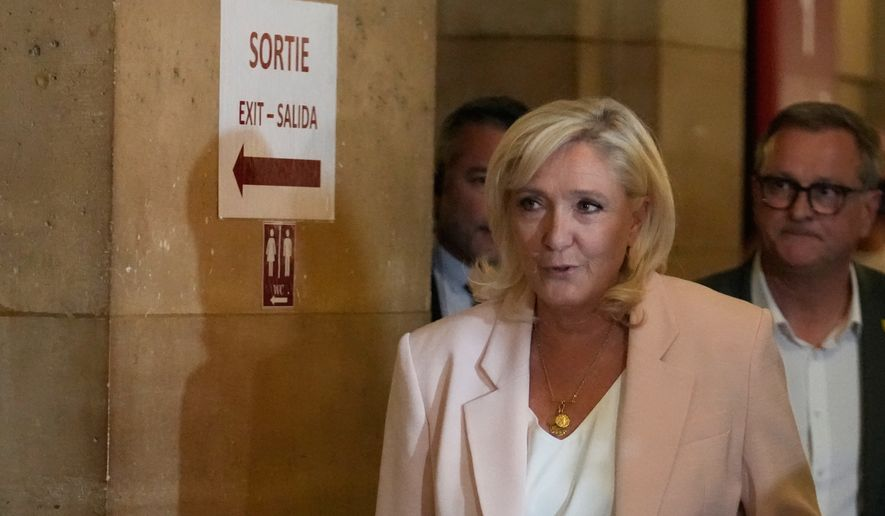
After leaving the courthouse with her head bowed and huddling for hours with party figures at National Rally headquarters, she emerged with a different message. She told TF1 she would appeal to the Court of Cassation, France's highest court, and argued that the appeal would suspend the tag requirement until that court rules. "I had stated that I would not campaign while wearing an electronic monitoring bracelet," she said. "But since I have the option to file an appeal... and that appeal suspends the effects of the ruling, I will campaign without an electronic monitoring bracelet."
There is precedent for the sequence, though not for the outcome she wants. Former President Nicolas Sarkozy appealed a 2023 sentence that included electronic monitoring; the Court of Cassation suspended it during review, then ultimately upheld his conviction, and he wore a tag last year. The high court has said it would aim to rule on Le Pen's case before the 2027 vote, with the first round in April and the runoff in May. It indicated it would decide no earlier than next week whether to take up her appeal.
A Career on the Line
Le Pen, 57, has run for president three times, losing to Macron in 2017 and 2022 and failing to reach the runoff in 2012. A fourth run would come as her party, which her father Jean-Marie Le Pen founded as the National Front in 1972 and which she renamed in 2018, sits at its strongest position yet. She has cast the case as political persecution, calling it a "witch hunt," and told the court her party acted in "complete good faith." Prosecutors countered that after taking over the leadership in 2011 she "professionalized" a system of diverting EU funds first set up loosely under her father.
Her likely stand-in, had she stepped aside, was Jordan Bardella, the 30-year-old party president who now polls slightly ahead of her. Bardella had pledged loyalty in a lengthy social media post the day before the verdict, writing that his support was "total." Le Pen, for her part, described the two as a "partnership consisting of a reliable prime minister and president" and said they would begin the campaign quickly. The dynamic is delicate: some in the party view Bardella as the stronger candidate, though opponents have long considered Le Pen the more formidable of the two. A May survey of more than 1,700 voters projected she could win a runoff against rivals including Jean-Luc Mélenchon and former prime ministers Gabriel Attal and Édouard Philippe, though other polls have suggested Philippe, who is courting right-leaning voters, could beat her in a second round.
Reaction Across the Spectrum
The verdict drew sharp responses from Le Pen's opponents. Marine Tondelier, who leads the Greens, said that in a party with "even the slightest shred of morality," Le Pen would decline to run given her conviction. Fabien Roussel of the French Communist Party said such a conviction, however the sentence was adjusted, should disqualify anyone from standing before voters. Clémentine Autain, a lawmaker on the left of Macron's coalition, accused the party of "fleecing taxpayers" while blaming immigrants for the country's ills.
Her lawyer, Rodolphe Bosselut, called the outcome "a good start" and said he was "partially" satisfied, citing the reduction in the ban as the key point. Macron, asked about the ruling during his visit to Damascus, declined to weigh in. "The president of the Republic does not comment on judicial decisions," he said. The European Parliament, which joined the case as a civil party, said it took note of the judgment and had acted to protect taxpayers' money, but would not comment further while an appeal to the Court of Cassation remains possible.
For now, Le Pen has what she needed to run and a plan to campaign unencumbered, both resting on a high court that has yet to say whether it will even hear her. Should the Court of Cassation decline to suspend the monitoring, or uphold it, the terms of her candidacy could change again well before voters go to the polls.
Author

We cover the world’s chaos so you don’t have to scroll twelve feeds to understand it.
Sign up for Atlas newsletters.
Stay up to date with curated collection of our top stories.