Russia launched one of the largest aerial assaults of its four-year war against Ukraine overnight Saturday into Sunday, firing 600 attack drones and 90 missiles — including a nuclear-capable Oreshnik hypersonic ballistic missile — in a barrage focused on Kyiv.
The attack began shortly after 1 a.m. local time on Sunday and lasted hours, with explosions echoing across the capital as residents took shelter in subway stations. Ukraine's Air Force said it destroyed or jammed 549 of the drones and 55 of the missiles; another 19 missiles failed to reach their targets. Sixteen missiles and 51 drones reached 54 locations, with debris damaging an additional 23 sites.
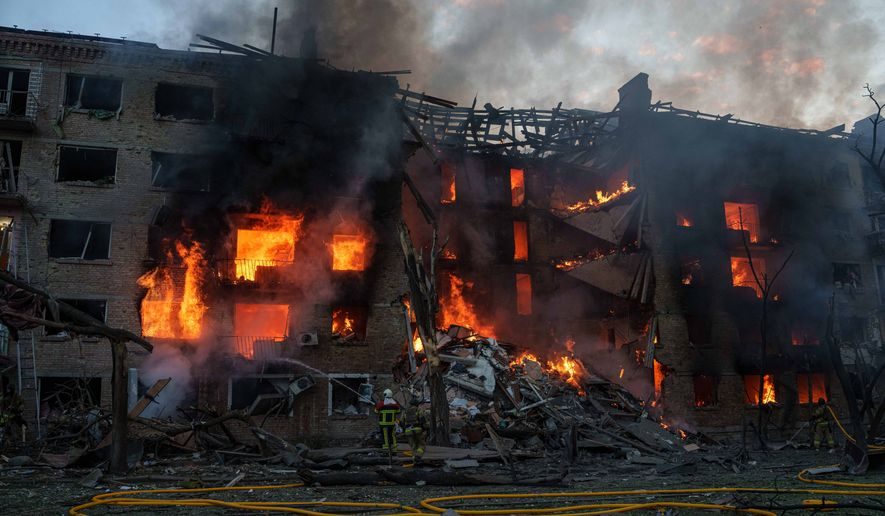
Four people were killed and around 100 wounded across Ukraine, officials said. Kyiv Mayor Vitali Klitschko reported two dead and 81 wounded in the capital, with two children among those hospitalized. Two more died in the wider Kyiv region. Prime Minister Yulia Svyrydenko said the strikes hit a water-supply facility, dozens of residential buildings, and several schools.
"The largest number of missiles was directed at the capital — at ordinary residential buildings, at schools; they burned down a food market, one of Kyiv's oldest markets," President Volodymyr Zelensky said in a statement.
A Museum, Embassies, and Government Buildings Damaged
The strikes did significant damage to the city's cultural and diplomatic landmarks. The Chernobyl Museum, which documents the 1986 nuclear disaster, was effectively destroyed. Zelensky said more than 40 percent of the museum was "irretrievably lost." The National Art Museum was damaged, and so was a building that houses the Kyiv bureau of the German public broadcaster ARD.
The foyer of the city's metro station on Independence Square was damaged, as were a post office in the same square and an opera house elsewhere in the city. The buildings of Ukraine's Foreign Ministry and Cabinet of Ministers also suffered minor damage. At least one missile struck the residence of Albania's ambassador to Ukraine. Albanian Foreign Minister Ferit Hoxha called the strike on the diplomatic residence "unacceptable" and "a grave escalation."
A nine-story residential building in the central Shevchenko district was hit, with one person killed when fires broke out on the top floors. Debris from a strike near a school in the same district blocked the entrance to an air-raid shelter, trapping several people inside. Beyond Kyiv, Ukrainian Foreign Minister Andrii Sybiha said the regions of Cherkasy, Kharkiv, Odesa, Poltava, Sumy, and Zhytomyr were also hit.
Zelensky, who toured several damaged sites on Sunday, said Russia had attacked "not only life, but also memory." Ukrainian Interior Minister Ihor Klymenko called the strike on the Chernobyl Museum "a deliberate attack on history, memory, and truth."
The Luhansk Dormitory Strike and Russian Retaliation
Russia's Defense Ministry confirmed the launch of an Oreshnik missile and framed the broader operation as a retaliatory strike. In a statement, the ministry said its forces had targeted "facilities of the Ukrainian military-industrial complex, military infrastructure, as well as command posts of the Ground Forces High Command, the Main Intelligence Directorate of the Ukrainian Ministry of Defense, and other command posts." The statement added that "no strikes were planned or carried out against civilian infrastructure in Ukraine."
The Kremlin tied the operation to a Ukrainian drone strike late Thursday into Friday on Starobilsk, in Russian-occupied Luhansk. Russian officials said the attack hit a student dormitory and killed 21 people, with most of the dead aged between 23 and 28. President Vladimir Putin vowed retaliation, calling the strike a terrorist act. Ukraine's military acknowledged conducting a strike in Starobilsk but said it had hit an elite Russian drone command unit, not a dormitory, and was in compliance with international law. The United Nations said it could not verify the circumstances of the strike but condemned attacks on civilians "wherever they occur."
Dmitry Medvedev, the deputy chairman of Russia's Security Council, said on social media that Sunday's strikes were tied directly to the Luhansk attack and called for further escalation. "We must strike — just as we did today, and with even greater force," he wrote. "The ruins and gray ash left in the wake of strikes on their capital's symbols serve to demoralize the enemy just as effectively as the loss of a battle standard."
The Oreshnik
Sunday's launch was the third time Russia has used the Oreshnik in combat since the missile's debut in the conflict. The system is an intermediate-range ballistic missile that Russian officials say travels at more than ten times the speed of sound and can carry conventional or nuclear warheads. Putin has previously asserted that the system is effectively impossible to intercept at that velocity.
Zelensky initially said the Oreshnik had been fired at Bila Tserkva, a city about 50 miles south of Kyiv, but his office later said it was still working to determine which weapon hit where. An open-source review of footage by Rollo Collins of the Centre for Information Resilience indicated the warhead split into roughly 36 submunitions on descent.
Ukrainian air defenses are heavily reliant on U.S. Patriot interceptors to engage ballistic threats, and stocks of those interceptors have been a recurring shortfall. Building a domestically produced alternative has become a stated priority for Ukraine's Defense Ministry, though that effort is years away from delivering results.
European Reaction and Stalled Talks
European capitals condemned the attack in quick succession. French President Emmanuel Macron and German Chancellor Friedrich Merz both criticized the use of the Oreshnik. German Foreign Minister Johann Wadephul described the strikes as "shocking" and called the Oreshnik deployment "a further escalation." European Council President António Costa called the operation "yet another stark reminder that Russia has no interest in engaging in meaningful peace negotiations." U.K. Foreign Secretary Yvette Cooper described the "awful scenes" in Kyiv and pledged to "keep up pressure on Russia."
European Union foreign policy chief Kaja Kallas described the use of the Oreshnik as "a political scare-tactic and reckless nuclear-brinkmanship" and rejected Moscow's stated rationale, arguing that the strikes were a response to battlefield setbacks rather than to Ukrainian attacks on civilians. "Russia hit a dead-end on the battlefield, so it terrorizes Ukraine with deliberate strikes on city centres," she wrote. EU foreign ministers will meet within days to discuss new measures.
The strikes came as U.S.-brokered peace negotiations between Kyiv and Moscow remain stalled. On Friday, Secretary of State Marco Rubio told reporters the talks had been "not fruitful" and that Washington was "not interested in getting involved in an endless cycle of meetings that lead to nothing."
Author

We cover the world’s chaos so you don’t have to scroll twelve feeds to understand it.
Sign up for Atlas newsletters.
Stay up to date with curated collection of our top stories.