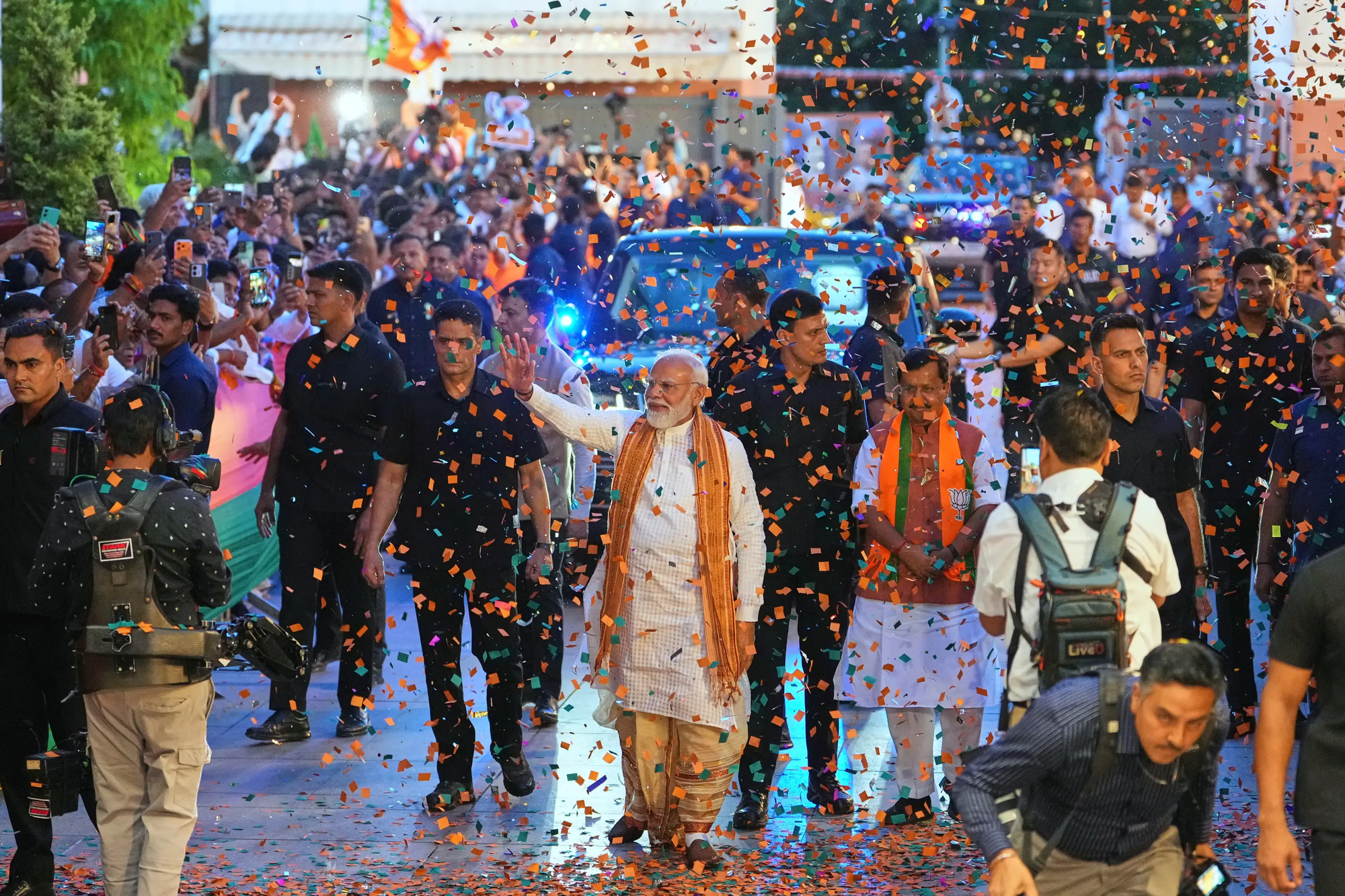
Prime Minister Narendra Modi's Bharatiya Janata Party won control of West Bengal Monday for the first time in its history, taking 206 of the state's 294 assembly seats and ending the 15-year rule of Mamata Banerjee's All India Trinamool Congress in one of the most politically resistant states the party has ever contested.
The result, announced as votes were counted under heavy security across a state of more than 100 million people, marks the BJP's furthest eastern expansion to date and effectively closes a corridor of party control running from Bihar through Bengal to Odisha. The same day, the BJP returned to power in Assam for a third consecutive term and held the small territory of Puducherry through its ruling coalition, while losing ground in two southern states.
"The 2026 West Bengal Assembly Elections will be remembered forever," Modi, 75, wrote on social media. "People's power has prevailed and BJP's politics of good governance has triumphed." Speaking to supporters at the BJP headquarters in Delhi, he urged that "the talk should not be of 'revenge,' but of 'change'" — a notable choice of words given the state's recent history of post-election political violence.
Banerjee, 71, lost not only the state but her own seat in Bhabanipur, falling to BJP candidate Suvendu Adhikari by 15,105 votes. She was visibly agitated when she addressed reporters in Kolkata. "BJP looted more than 100 seats. The Election Commission is the BJP's commission," she said, vowing to "bounce back."
Why Bengal mattered
For more than a decade, West Bengal has stood as the great exception in the BJP's national advance. Bihar, Uttar Pradesh, and the western and northeastern states had all fallen in succession, but Bengal — argumentative, culturally distinct, and proud of a regional identity built around Bengali language and the legacy of the Bengali Renaissance — had repeatedly turned the BJP's campaigns aside. The state had seen only one change of government in nearly half a century: a 34-year run by the Communist-led Left Front, followed by Banerjee's three terms beginning in 2011.
The BJP's win is also a generational marker for the party itself. Senior BJP figures, including Home Minister Amit Shah, have spent the better part of a decade building organizational depth in the state, treating Bengal as a long-term project rather than a quick conquest. The party finished a distant third in the 2016 state election, surged to runner-up status in 2021 with roughly 39 percent of the vote, and has now crossed the threshold with about 44 percent.
Rahul Verma, a fellow at the Centre for Policy Research in Delhi, framed the result as the culmination of a "seven-year project" by the party leadership. He cited anti-incumbency, fatigue with the Trinamool's interference in daily life, and a smoother BJP campaign that no longer carried the "outsider" stigma of past cycles. "The BJP had a strong and well organized presence in West Bengal and Modi is seen as a charismatic leader," Verma said. "This kind of result also wouldn't have happened without a consolidation of the Hindu vote."
Bhanu Joshi, a political scientist who has studied Banerjee's coalition, said the Trinamool's social base — women, Muslims, and significant sections of the Hindu vote across rural and urban Bengal — had eroded under the dual pressure of organizational decay and welfare saturation. "The BJP's opening was to translate this anti-TMC fatigue into a sharper language of Hindu consolidation," Joshi said. "Welfare and organisation are no longer being strong enough to contain polarisation."
The voter-roll controversy
The election unfolded against the backdrop of a fiercely contested revision of West Bengal's electoral rolls — the special intensive revision, or SIR — conducted by the BJP-controlled Election Commission of India in the months before the vote.
The exercise, presented by the commission as a routine cleanup of duplicate or ineligible names, removed more than 2.7 million voters from the rolls in West Bengal alone. Independent analyses found that Muslims and other minority communities, who do not traditionally support the BJP, were disproportionately affected. Nearly three million people across India were still awaiting tribunal decisions on their challenges when polling began.
Banerjee, civil society groups, and several opposition leaders described the exercise as "mass disenfranchisement." The commission and the BJP rejected those characterizations and said the revision had been conducted in line with normal practice. The dispute is likely to continue beyond the election in courts and tribunals, particularly in seats where the margin of victory was smaller than the number of voters removed.
Verma's read on the SIR's impact was measured. The exercise "played a marginal but still important role in these results," he said, but it could not on its own explain the scale of the BJP's win. Uday Chandra, a professor at Ashoka University, took a sharper view: "Over nine million voters were excluded. Most of those were Hindus of unprivileged backgrounds and Muslims," he said. "We no longer have a level playing field."
The southern shock
If Bengal moved as the BJP had hoped, the south delivered the day's bigger surprises.
In Tamil Nadu, the ruling Dravida Munnetra Kazhagam was swept aside by the Tamilaga Vettri Kazhagam, a party founded only two years ago by film star C. Joseph Vijay. Vijay, 51, ran on youth employment, governance, and direct cash transfers to women and the unemployed. The result was decisive enough that DMK chief minister M.K. Stalin, 73, lost his Kolathur stronghold to a TVK newcomer, V.S. Babu.
The collapse ends a six-decade rotation between the DMK and the AIADMK as Tamil Nadu's two power blocs and marks the first time in nearly fifty years a new political outfit has captured the state. "This result shows that the youth want a new face. It is not just anti-incumbency," said Ramu Manivanan, a political scientist who has tracked Tamil Nadu's politics for decades. "Vijay as an actor has a large female fan base as a cinema star. All that has influenced the outcome."
In Kerala, the Indian National Congress-led United Democratic Front defeated the Left Democratic Front after two consecutive terms, ending the last remaining Communist-led state government in India. Congress leader Rahul Gandhi thanked Kerala voters for what he called a "truly decisive mandate." For the Communist movement, which captured the highest opposition tally in the country's first 1951-52 elections, the result eliminates the last state in which the left holds power.
The national picture and what comes next
Taken together, Monday's results put the BJP in power, directly or in alliance, in 20 of India's 28 states. The 2024 general election had forced Modi to govern through coalition partners after the BJP fell short of an outright parliamentary majority — a result that gave the opposition INDIA alliance a brief moment of momentum. The Bengal verdict, paired with the Trinamool's collapse and the DMK's defeat, removes two of that alliance's most important regional anchors.
"Looking back at 2024, it now seems like that was a temporary setback to BJP," Verma said. "They are returned to their dominant position. With every successive defeat, there is much more pressure mounting on the opposition; while the BJP looks even more invincible." Author and journalist Nilanjan Mukhopadhyay called the win "a personal political victory not only for Narendra Modi, but also for Home Minister Amit Shah, who effectively ran the campaign." Within the BJP, Mukhopadhyay said, the result is likely to elevate Shah's standing in the party's succession conversation, placing him ahead of Yogi Adityanath, Nitin Gadkari, and Rajnath Singh in the next-generation hierarchy.
The economic backdrop, however, is not as favorable as the electoral one. Modi enters the second half of his third term carrying an unemployment rate that has remained stubbornly elevated, an unfinished trade negotiation with the United States, and the spillover effects of the U.S.-Iran war on energy prices and inflation. India is among the largest importers of crude through the Strait of Hormuz, and the disruption of the past two months has weighed directly on Indian household budgets.
Bengal will not change those numbers. But it does change the political calculation around them. Modi now has the strongest state-level mandate of his third term, in a state his party had pursued for more than a decade, and in a year when the opposition was supposed to be regrouping rather than retreating. Whether the SIR controversy meaningfully shadows the result will depend on what the courts and tribunals do with the millions of cases still pending. For now, the BJP's eastern arc is closed, and the map of Indian politics has been redrawn in a way that will define the run-up to 2029.
Author

We cover the world’s chaos so you don’t have to scroll twelve feeds to understand it.
Sign up for Atlas newsletters.
Stay up to date with curated collection of our top stories.