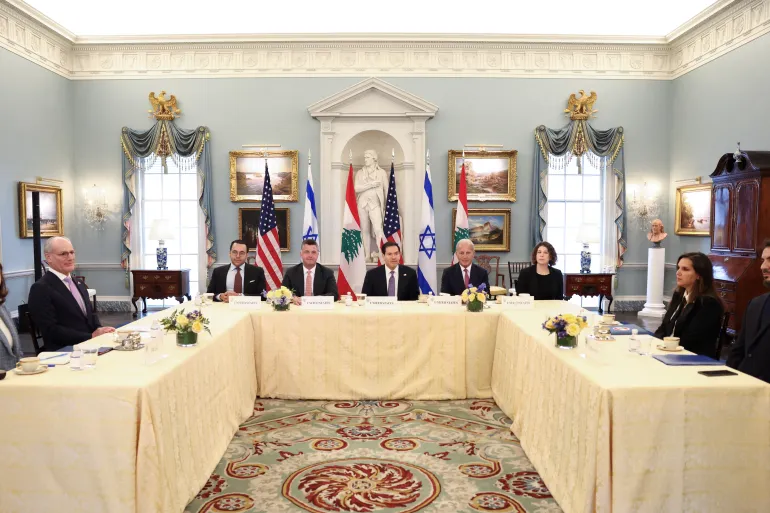
For the first time since 1993, Israeli and Lebanese officials sat in the same room on Tuesday — at the State Department, with Secretary of State Marco Rubio between them — and talked about ending a conflict that has killed more than 2,000 people in Lebanon alone since early March.
The meeting lasted just over two hours. Israeli Ambassador Yechiel Leiter and Lebanese Ambassador Nada Hamadeh Moawad emerged with polite words about the conversation and an agreement to keep talking. But the two governments walked in with incompatible demands, and nothing that happened inside the building changed that.
Israel refuses to discuss a ceasefire in Lebanon. Lebanon says a ceasefire is the only thing its ambassador was authorized to discuss. And Hezbollah, the Iranian-backed militant group whose disarmament is the stated goal of the entire exercise, was not at the table and has no interest in being there.
"We reject negotiations with the usurping Israeli entity," Hezbollah leader Naim Qassem said in a televised address Monday, calling the talks "futile" and demanding Lebanon pull out. His fighters underscored the point on Tuesday by claiming 24 separate attacks on northern Israel and Israeli troops in southern Lebanon while the diplomats were still meeting in Washington.
Rubio's Gamble
Rubio framed the session as the beginning of a long process, not a one-day event. "We understand we're working against decades of history and complexities," he said before the talks began. He called it "a historic opportunity."
The secretary of state has taken a direct hand in the Lebanon track at a moment when his involvement in the broader Iran conflict has been questioned. Vice President JD Vance led the U.S. delegation to the failed Iran talks in Islamabad last weekend. Rubio was in Florida watching a mixed martial arts event with President Trump while Vance was announcing that the negotiations had produced no breakthrough.
Tuesday's meeting gave Rubio a diplomatic stage of his own. Also present were State Department counselor Michael Needham, U.S. Ambassador to Lebanon Michel Issa — a personal friend of Trump's — and U.S. Ambassador to the United Nations Mike Waltz.
The State Department said afterward that all sides had "agreed to launch direct negotiations at a mutually agreed time and venue." The statement laid out each country's positions without indicating they had found any overlap.
Two Countries, Two Agendas
Leiter was the more expansive of the two ambassadors after the meeting. He told reporters the most positive development was that "the Lebanese government made it very clear that they will no longer be occupied by Hezbollah." He said both sides had discussed a long-term vision including a delineated border, a security arrangement, and eventually a full peace agreement.
"We discovered today that we are on the same side of the equation," he said. He added that talks would likely continue in Washington in the coming weeks.
Leiter also took a shot at France, which has its own diplomatic history in Lebanon. "We'd like to keep the French as far away as possible from pretty much everything, but particularly when it comes to peace negotiations," he said, adding that Paris was "not a positive influence." The French Embassy in Washington declined to comment.
Moawad was brief. She called the meeting "constructive" and said she had pressed for a ceasefire, the return of displaced people, and measures to address what she described as a severe humanitarian crisis. She did not take questions.
Lebanese officials had made clear ahead of time that their ambassador carried limited authority. One senior government official, speaking anonymously, was blunt about the prospects: "What does Lebanon have to offer on a negotiating table? Nothing."
The Lebanon Problem That Won't Go Away
The difficulty with the talks is structural, not diplomatic. Israel wants Lebanon's government to take responsibility for disarming Hezbollah — the same objective that has eluded every international effort for two decades. The Lebanese state has never had the capacity to do this by force. The last time a Western-backed government tried to move against the group, in 2008, it triggered a brief civil war.
Lebanon's government did ban Hezbollah's military wing last month after the group opened fire on Israel in support of Iran at the start of the wider war. But banning something on paper and dismantling it on the ground are different undertakings entirely, and no one in Beirut is under any illusion about the gap.
Hezbollah has been degraded by weeks of Israeli bombardment. Its senior leadership was decimated earlier in the war. But Qassem made clear Monday that the group considers itself bound by nothing it did not agree to. "The battlefield will speak," he said.
Prime Minister Nawaf Salam had initially planned to travel to Washington this week for follow-up meetings, but he canceled after Hezbollah supporters rallied outside his office over the weekend in protest of the talks.
The Ceasefire Question
Hanging over Tuesday's meeting was a dispute that has threatened to unravel the broader regional picture. Iran and Pakistan — the mediator of the U.S.-Iran ceasefire announced April 7 — both maintain that the two-week truce covers Lebanon. The United States and Israel say it does not.
Vance, who led the American side in Islamabad, called the disagreement "a legitimate misunderstanding." The distinction matters enormously. On April 8, the same day the Iran ceasefire was announced, Israel launched what it called its largest coordinated attack inside Lebanon — striking 100 sites and killing more than 350 people in one of the deadliest single days since the fighting began. Iran warned the strikes could collapse the ceasefire entirely.
Israel has since stopped hitting Beirut directly but has continued operations across the south. More than a million people are displaced. The UN has documented more than 2,100 dead, including 252 women, 166 children, and 88 medical workers.
The State Department denied any link between the Islamabad negotiations and Tuesday's meeting, saying the Israel-Lebanon talks had been planned for a month. That may be technically accurate. But the two tracks cannot be separated in practice — Iran views the Lebanon conflict as part of any broader deal, and the Trump administration has been pushing Netanyahu to scale back precisely because the fighting threatens the Iran ceasefire.
Where Things Stand
Leiter said he expects more meetings soon. Rubio's team stressed the long-term nature of the effort. The joint statement expressed "hope that talks can exceed the scope of the 2024 agreement and bring about a comprehensive peace deal."
That 2024 agreement — a ceasefire between Israel and Hezbollah negotiated last November — required Israel to withdraw its forces from southern Lebanon. It hasn't. Israeli troops remain in the south, and Defense Minister Israel Katz has said hundreds of thousands of displaced residents will not be allowed to return home until the area is demilitarized.
Israel and Lebanon have been in a formal state of war since 1948. The last time their officials held anything resembling direct negotiations was more than three decades ago. Whatever framework eventually emerges — if one does — will have to contend with a Hezbollah that is weakened but undefeated, a Lebanese government that is willing but powerless, and an Israeli military that has shown no sign of stopping.
Rubio called the talks "a process, not an event." Tuesday proved him right on both counts. It was a process. It was not, by any meaningful definition, an event that changed the trajectory of the war.
Author

We cover the world’s chaos so you don’t have to scroll twelve feeds to understand it.
Sign up for Atlas newsletters.
Stay up to date with curated collection of our top stories.