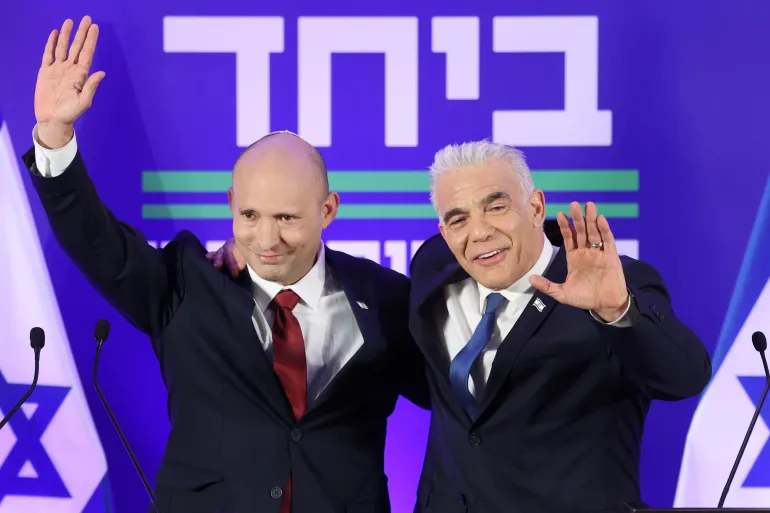
Former Israeli prime ministers Naftali Bennett and Yair Lapid announced Sunday in Herzliya that they would run on a joint ticket in the country's general election scheduled for October 27, reviving the alliance that briefly ended Benjamin Netanyahu's 12-year run in office in 2021 and setting the stage for what is shaping up to be the most consequential vote since the Hamas attacks of October 7, 2023.
Speaking from identical podiums at a joint press conference, the two former prime ministers said they would run under a new unified party named "Together," with Bennett at the top of the ticket. "Tonight, we are uniting and establishing the 'Together' party under my leadership, a party that will lead to a great victory, and the opening of a new era for our beloved country," Bennett told reporters.
Former military chief of staff Gadi Eisenkot, who heads the Yashar party, is widely expected to align with the new bloc in the coming weeks. Combined, the three figures represent the most credible attempt yet to consolidate the fractured anti-Netanyahu opposition into a single electoral force.
The 2021 precedent and its limits
The Bennett-Lapid pairing is not new. The two formed the so-called "change government" in 2021 after four inconclusive elections in two years, building an unusually wide coalition that stretched from Bennett's right-wing Yamina to Lapid's centrist Yesh Atid and included, for the first time in Israeli history, a party representing Palestinian citizens of Israel. Under their rotation agreement, Bennett served first as prime minister, with Lapid taking over after 12 months.
The coalition produced a state budget for the first time in years and reduced earmarked funding for ultra-Orthodox parties, but collapsed in 2022 after defections from Bennett's bloc and disputes over security policy and the West Bank.
"They achieved quite a lot," said Mitchell Barak, an Israeli political pollster and former Netanyahu aide. "As well as stabilising the government and passing an overdue budget, they went some way in sidelining the religious parties, reducing specialised funding and preferential treatment of them."
A Jerusalem Post poll published Monday found that the combined Bennett-Lapid ticket is projected to win four fewer seats than the two parties would secure running separately, and one seat fewer than Netanyahu's Likud. Israeli political analyst Nimrod Flashenberg cautioned against reading the alliance as decisive. "This is more like the semifinal than the final," he said. "We're seeing who will lead the anti-Netanyahu bloc and, with Lapid joining Bennett, that looks to be clear. Now we have to wait on the others, such as Eisenkot."
A war that didn't end the way Netanyahu promised
The alliance lands at a moment of clear vulnerability for Netanyahu. The U.S.-Israeli campaign against Iran, launched on February 28 under Operation Epic Fury, was paused under a U.S.-brokered ceasefire on April 8 that Trump has since extended indefinitely. Iran's military was badly degraded, and the country's longtime supreme leader was killed in the opening hours of the war, but Tehran's government remains in power, its enriched uranium stockpile intact, and the Strait of Hormuz effectively closed under Iranian control.
The parallel ceasefire with Hezbollah, also brokered by Washington, has held in fits and starts. Israeli forces still occupy a roughly 10-kilometer-deep strip of southern Lebanon. Hamas remains in place in Gaza more than two and a half years after October 7.
"After 925 days of fighting since October 7, Israel has failed to achieve decisive victory on any front," wrote Yoav Limor, a prominent Israeli military affairs commentator. "At the end of yet another war, it is perceived as a country whose decisions are not made in Jerusalem, but in Washington."
A poll by the Israel Democracy Institute conducted during the first week of the Iran war found that 64 percent of Israelis trusted Netanyahu to direct the campaign. A second poll taken after the April 8 ceasefire found Israelis rated the government's management of the war more negatively than positively, and a majority said fighting against Hezbollah in Lebanon should have continued.
Tel Aviv-based political analyst Dahlia Scheindlin summarized the shift bluntly: "People were disappointed because it hadn't achieved the goals."
Trump's distance and the northern fallout
Israelis have also begun to question the durability of the U.S.-Israel relationship. In the IDI poll, most respondents said it was "fairly" or "very" unlikely that any final U.S.-Iran agreement would adequately account for Israeli security concerns.
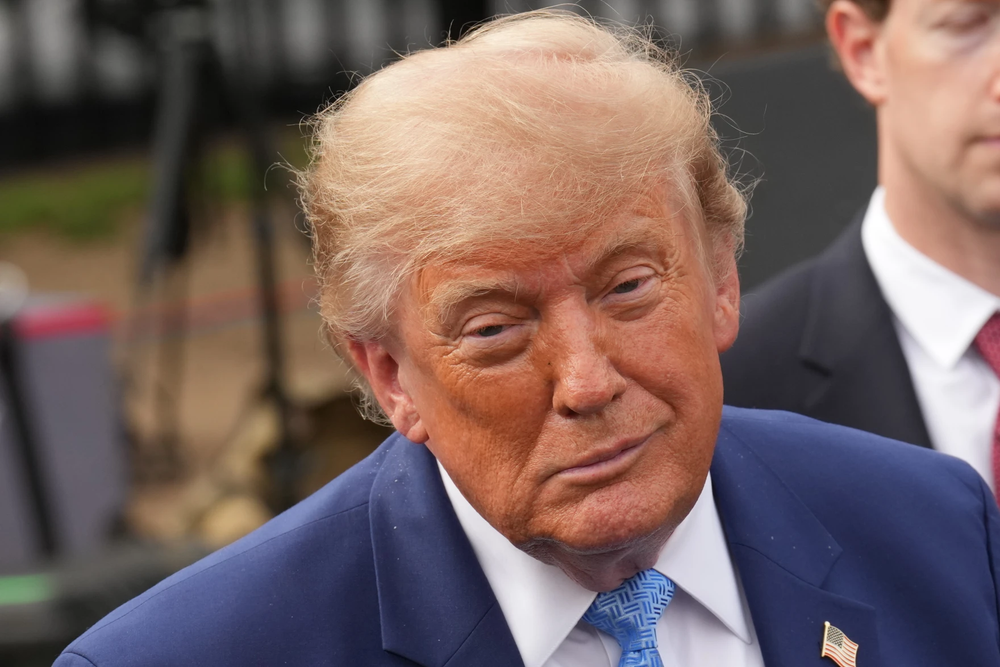
Netanyahu announced late last year that he would award Trump the Israel Prize, the country's highest civilian honor, making him the first foreign leader to receive it. Israel had invited Trump to formally accept the prize in Jerusalem on April 22, the country's 78th independence celebration. Trump did not come. Asked about the relationship between the two leaders, Netanyahu's office declined to comment, but a senior Israeli official, speaking on condition of anonymity, said the two still speak daily.
In northern Israel, the political damage is more concrete. Towns that absorbed roughly six weeks of Hezbollah missile fire remain in disarray. Shops in Kiryat Shmona are still closed; protests have broken out in recent days, with much of the anger directed at Netanyahu personally. "I live 100 meters from the border," said local resident Asaf Oakil. "The ceasefire? It's a mistake."
"I really hope that the residents of the north will learn from this and vote for someone who can help us here, not someone who brings us down and buries us," said Shosh Tsaoula, another Kiryat Shmona resident.
The corruption case Netanyahu cannot shake
Beneath the war debate sits the legal exposure that has shadowed Netanyahu's career for nearly a decade. He remains on trial in three corruption cases — bribery, fraud, and breach of trust — that have been grinding through Israeli courts since 2020. Critics have long argued that his attempts to weaken the independence of the judiciary, the legal reforms that triggered mass protests in 2023, and his deflections of responsibility for the October 7 intelligence failure are all linked to the trial's outcome.
"With Netanyahu, political resilience comes baked in," Flashenberg said. "My instinct is that he'll still be prime minister after the elections. He's nowhere near as popular as he was before October 7, but time and wars have gone some way to eclipsing that."
Whether Israelis agree will come down to whether Netanyahu can convince a fatigued electorate that what he calls "preemptive" wars on three fronts have produced lasting security, or whether voters conclude — as Bennett and Lapid will spend the next six months arguing — that the country is paying a steep economic and strategic price for ceasefires that may yet collapse.
"With unstable ceasefires that can lapse at any given point," said Nadav Eyal, a commentator for Yediot Ahronoth, "voters will be not happy about it."
The election is set for October 27. The opposition now has six months and a single banner under which to organize. Netanyahu has the same six months to argue that the alternative is worse.
Author

We cover the world’s chaos so you don’t have to scroll twelve feeds to understand it.
Sign up for Atlas newsletters.
Stay up to date with curated collection of our top stories.