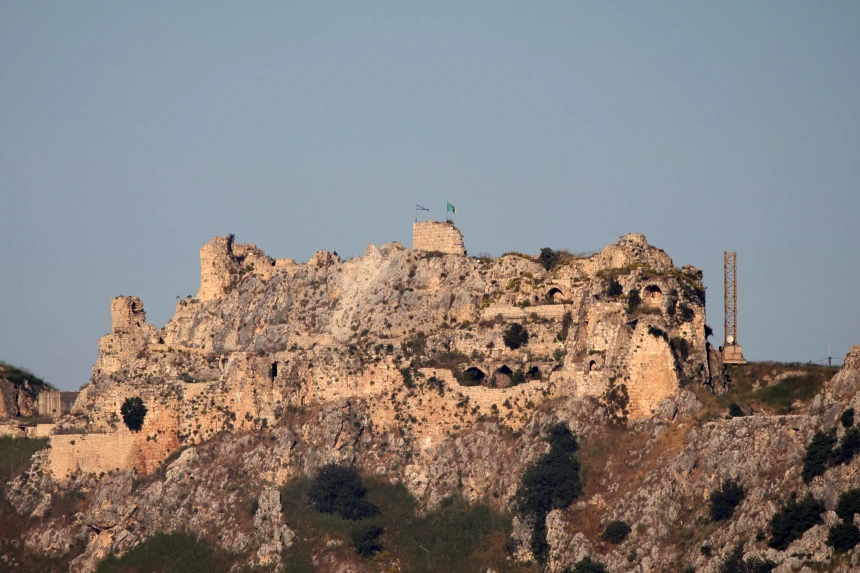
Israeli Prime Minister Benjamin Netanyahu on Sunday said the country would deepen and expand its operations inside southern Lebanon, calling the Israeli military's capture of the strategic Beaufort Castle "a dramatic shift" in Israeli policy toward Hezbollah and signaling that the current ground offensive will push further into the south.
Netanyahu delivered the message in a video statement released by his office, standing in front of an Israel Defense Forces photograph of the captured castle. "The capture of Beaufort is a dramatic stage and a dramatic shift in the policy we are leading," he said. "Now my directive is to deepen and expand our hold on areas that had been under Hezbollah's control."
The statement was released as Hezbollah continued rocket and drone fire on northern Israel. A soldier was killed by a Hezbollah drone the previous night, the thirteenth Israeli to die since the most recent Israel-Lebanon ceasefire was announced in mid-April. Photographs released by the IDF showed the Israeli flag and the flag of the Golani Brigade flying over the castle ridge.
A Site Layered With History
The capture of Beaufort Castle carries significance beyond its military value. Israeli forces seized the castle for the first time during the opening days of the First Lebanon War in June 1982. It became, in Netanyahu's words on Sunday, "a symbol of deep division within our society" — a reference to the long and costly Israeli presence in southern Lebanon that followed.
Israel held the Beaufort ridge throughout the 18-year occupation of southern Lebanon that lasted until 2000, when Israeli forces withdrew under public pressure after years of attritional fighting against Hezbollah that cost hundreds of Israeli soldiers their lives. The withdrawal became one of the most contested chapters in modern Israeli political memory, frequently cited by Hezbollah's leadership as a foundational victory and frequently invoked in Israel as a cautionary case against open-ended foreign deployments.
"Today, we have returned to Beaufort differently," Netanyahu said on Sunday. "We have returned united, determined, and stronger than ever. We have broken through the barrier of fear. We are taking the initiative. We are operating on all fronts — in Syria, Gaza, and Lebanon. We have established security zones beyond our borders in order to protect our communities."
The phrase "security zones beyond our borders" echoes the language Israeli officials used during the 1985 to 2000 period, when the Israeli military maintained a self-declared security buffer in southern Lebanon. Netanyahu did not specify the depth or duration of the current zones.
Casualty Claims and the Pace of Operations
Netanyahu also offered new operational figures for the campaign against Hezbollah, claiming the IDF had eliminated 8,000 fighters from the Iran-backed group since it began attacking Israel in October 2023 in the wake of the Hamas-led massacre that triggered the war in Gaza.
Three thousand of those operatives, Netanyahu said, had been killed since Israel opened its formal war against Iran in June 2025. Seven hundred had been killed in the past month alone. The figures could not be independently verified, and Hezbollah has not released comparable casualty numbers.
"It will take time, but we will complete the mission," Netanyahu said.
The pace described in the statement, paired with the visible push to the Beaufort ridge, suggests the current escalation is the most intense phase of Israel-Hezbollah fighting along the Lebanese border since the conflict reignited in the days following October 7, 2023. The Israeli stated military objective has been the systematic dismantling of Hezbollah infrastructure in the southernmost band of Lebanon.
A Fragile Ceasefire Under Strain
The escalation has unfolded against the backdrop of a Lebanon ceasefire announced in mid-April that was widely understood at the time as the diplomatic capstone to the broader U.S.-brokered freeze of Middle East fighting that followed the U.S. and Israeli campaign against Iran. That agreement has been under strain almost since its announcement.
Thirteen Israelis have been killed since the truce began, with the deadliest engagements occurring over the past several weeks as Israeli forces have pushed deeper into southern Lebanese territory and Hezbollah has resumed cross-border rocket and drone fire. Sunday's statement was the most explicit signal yet from Netanyahu that the formal status of the April ceasefire will no longer constrain the IDF's posture inside Lebanon.
The phrase "dramatic shift in the policy we are leading," delivered in front of an image of the captured castle, was unambiguous. Netanyahu did not characterize the operation as a defensive measure, nor did he frame it as a response to a specific Hezbollah action. The framing was openly expansionist: the directive, he said, is "to deepen and expand our hold on areas that had been under Hezbollah's control."
Operations on Three Fronts
Netanyahu's reference to operations "on all fronts — in Syria, Gaza, and Lebanon" signaled a posture that does not appear to be contracting in the near term. In Syria, Israeli forces have maintained positions inside the buffer zone established along the Golan Heights since the collapse of the Assad government in late 2024, with periodic airstrikes on weapons depots and military infrastructure. In Gaza, Israeli operations have continued at lower intensity than during the height of the 2023-2024 war but have not ended. Lebanon now appears to be the principal axis of active fighting.
Sunday's announcement also came as Israeli and Lebanese delegations have remained in Washington as part of the broader regional diplomatic effort following the Iran war. Those talks have been described by participants as focused on the Iran file and on the Strait of Hormuz, rather than on the southern Lebanon front specifically.
For now, the directive is clear from the Israeli side. "We are taking the initiative," Netanyahu said. "It will take time, but we will complete the mission."
Author

We cover the world’s chaos so you don’t have to scroll twelve feeds to understand it.
Sign up for Atlas newsletters.
Stay up to date with curated collection of our top stories.