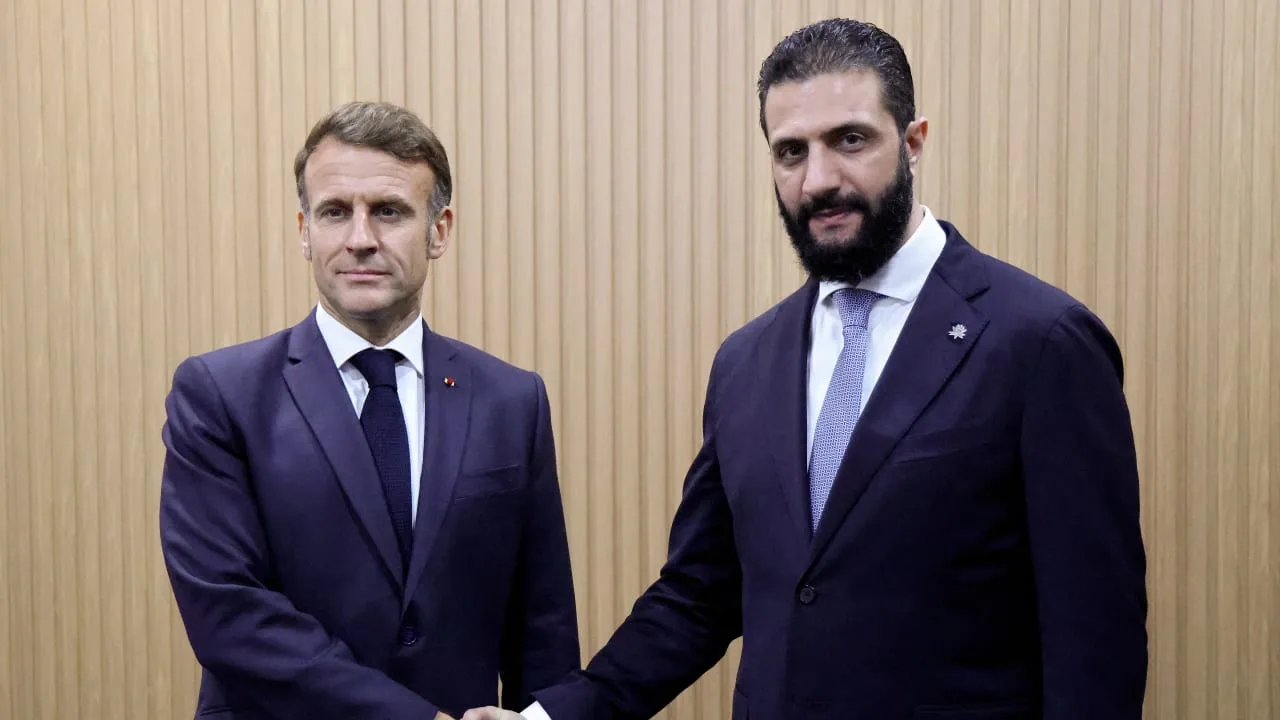
Emmanuel Macron landed in Damascus on Monday evening, the first Western European head of state to set foot in Syria since Bashar al-Assad was driven from power in December 2024. Syria's foreign minister, Asaad al-Shaibani, met him on the tarmac. By nightfall the French president and Syria's new leader, Ahmed al-Sharaa, were touring the Umayyad Mosque together, a scene that would have been unthinkable a year and a half ago, when al-Sharaa was still a former al-Qaeda commander under international sanctions.
"I have come to express France's commitment to the Syrian people. For a sovereign Syria, united in its diversity and at peace with its neighbors," Macron wrote on X shortly after arriving. "Together, let us open a new chapter of stability and peace."
A Visit Freighted With History
No French president had been to Syria since Nicolas Sarkozy in 2009, two years before Assad's crackdown on protesters spiraled into a civil war that killed more than half a million people and left the country in ruins. France's ties to the place run deeper than that. Paris administered Syria under a League of Nations mandate from 1920 until independence in 1946, a colonial history that gives the visit added weight.
Macron was not the first foreign leader through the door. Qatar's emir, Sheikh Tamim bin Hamad al-Thani, came in January 2025, the first head of state to visit after Assad fell. European Commission President Ursula von der Leyen followed, as did Ukraine's Volodymyr Zelensky in April. But Macron is the first from Western Europe or North America, and the symbolism was not lost on Damascus. SANA, the state news agency, called the trip "a pivotal step in the process of restoring Syria's international presence."
Ordinary Syrians read it much the same way. "If Syria wasn't safe and stable, no president or foreign official would take the risk of coming," said Diala Akkashe, a 33-year-old dressmaker. Faisal Azouz, a 76-year-old retired teacher, put it plainly: "We hope this visit will represent a new start for Syria."
Business in Tow
Macron did not come alone. His delegation included Rodolphe Saadé, chief executive of the shipping giant CMA CGM, and Patrick Pouyanné, who runs TotalEnergies, a lineup that signaled what much of the visit was about. Syria needs hundreds of billions of dollars to rebuild after 13 years of war, and the competition to supply that money and expertise is already under way among Gulf states, Turkey, and now Europe.
Reconstruction, energy, and investment topped the agenda. France, the euro area's second-largest economy, has said it wants a role in rebuilding Syria's agriculture, industry, tourism, and financial sector. Al-Sharaa, in an interview with BFMTV, welcomed that, praising what he called France's "constructive role" in the transition and crediting Macron with helping lift the sanctions that had strangled the economy. Most of those Western penalties were removed last year; the European Union lifted its economic sanctions in May 2025.
French companies remain cautious about returning to a country still scarred by war, and the memorandums of understanding Syria has signed with various states and firms have yet to translate into actual projects. Macron and al-Sharaa were set to hold formal talks Tuesday, followed by economic discussions, the signing of memorandums, and a joint news conference.
The Man Across the Table
The visit rests on a bet about al-Sharaa himself. He led Hayat Tahrir al-Sham, the group once tied to al-Qaeda through its earlier incarnation as the al-Nusra Front, before breaking with al-Qaeda in 2016 and eventually toppling Assad. Macron was among the first Western leaders to gamble on him, hosting him in Paris in May 2025 and pressing Washington and Brussels to drop sanctions.
That gamble carries real risk. Western governments have worried openly about the treatment of women and minorities under Islamist-led rule, and about whether Syria will move toward genuine democracy. Those concerns are not abstract. Sectarian violence tore through Alawite and Druze areas last year, killing hundreds, and a bombing at a Damascus cafe last week left ten dead. Macron was expected to press al-Sharaa on his pledge to protect minorities. A French official said bluntly that Syria could only be a partner if it embraced pluralism, and that Paris would not accept one form of exclusive power simply replacing another.
Other files were on the table too: the fight against the Islamic State, which Syria joined the U.S.-led coalition against last year, and a small number of French jihadists still on Syrian soil. France also mediated between Damascus and the Kurdish forces who fought IS in the north, groups that signed a U.S.-backed deal in February to fold their institutions into the state. As a gesture, the Élysée said Macron would return 23 archaeological artifacts loaned to Paris in 2010 and never sent back because of the war.
Regional Currents
The timing was deliberate. Both Macron and al-Sharaa were due in Ankara on Tuesday for a NATO summit, where the Syrian leader is expected to meet President Trump on the sidelines, another marker of how far he has traveled from wanted militant to courted head of state. Al-Sharaa's principal backer during the war was Turkey, whose growing influence over Damascus unsettles some in the region.
One point of friction was Lebanon. Trump has floated the idea of Syrian forces taking on Hezbollah, the Iran-backed group that fought for Assad. Macron pushed back hard. A French official said the president told al-Sharaa that Syria should under no circumstances send troops into Lebanon, and that al-Sharaa agreed he would not, whatever the pressure. Israel, meanwhile, has kept up incursions and airstrikes inside Syria since Assad's fall, and some Israeli officials still describe the new government as an enemy. One French analyst framed Macron's trip as an effort to shore up the new order in Damascus at a moment when Israel would prefer Syria weak and divided.
For al-Sharaa, the visit was another step out of isolation. For Macron, it was a chance to plant France's flag early in a country whose reconstruction is about to become one of the region's great contests. Whether the bet on Syria's new leadership pays off, on pluralism, on stability, on the return of French business, is a question Tuesday's meetings will only begin to answer.
Author

We cover the world’s chaos so you don’t have to scroll twelve feeds to understand it.
Sign up for Atlas newsletters.
Stay up to date with curated collection of our top stories.