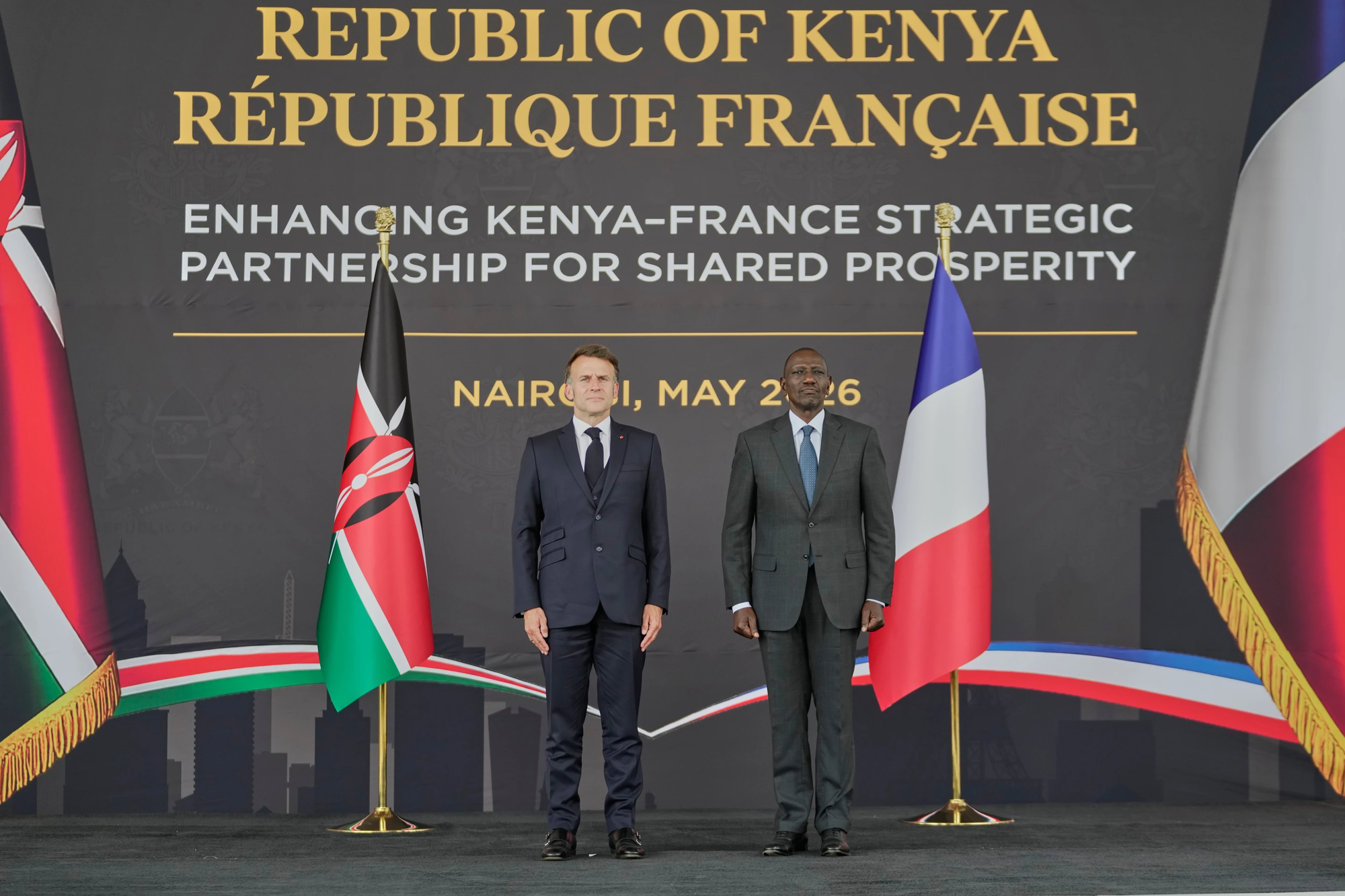
French President Emmanuel Macron arrived in Nairobi on Sunday for the start of the Africa Forward summit, a two-day gathering co-hosted with Kenyan President William Ruto that France is using to recast its role on a continent where its influence has been visibly slipping.
The summit, which runs May 11 and 12, is the first such forum Macron has convened in an English-speaking African country. About 30 heads of state and government are expected, along with more than 2,000 business executives, investors, and officials from multilateral development banks. Roughly ten leaders had arrived by Sunday evening.
"It does feel like a rebranding of how France is positioning itself on the continent," Beverly Ochieng, a senior analyst at Control Risks based in Senegal, said in the run-up to the summit. "It is moving away from some of its former colonial partners, security partners, towards countries where it has more of a cultural, a different footprint."
Macron arrived in Kenya from Egypt, where he opened a new campus for the Université Senghor in Alexandria alongside President Abdel Fattah el-Sisi. He will close the tour Wednesday in Addis Ababa, where he is scheduled to meet African Union Commission Chairperson Mahmoud Ali Youssouf and U.N. Secretary-General António Guterres.
Why Nairobi, and why now
The choice of Kenya is the signal. France has spent decades building its African strategy on a francophone foundation — Mali, Burkina Faso, Niger, Senegal, Côte d'Ivoire, Cameroon, the Central African Republic, and the Sahel more broadly. That foundation has cracked since 2020.
A run of coups across the Sahel has produced military governments in Mali, Burkina Faso, and Niger that have expelled French troops, withdrawn from longstanding security arrangements, and in several cases invited in Russian mercenary forces. France handed over control of its last major military base in Senegal in July 2025, after Senegalese President Bassirou Diomaye Faye declared that foreign bases were incompatible with the country's sovereignty. Faye is expected in Nairobi this week. The Sahelian juntas were not invited.
The Elysée framed Africa Forward as a "renewed partnership" — a phrase Macron's team has used repeatedly to distance itself from the term Françafrique, the postwar arrangement under which Paris maintained influence over its former colonies through political collusion, preferential commercial access, and at times outright graft. Macron has gone further than his predecessors in publicly acknowledging colonial-era abuses in Rwanda, Cameroon, and Senegal, though he has stopped short of issuing a formal apology for torture and other actions by French troops in Algeria.
Whether the rhetorical reset is matched by substance is what next week is supposed to test. "Africa is not coming to Europe, it is a case of Europe coming to Africa on an equal basis," Abraham Korir Sing'Oei, Kenya's foreign ministry permanent secretary, told reporters Thursday. "It's not Africa begging, it's not about aid. It's about what we can do together with an equal relationship."
What's on the table
The summit's centerpiece is commercial. A business forum organized May 11 by Bpifrance, Business France, and Proparco will bring together roughly 2,000 African, French, and European executives, investors, and public officials. The focus areas the Elysée has identified are energy, agri-industry, digital, healthcare, logistics, sustainable urban development, and the cultural and creative industries.
Macron used the Sunday before the summit opened to put numbers on the board. He told reporters in Nairobi that more than €1 billion in deals had been signed. CMA CGM, the French shipping group, inked a strategic partnership with the Kenyan government covering logistics and transport infrastructure. Meridiam, the French infrastructure developer, will expand Kenya's second-largest wind farm. Eleven agreements were signed Sunday alone, ranging from nuclear energy and modernized transport to sustainable agriculture.
Executives of nearly every major French multinational with African operations have confirmed attendance: Patrick Pouyanné of TotalEnergies, Rodolphe Saadé of CMA CGM, Jean-Pascal Tricoire of Schneider Electric, Maxime Saada of Canal+, Christel Heydemann of Orange, Antoine de Saint-Affrique of Danone, and Thierry Déau of Meridiam. African corporate representation is heavy as well: Aliko Dangote of the Dangote Group, Mostafa Terrab of Morocco's OCP, Jeremy Awori of Ecobank, Jean-Louis Billon of Sifca, and Hassanein Hiridjee of Axian.
Among the leaders confirmed are Nigeria's Bola Tinubu, Côte d'Ivoire's Alassane Ouattara, Ethiopia's Abiy Ahmed, Gabon's Brice Clotaire Oligui Nguema, Togo's Faure Gnassingbé, Mozambique's Daniel Chapo, Botswana's Duma Boko, Zambia's Hakainde Hichilema, and the Central African Republic's Faustin-Archange Touadéra. Rwanda's Paul Kagame and the Democratic Republic of Congo's Félix Tshisekedi will both attend, although no bilateral meeting between them is planned — France has tried unsuccessfully to broker direct talks before.
The notable absences sketch the limits of the reset. South African President Cyril Ramaphosa is not attending; his international relations minister, Ronald Lamola, is in India for a BRICS+ meeting. Angola's João Lourenço is out. Congo-Brazzaville's Denis Sassou Nguesso is openly boycotting after a low-level French delegation attended his April inauguration while Russia sent a 34-person team led by Deputy Prime Minister Alexander Novak. Sassou Nguesso flew to Moscow days later to meet Vladimir Putin.
The competition
The vacuum France has left in the Sahel is being filled. Russia has expanded its footprint in Mali, Burkina Faso, and Niger through the Wagner Group's successor networks, often by exploiting anti-French sentiment in local information environments. China continues to dominate continental infrastructure financing. Kenya itself offers a recent illustration of the dynamic — Ruto's government terminated a $1.5 billion highway expansion deal with a Vinci-led French consortium last year and handed the project to Chinese firms after concluding the contract carried unacceptable risk.
France has tried to respond on multiple fronts. Imports from Africa grew by roughly 25 percent between 2021 and 2024, according to International Trade Centre data. Paris signed a €300 million investment agreement with Nigeria in 2024 covering infrastructure, healthcare, transport, and renewables. A defense pact with Kenya signed in October 2025 deepened cooperation on intelligence sharing, maritime security, and peacekeeping. Macron has also invested heavily in restoring relations with Rwanda after years of strain over the 1994 genocide and with Algeria over the war of independence.
Whether any of it adds up to a durable strategy is the open question. Amaka Anku, head of the Africa section at Eurasia Group, argued that France's loss of influence in the Sahel was structural rather than personal. "That was a long time coming, it's inherited," she said. "The best thing Macron did was to try to expand France's relations with anglophone Africa."
Africa expert Niagale Bagayoko took a more skeptical view. "Nothing particularly new can happen in Franco-African relations before the end of Emmanuel Macron's term. There is too much baggage." Bagayoko said Macron is widely perceived in Africa as having "failed to grasp" how public opinion on the continent has shifted, and is seen by many as "arrogant and paternalistic."
The CFA franc, the France-backed currency used by several African states and long viewed as a colonial-era holdover, was reformed under Macron but the changes were widely seen as cosmetic. Former French ambassador Nicolas Normand called the reform "homeopathic" and faulted Macron for misreading the symbolism. The 2017 incident in Ouagadougou — when Macron, addressing university students, joked that then-Burkinabé President Roch Marc Christian Kabore had stepped out to "fix the air conditioning" — is still cited in francophone Africa as a defining moment.
The domestic angle and what comes next
For Macron, with roughly a year left before the end of his second term, the summit doubles as a legacy moment. One French diplomat described it as a "report card on his Africa policy." For Ruto, who is co-hosting, the personal stakes are also real. Kenyan opposition leader Kalonzo Musyoka criticized the choice of venue, accusing the government of using the summit to project a unity that doesn't exist domestically as the country moves toward its 2027 election. "There will be an air of pretense that we are a cohesive nation. We know that is far from the truth."
Ruto pushed back at a Sunday press conference, saying Kenya was "neither looking East nor West" but "looking forward." He said both presidents expect the summit to be a "turning point." Macron, asked about France's relations with the Sahelian states that have expelled French forces, said France can "disagree" with West African governments but "never disagrees with the people."
After Tuesday's closing session, Macron will travel to Addis Ababa for a trilateral meeting with Guterres and Youssouf at AU headquarters, where a joint declaration on peace and security is expected. The substance of what survives the photo opportunities — the deal flow, the follow-through, the willingness of African counterparts to treat the new framing as more than a presentation slide — is what will determine whether the Nairobi summit reads as a pivot or as a farewell tour.
Author

We cover the world’s chaos so you don’t have to scroll twelve feeds to understand it.
Sign up for Atlas newsletters.
Stay up to date with curated collection of our top stories.