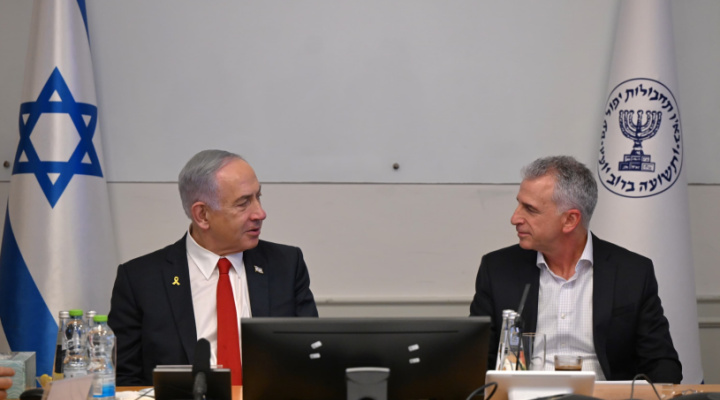
Mossad Director David Barnea said Israel’s campaign against Iran will not be considered complete until the regime in Tehran is replaced, making one of the clearest public statements yet from a senior Israeli official that regime change remains part of the strategic end state envisioned by at least part of Israel’s security establishment. He delivered the remarks on April 14 at a Holocaust Remembrance Day ceremony, where he said Mossad’s responsibility “will be complete only when the regime is changed” and added that Israel had planned from the outset for the campaign to continue beyond the strikes on Tehran.
Barnea’s language was notable for both its clarity and its timing. A ceasefire remained in effect, diplomacy between Washington and Tehran was still being explored, and the public line from some American officials had focused more narrowly on nuclear and missile constraints than on overthrowing Iran’s ruling system. By contrast, Barnea said directly that replacing what he called the “extremist” or “radical” regime was the point at which Israel’s mission would end.
He also placed the statement in a Holocaust memorial setting, linking present-day intelligence and military action to the principle that Israel must act against declared existential threats before they mature further. In that sense, the speech was not framed as a tactical update but as a declaration of strategic doctrine.
What Barnea Actually Said
Across multiple accounts of the speech, the core message was consistent. Barnea said Mossad never believed the campaign would end with the cessation of immediate hostilities or with the first wave of attacks on Tehran. Instead, he said the organization had “planned intensively” for operations to continue afterward and to produce results even after the most visible strikes ended.
He said Mossad had operated “in the heart of Tehran” during the campaign and had provided precise intelligence to the Israeli Air Force for strikes on missile threats. He described the agency’s work as one element of a longer campaign and said the broader mission remained unfinished. In one version of his remarks, he said, “Our commitment will be fulfilled only when this extremist regime is replaced.” In another, he said, “Regime change in Iran is our mission.” The wording varied slightly by account, but the substance did not.
Barnea also presented the campaign as a response to what he described as a steadily intensifying Iranian threat, including nuclear risk and the growth of Iran’s ballistic missile arsenal. He said Israel had warned repeatedly about both. The speech cast the war not as a limited punitive action but as part of a continuing confrontation with a state whose declared hostility, in the Israeli view, rules out any return to passive containment.
The Speech and the Debate Behind It
The statement also served another purpose: it responded to criticism that Mossad had either overpromised or misled Israeli and American leaders about how quickly the Iranian regime might weaken or fall. In recent reporting, Barnea had been tied to internal discussions before the war in which Israeli leaders argued that Iran was vulnerable not only to military pressure but also to political destabilization from within. Some reports said he had told Prime Minister Benjamin Netanyahu and Trump administration officials that the opposition in Iran could be galvanized quickly, while later accounts from Israeli officials disputed that interpretation and said the expectation had always been for a longer process measured in months, not days.
That dispute sits at the center of the significance of Barnea’s remarks. By saying publicly that the campaign was never expected to end immediately and that post-strike activity had always been part of the plan, he was attempting to define the historical record in real time. He was effectively rejecting the idea that the failure of immediate collapse represented operational failure. Instead, he was arguing that the campaign had only created more favorable conditions for a longer effort.
Some accounts of the behind-the-scenes debate were blunt. One report said senior U.S. officials viewed some of the regime-change scenarios presented by Netanyahu’s government as detached from reality, with CIA Director John Ratcliffe and Secretary of State Marco Rubio both reportedly skeptical of ideas such as a Kurdish ground incursion or rapid internal collapse. Israeli officials, in turn, denied that Barnea had promised an immediate uprising during the war itself.
That makes Barnea’s speech more than rhetoric. It was a public defense of Mossad’s strategic judgment at a moment when responsibility for the campaign’s political assumptions was being contested among Israeli leaders, U.S. officials, and the intelligence services on both sides.
How Barnea’s Position Fits With the Wider War
Barnea’s statement came while the United States and Iran were still circling possible renewed talks and while the Trump administration was sending mixed signals about whether the war was effectively over or merely paused. President Donald Trump said negotiations might resume and at times described the conflict as close to finished, while Vice President JD Vance said the administration wanted a “grand bargain.” Against that backdrop, Barnea’s speech introduced a more maximalist formulation from the Israeli side.
The difference matters because Washington has not publicly adopted regime change as a formal war aim in the same direct way. American officials have concentrated more often on Iran’s nuclear program, missile capacity, and the terms of any future agreement. Israeli officials, by contrast, have more openly connected military success to the possibility that the Islamic Republic could be weakened enough for its own people to bring it down. Barnea’s remarks were perhaps the clearest articulation of that position by any serving Israeli intelligence chief during the conflict.
His speech also aligned with earlier Israeli framing that the war was intended not only to degrade Iranian capabilities but to create conditions for deeper internal change. One report noted that Israeli leaders had repeatedly said the goal was to distance the nuclear and missile threat while also weakening the regime to the point that an uprising could become possible. Barnea’s intervention made clear that, from his perspective, the latter element remained active policy rather than background speculation.
What the Remarks Mean Now
Barnea is due to step down in June, which gives his remarks additional weight. The speech can be read partly as a final institutional marker before his departure: an attempt to define Mossad’s role in the Iran campaign, to defend the agency against criticism, and to reaffirm that its work is not finished simply because the most visible phase of the fighting has paused.
His comments also sharpen the question of what “ending” the Iran campaign actually means. If the campaign ends when missile sites are destroyed or enrichment is constrained, that is one kind of objective. If it ends only when the regime itself is replaced, that is a different and much broader one. Barnea chose the second definition in public, and he did so without ambiguity.
Whether that objective is achievable is a separate matter, and one that remains contested even among officials and intelligence professionals involved in the war. But the significance of the speech lies in the fact that the head of Israel’s external intelligence service stated plainly that, in his view, the campaign in Iran is not over with a ceasefire, not over with strikes on Tehran, and not over with military attrition alone. In his formulation, it ends only when the Islamic Republic no longer rules Iran.
Author

We cover the world’s chaos so you don’t have to scroll twelve feeds to understand it.
Sign up for Atlas newsletters.
Stay up to date with curated collection of our top stories.