North Korea carried out a new weapons launch on Tuesday, firing at least one close-range ballistic missile and several other projectiles toward waters off its west coast. South Korea’s military said the launch was detected from the Jongju area in North Pyongan Province and moved toward the Yellow Sea, the body of water between the Korean Peninsula and China. The ballistic missile flew roughly 80 kilometers, or about 50 miles.
The launch was North Korea’s first weapons event since April 19, when it fired multiple short-range ballistic missiles that state media later described as a test of cluster munition warheads. Tuesday’s launch appears to have been broader than a single missile firing. South Korean military reporting indicated that North Korea also launched other weapons, with local accounts pointing to multiple rocket launch systems and possibly other systems whose trajectories did not match standard ballistic missiles or artillery rockets.
That mix is the central point. North Korea did not simply fire one missile into the sea. It tested a package of weapons that, taken together, suggests an interest in simultaneous strikes, layered launches, and air-defense evasion. South Korean officials are still analyzing the event, but the early picture is of a coordinated demonstration involving close-range ballistic missiles, artillery rockets, and possibly loitering munitions or another newer system.
Pyongyang’s account of the launch
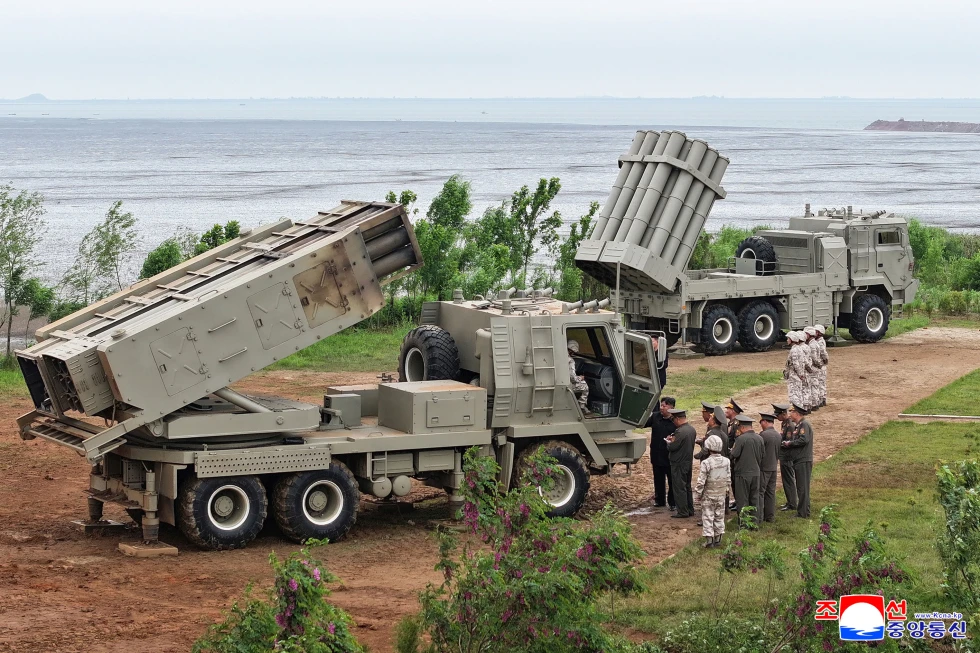
North Korean state media later said Kim Jong Un supervised the tests and described them as involving multiple weapons systems. The systems named in the North Korean account included ballistic missiles with new warheads intended for battlefield nuclear use, nuclear-capable cruise missiles guided by artificial intelligence technology, and 240-millimeter rocket artillery fitted with what Pyongyang called “ultra-precision” navigation systems. South Korea’s military did not immediately verify those claims.
The North Korean description was aimed at showing progress across several categories at once. The ballistic missiles were presented as tactical systems capable of carrying new warheads. The cruise missiles were described as nuclear-capable and supported by AI-guided technology. The rocket artillery was described as improved through precision navigation. Whether all of those claims are accurate remains subject to outside verification, but Pyongyang’s messaging was clear: the tests were meant to show a broader modernization effort, not a routine launch.
Kim reportedly expressed satisfaction with the performance of the cruise missile systems, particularly those intended for deployment with long-range artillery units near the South Korean border. He called for faster modernization of artillery forces and said North Korea should develop capabilities that “no one can match.”
The emphasis on front-line deployment matters. North Korea’s tactical missile and artillery systems are designed primarily for contingencies on the peninsula. A weapon does not have to fly far to matter militarily when many of the most important targets in South Korea, including Seoul and major military facilities, are within range of North Korean artillery, rockets, and short-range missiles.
A continuation of April’s tests
Tuesday’s launch followed the April 19 test of short-range ballistic missiles that North Korea said were fitted with cluster warheads. In that earlier event, state media said Kim oversaw the firing of upgraded Hwasong-11 Ra tactical ballistic missiles. The missiles reportedly struck a target area 136 kilometers away and were tested to assess new warheads carrying cluster bombs and fragmentation mines.
The Hwasong-11 family is the North Korean missile line often compared to Russia’s Iskander system. The Hwasong-11 Ra is generally described as a smaller variant. North Korea had previously displayed related markings when it unveiled the Hwasan-31 tactical nuclear warhead in 2023, which is why South Korean analysts track these launches closely for signs of battlefield nuclear deployment planning.
The April test already suggested that North Korea was refining warheads designed for area effects against troop concentrations, bases, ports, and air-defense sites. Tuesday’s launch added another layer by pairing ballistic missiles with other projectiles. South Korean assessments described that as an unusual combination, likely intended to demonstrate mixed-fire tactics and the ability to complicate interception by South Korean and U.S. defenses.
That is the military logic behind launching different systems together. Ballistic missiles, artillery rockets, cruise missiles, and drones fly different profiles. They travel at different speeds, at different altitudes, and along different trajectories. A defender has to classify the threat, assign interceptors or countermeasures, and protect priority targets in real time. North Korea’s test appears designed to stress that problem.
The political setting around the launch
The launch came at a sensitive moment in regional diplomacy. Russian President Vladimir Putin and Chinese President Xi Jinping recently voiced opposition to outside pressure on North Korea, including sanctions, military pressure, and diplomatic isolation. Russia and China, both permanent members of the U.N. Security Council, have repeatedly blocked or diluted U.S.-led efforts to tighten sanctions on Pyongyang over its weapons programs.
There has also been speculation that Xi could visit North Korea soon. If such a trip occurs, it would be his first visit to Pyongyang since June 2019. North Korea’s latest launch therefore occurred as Pyongyang’s two principal external backers were signaling opposition to Western pressure and as the possibility of a high-level China-North Korea engagement was drawing regional attention.
North Korea has also deepened its relationship with Russia since the start of Russia’s war in Ukraine. Pyongyang has sent conventional weapons and troops to support Moscow’s war effort, while using the relationship to strengthen its position against Washington and Seoul. At the same time, Kim has continued to rely on China as North Korea’s main economic lifeline.
The United States has continued to signal interest in renewed diplomacy. President Donald Trump has repeatedly said he wants to reopen talks with Kim. Pyongyang has not accepted those overtures and has instead said Washington must abandon demands for North Korea’s nuclear disarmament as a precondition for negotiations.
South Korea’s response
South Korea’s Joint Chiefs of Staff said the South Korean military is closely monitoring North Korean activity and maintaining readiness with the United States. Seoul also said it was sharing information with the United States and Japan in preparation for possible additional launches.
The launch came hours after South Korean President Lee Jae Myung used a Cabinet meeting to call for stronger military development. Lee emphasized artificial intelligence, drone capabilities, and the possible acquisition of a nuclear-powered submarine, an issue that has already featured in his diplomacy with Washington.
Lee did not directly address North Korea’s launch in those remarks, but he said South Korea must show the resolve to protect its own security while strengthening its alliance with the United States. The message fit the broader defense debate in Seoul: even a government that favors improved ties with Pyongyang is under pressure to respond to North Korea’s expanding missile, drone, and nuclear-capable systems.
For now, the launch leaves three confirmed points. North Korea fired at least one close-range ballistic missile from Jongju toward the Yellow Sea. It launched additional projectiles that South Korean authorities are still analyzing. And Pyongyang later described the event as a test of new warheads, AI-guided nuclear-capable cruise missiles, and precision artillery systems under Kim’s supervision. The details will continue to be reviewed, but the direction is already clear: North Korea is not only adding missiles. It is working on the ability to fire different weapons together in ways meant to challenge the defenses built to stop them.
Author

We cover the world’s chaos so you don’t have to scroll twelve feeds to understand it.
Sign up for Atlas newsletters.
Stay up to date with curated collection of our top stories.