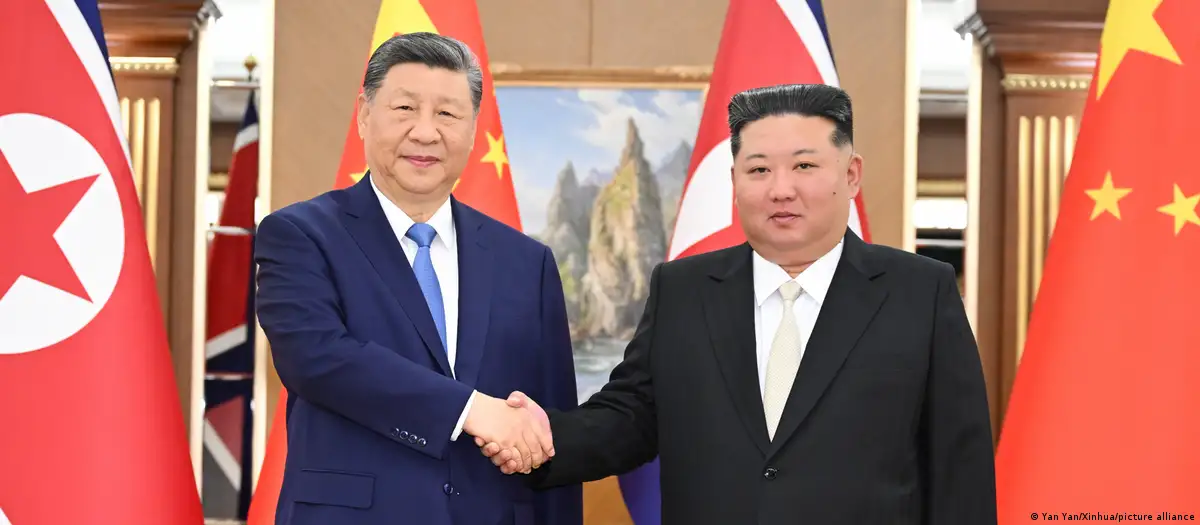
Xi Jinping landed in Pyongyang on Monday for a two-day state visit, his first trip to North Korea in nearly seven years and his first journey outside China this year. Kim Jong Un met him on the tarmac at Sunan airport, and what followed was a display North Korea reserves for guests it wants to flatter.
A red carpet, an honor guard, a 21-gun salute at Kim Il Sung Square, a military band, children with flowers, crowds with balloons. Banners along the avenues called the two countries' friendship unbreakable. Kim and his wife, Ri Sol Ju, escorted Xi and his wife, Peng Liyuan, to the Kumsusan guesthouse, where the leaders sat down for talks. Xi brought a heavyweight delegation, including Foreign Minister Wang Yi, Defense Minister Dong Jun, and his de facto chief of staff, Cai Qi.
The warmth was the point. So was the timing.
What Xi came to offer
Xi framed the visit as a reset of a relationship that had drifted. China's support for North Korea would hold "no matter how the international situation changes," he told Kim, and Beijing's backing for Kim's leadership and for the two countries' shared interests would not waver.
Most of what Xi put on the table was economic. He called for expanding "pragmatic cooperation" in trade and pushed both sides to take advantage of reopened border crossings and the return of flights and passenger trains to move people back and forth again. Air China resumed service between the capitals in March. The cooperation he described stretched across agriculture, health, construction, and technology, alongside diplomacy, law enforcement, and the military.
That economic lever is China's strongest. North Korea relies on its neighbor for the bulk of its trade, by some estimates as much as 95 percent, and pandemic-era closures had frozen much of that exchange. Kim, for his part, called the visit proof of how "unbreakable" the relationship is and said consolidating the friendship was North Korea's "unchanging strategic choice."
The word nobody said
For all the talk of cooperation, one term was missing from the official summaries: denuclearization.
The omission was not an accident. China has avoided the word in its public statements on North Korea since the summer of 2023, and its absence here lands as a quiet signal that Beijing has stopped pressing Kim to give up his weapons. On Sunday, Kim's sister, Kim Yo Jong, made the North's position blunt, calling its status as a nuclear weapons state "the line of no retreat."
Kim spent the days before Xi's arrival reinforcing that message. He toured a newly opened plant for producing nuclear material, hinting at larger plans for the arsenal. He boarded a new destroyer and vowed to build a nuclear-armed navy. He visited a munitions factory and ordered missile output increased 2.5 times over the next five years. The Stockholm International Peace Research Institute estimated over the weekend that the North now holds roughly 60 warheads, up from about 50 a year ago, with material for at least 30 more.
Why now
The pull behind Xi's trip is Russia. Since Moscow's invasion of Ukraine, North Korea has supplied weapons and troops to the war, sending more than 10,000 soldiers and, by some counts, as many as 14,000. In return it has drawn money, battlefield experience, and military help. One South Korean government institute estimated Moscow has paid Pyongyang as much as $14.4 billion since 2023, much of it possibly in the form of sensitive military technology.
That tilt toward Moscow has unsettled Beijing, which long played senior partner to a dependent North Korea and now finds Kim negotiating from unfamiliar strength. Analysts read the visit as an effort to pull Pyongyang back toward China's orbit before Russia's influence sets too deeply. Kim has hosted a run of foreign officials and watched his economy recover from pandemic isolation, helped by tourism from China and Russia, and he received Xi accordingly, with pageantry but not deference.
The trip also coincides with the 65th anniversary of the 1961 friendship treaty between the two countries, still the only mutual defense pact China has ever signed.
The wider board
Beyond the bilateral relationship, the meeting touched the issues that animate Beijing's regional strategy. Kim pledged to "unswervingly adhere to the One China principle" and back China's claims over Taiwan, an unusually explicit endorsement from Pyongyang. Xi, without naming Japan, urged North Korea to oppose attempts to "revive militarism," echoing complaints he has aired about Tokyo's expanding defense posture.
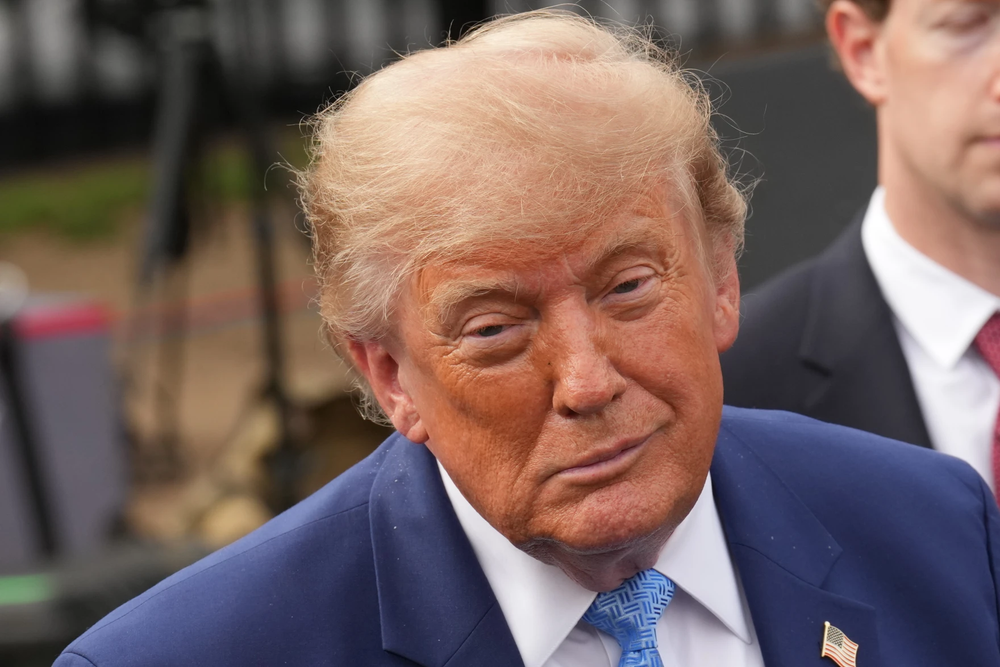
Washington hovered over the visit as well. Xi traveled to Pyongyang weeks after hosting both Trump and Vladimir Putin in Beijing, and Trump has said he discussed North Korea with Xi and wants to meet Kim again. Talks between Trump and Kim collapsed in 2019 over sanctions, and Pyongyang has since rebuffed offers to restart them, insisting the United States first drop its demand for denuclearization. Kim Yo Jong dismissed as "false" any suggestion that Xi and Trump had discussed the subject.
Some in Seoul hope the trip nudges Kim toward dialogue; South Korea's Foreign Ministry said it hoped the visit would play a constructive role, and a senior official said he expected the two leaders to weigh a possible Kim-Trump meeting later this year. Whether Xi extracts anything concrete from a more confident Kim is another matter. The welcome was lavish. What North Korea is prepared to give in return remained, by the end of the first day, largely unstated.
Author

We cover the world’s chaos so you don’t have to scroll twelve feeds to understand it.
Sign up for Atlas newsletters.
Stay up to date with curated collection of our top stories.