Russia test-fired its new RS-28 Sarmat intercontinental ballistic missile on Tuesday morning, with President Vladimir Putin saying the weapon will go on combat duty by the end of this year.
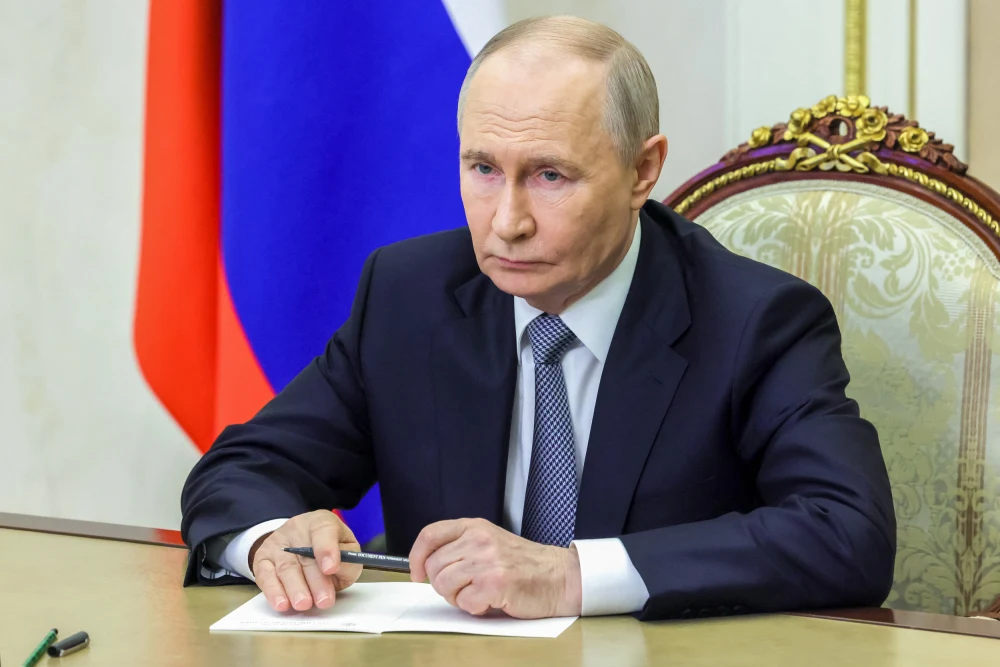
The missile launched at 11:15 a.m. Moscow time from the Plesetsk Cosmodrome in the Arkhangelsk region, according to the Kremlin. About half an hour later, officials said it had struck its designated target at the Kura test range on the Kamchatka Peninsula in Russia's Far East. Putin watched the launch from his office on a video link.
Col. Gen. Sergei Karakayev, commander of Russia's Strategic Missile Forces, briefed Putin afterward. "The launch was successful, and the mission objectives were achieved," he said, telling Putin that the first Sarmat-armed regiment will be stationed at the Uzhur formation in Krasnoyarsk Krai before the year is out.
"The Sarmat will indeed be placed on combat duty at the end of the current year," Putin confirmed. He called the test "a major event and unconditional success." There are no independent confirmations of the claimed results.
The Numbers Putin Put on the Missile
Putin said the Sarmat carries a warhead with combined yield "four times that of any existing equivalent" and credited it with an operational range exceeding 35,000 kilometers, or roughly 21,750 miles. "It has the ability to penetrate all existing and future anti-missile defense systems," he said.
Independent assessments are more conservative. Outside experts have generally placed the Sarmat's range closer to 11,000 miles, with payload capacity of up to 10 tons. By comparison, the U.S. LGM-30 Minuteman III has a maximum range of roughly 8,000 miles, and Britain's submarine-launched Trident II carries up to eight warheads to about 7,000 miles.
Pavel Podvig, a senior researcher at the UN Institute for Disarmament Research, said a year-end deployment is plausible but cautioned that it "will not lead to a significant change in the deterrent potential of Russia's strategic forces."
NATO has long designated the Sarmat as "Satan II." It is the first ICBM developed in post-Soviet Russia to be classed as super-heavy, and is meant to replace roughly 40 Soviet-built R-36M Voyevoda missiles still in service.
A History of Delays
Putin first unveiled the Sarmat in March 2018 as the centerpiece of a new generation of Russian strategic weapons. Development of the system began as early as 2011.
The program has had a difficult run. The first successful test from Plesetsk was carried out in 2022. A February 2023 test failed. A September 2024 launch ended in what Western analysts described as a massive explosion at the launch silo, with satellite imagery showing a deep crater on the pad. Last October, Putin himself acknowledged that the missile was not yet operational, walking back earlier claims.
The deployment announcement also lands a week after the reported arrest, on corruption charges, of the chief executive of the plant that builds the missile.
Arms Control Collapse Frames the Test
The launch comes just over three months after the expiration of New START, the last remaining strategic arms control treaty between Moscow and Washington. The 2010 agreement formally lapsed on February 5, ending more than half a century of negotiated caps on the two countries' strategic arsenals.
Russia and the United States together hold roughly 8,000 nuclear warheads — about 4,300 on the Russian side and 3,700 on the American side, according to the Federation of American Scientists. With the treaty gone, there are no longer any legal limits on either stockpile.
The Kremlin said it notified Washington in advance of Tuesday's test through state news agency TASS. Moscow and Washington agreed earlier this year to restore high-level military channels that had been shut since late 2021, but there has been no public progress on extending or replacing New START. President Donald Trump has pushed for a successor treaty that brings China in; Beijing has publicly rejected the idea.
The Broader Modernization Effort
The Sarmat is one piece of a wider Russian nuclear modernization push that Putin first laid out in 2018.
Putin said Tuesday that work on two of the other weapons announced then is now in its "final stages." The Poseidon is a nuclear-armed underwater drone designed to detonate near coastlines and generate a radioactive wave. The Burevestnik is a nuclear-powered cruise missile that, by virtue of its propulsion, is intended to loiter for days and approach targets from unexpected directions.
The Avangard hypersonic glide vehicle, capable of speeds of around Mach 27, is already in service. The nuclear-capable Oreshnik intermediate-range ballistic missile has been used twice against Ukraine in its conventional configuration. Putin said Tuesday that it can also be armed with nuclear warheads. Oreshnik's range of roughly 3,100 miles puts every European capital within reach.
"We were forced to consider ensuring our strategic security in the face of the new reality and the need to maintain a strategic balance of power and parity," Putin said.
The test landed three days after the May 9 Victory Day parade on Red Square — a scaled-back affair that, for the first time in nearly two decades, did not feature heavy weapons — at which Putin said the war in Ukraine was nearing its end.
Author

We cover the world’s chaos so you don’t have to scroll twelve feeds to understand it.
Sign up for Atlas newsletters.
Stay up to date with curated collection of our top stories.