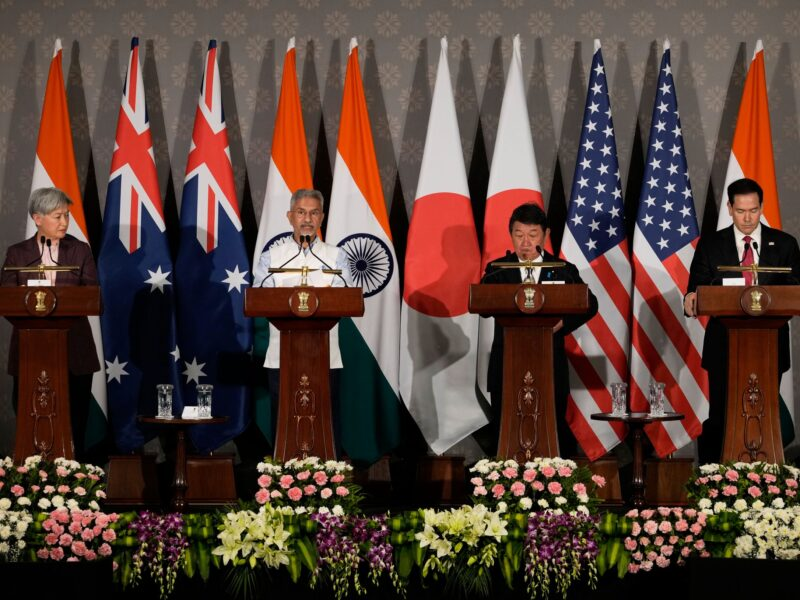
The foreign ministers of the Quad — the United States, Australia, India, and Japan — met in New Delhi on Tuesday for their 11th ministerial gathering, announcing a series of new initiatives on maritime surveillance, critical minerals, port infrastructure, and energy security as the four-country grouping looked to translate years of declarations into operational programs.
The talks at Hyderabad House brought together U.S. Secretary of State Marco Rubio, Indian External Affairs Minister Subrahmanyam Jaishankar, Japanese Foreign Minister Toshimitsu Motegi, and Australian Foreign Minister Penny Wong. The four ministers issued a joint statement, signed bilateral agreements on the margins, and gave a joint press conference. The meeting lasted just over an hour.
The ministers framed the gathering as a deliberate step away from the dialogue-only posture that critics have accused the Quad of falling into. "Our goal collectively over the last year has been to turn this from a forum in which we meet and talk about problems, to one where we actually do something about it," Rubio said in his opening remarks. Wong said the region was experiencing "acute economic stress" and "a deteriorating strategic environment," while Motegi noted that the four countries collectively represent nearly 2 billion people and about a third of global GDP.
Critical Minerals Framework
The most consequential policy outcome was the formal launch of the Quad Critical Minerals Initiative Framework, designed to coordinate investment across mining, processing, and recycling and to reduce the four countries' dependence on Chinese rare earth supply. The Quad has set a goal of mobilizing up to $20 billion in combined public and private financing for projects with what officials described as a "Quad nexus," drawing on export credit agencies, development finance institutions, and public guarantees, loans, and subsidies.
China currently controls more than 60 percent of global rare earth mining and roughly 85 percent of the world's processing and refining capacity. The framework borrows heavily from Japan's playbook after the 2010 maritime confrontation with China that resulted in a halt to Chinese rare earth exports to Japan. Tokyo responded with a roughly $1 billion diversification drive, cutting its dependence on Chinese rare earths from over 90 percent in 2010 to around 60 percent today.
Alongside the broader Quad framework, Rubio and Jaishankar separately signed a bilateral U.S.-India agreement on critical minerals and rare earths. The Indian Ministry of External Affairs said the bilateral pact built on commitments made during Prime Minister Narendra Modi's February 2025 visit to Washington. "Vibrant innovation economies such as ours cannot afford to leave the foundational materials of these industries vulnerable to single-source monopolies that could deny us these things," Rubio said at the signing.
The joint statement also went further than past Quad texts in naming the practices the framework is meant to counter, citing "arbitrary export restrictions, price manipulation, and disruptions particularly on critical minerals that impact global supply chains."
Maritime Initiatives and the South China Sea
The ministers launched the first-ever Indo-Pacific Maritime Surveillance Collaboration, designed to pool the four countries' maritime surveillance capabilities and improve information sharing in the region, with an initial focus on the Indian Ocean. The initiative will work alongside an expansion of the existing Indo-Pacific Partnership for Maritime Domain Awareness, which is developing what officials described as a "Common Operating Picture" for the region's waters.
The Quad also announced its first joint infrastructure project under the broader Ports of the Future Partnership: a pilot port-infrastructure initiative in Fiji. "We are going to be partnering on issues of port infrastructure, in particular in response to insufficient port capacity in the Pacific Islands," Rubio said. Officials did not disclose financing details or a construction timeline.
The joint statement returned to the now-familiar Quad language on the South and East China Seas without naming Beijing directly. The ministers said they remained "seriously concerned" about the situation in both bodies of water and reiterated their "strong opposition to any destabilizing or unilateral actions including by force or coercion." The statement called out "dangerous maneuvers by military aircraft," the "unsafe use of water cannons and flares," and "ramming or blocking actions." It did not mention Taiwan.
Additional initiatives included an expanded Quad-at-Sea Ship Observer Mission to be hosted by India, a counterterrorism tabletop exercise focused on state-sponsored terrorism and unmanned aerial vehicles to be held in Australia in June, and a Quad Open Radio Access Networks rollout with Palau.
Energy Security and the Hormuz Question
The Quad also issued a separate joint statement on Indo-Pacific energy security, against the backdrop of the U.S. blockade of Iranian ports and the disruption of shipping through the Strait of Hormuz. The four countries announced the new Quad Initiative on Indo-Pacific Energy Security and a Quad Fuel Security Forum that the U.S. Department of Energy will host later this year. Officials said the initiative would focus on supply chains, market analysis, and emergency response.
The ministers explicitly condemned Iran's proposal to impose tolls on vessels transiting the Strait of Hormuz and called for the "uninterrupted flow of global commerce" through both the strait and the Red Sea. "We recognize the importance of maintaining the principle of freedom of navigation and our opposition to any tolling proposition," Wong said. Motegi, in remarks published before the meeting, said disruptions to energy shipments through the strait would weigh heavily on Asian economies. The text framed energy security as a particular vulnerability for developing and small island states in the region.
China's Response and the Leaders' Summit Question
Beijing pushed back on the announcements without addressing any of the specific initiatives by name. Foreign Ministry spokeswoman Mao Ning said in Beijing that "we do not support forming exclusive small groupings or bloc confrontation," and that "any cooperation should not undermine mutual trust and cooperation among regional countries."
The meeting also left unresolved one of the central questions hanging over the Quad: when the four heads of state will next meet. The joint statement said the partners "look forward to the convening of the Quad Leaders' Summit," without specifying a date or location. The Quad has not held a leaders' summit since 2024. India was widely expected to host one but the gathering was delayed amid frictions over U.S. tariffs and a stalled bilateral trade deal. Australia is next in line to chair the grouping.
Brahma Chellaney, an Indian international-affairs analyst, said on social media that "without the political weight of a leaders' summit, the Quad risks losing its strategic coherence and punch." Rubio told reporters that officials were working toward a leaders' meeting later this year, but no date has been confirmed.
Author
We cover the world’s chaos so you don’t have to scroll twelve feeds to understand it.
Sign up for Atlas newsletters.
Stay up to date with curated collection of our top stories.