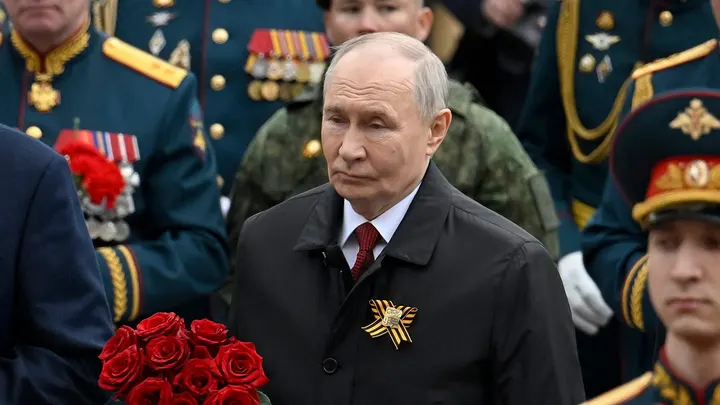
Russian President Vladimir Putin said Saturday that he believes the war in Ukraine is "coming to an end," a notable shift in language from a leader who has spent more than four years insisting the fight would continue until every objective of what Moscow calls the "special military operation" had been met.
"I think that the matter is coming to an end," Putin told reporters at a Kremlin press conference following Russia's annual Victory Day parade. "I think it is heading to an end, but it's still a serious matter. They spent months waiting for Russia to suffer a crushing defeat, for its statehood to collapse. It didn't work out. And then they got stuck in that groove and now they can't get out of it."
The remarks came on the same day Moscow held its most pared-down May 9 parade in nearly two decades and just hours after Putin used his eight-minute Victory Day address to pledge continued military action in Ukraine. The juxtaposition was striking. Within the span of a single afternoon, the Russian leader vowed his forces would "march forward" and then suggested the end of the war was close.
The Kremlin moved quickly to temper expectations. Spokesman Dmitry Peskov told state television that "the issue of a Ukrainian settlement is far too complex, and reaching a peace agreement is a very long way with complex details." German government officials, cited anonymously by news agencies on Sunday, called Putin's overture "not credible," saying Moscow had not altered any of its preconditions for ending the war.
A parade without hardware
Putin's comments cannot be separated from the staging of the day itself. For the first time in close to twenty years, no tanks, intercontinental ballistic missiles, or mobile launchers rolled across the cobblestones of Red Square. Russian military equipment was instead shown to spectators on giant screens, in a seven-minute compilation of combat footage and what state media described as "the latest Russian technology" — drones, multiple-launch rocket systems, airborne combat vehicles, air-launched ballistic missiles, and nuclear submarines.
The parade ran 45 minutes total. Putin spoke for roughly ten of those. Soldiers, including a contingent of North Korean troops who fought alongside Russian forces in the Kursk region, marched past the rostrum. Russian and North Korean units moved in lockstep to brass band accompaniment and chants of "ura."
The guest list was thin. Belarusian President Alexander Lukashenko, Kazakhstan's Kassym-Jomart Tokayev, the leaders of Uzbekistan, Laos and Malaysia, and the king of Malaysia attended. Chinese President Xi Jinping and North Korean leader Kim Jong Un, who had been present in previous years, did not.
Russian officials publicly attributed the trimmed-down format to security concerns, with full Victory Day celebrations canceled outright in 27 Russian cities. Reporting in recent weeks has indicated that more than 40 air defense systems were redeployed to Moscow ahead of the parade and that snipers and machine gun crews were stationed on the Kremlin towers. Ukrainian long-range drone strikes, which analysts believe can now reach roughly 70 percent of the Russian population, have intensified in the months leading up to the parade.
Moscow had warned Kyiv that any disruption of the May 9 events would draw a "massive missile strike" on Kyiv and instructed foreign embassies to evacuate staff. Ukrainian President Volodymyr Zelenskyy responded with a tongue-in-cheek presidential decree "allowing" the parade to proceed, stating that for the duration of the ceremony "the area of Red Square shall be excluded from the plan for the use of Ukrainian weapons" and including coordinates for the landmark. Peskov dismissed the decree as a "silly joke," saying: "We don't need anyone's permission to be proud of our Victory Day."
The three-day ceasefire and the prisoner swap
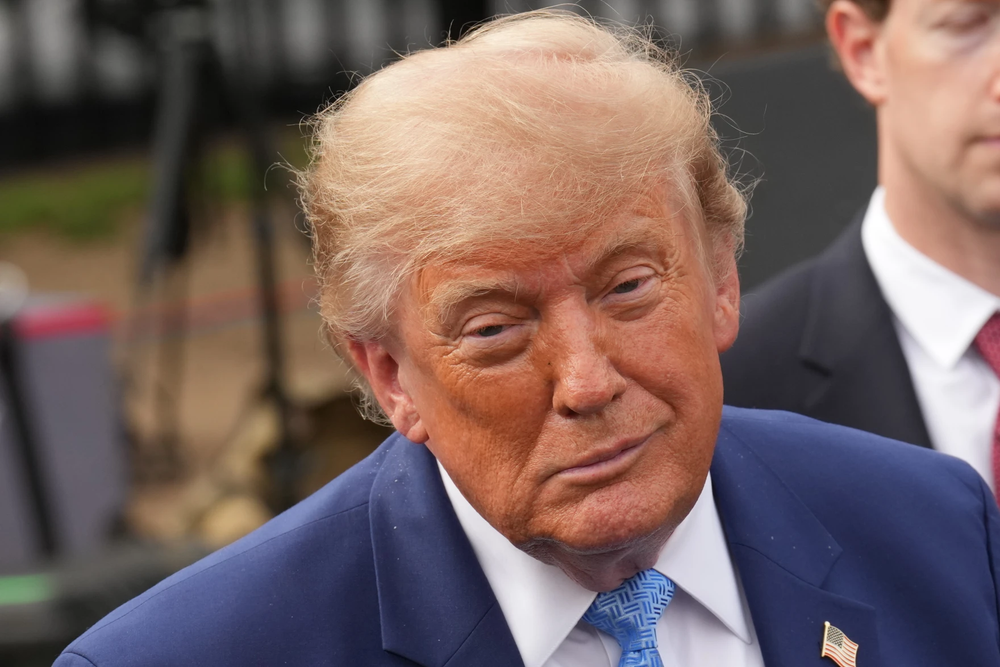
The parade unfolded under the cover of a three-day ceasefire that President Donald Trump announced Friday, running from Saturday through Monday and covering the Victory Day period that Moscow had pressed Washington to protect. The same agreement provides for an exchange of 1,000 prisoners of war from each side.
"This ceasefire will include a suspension of all kinetic activity, and also a prisoner swap of 1,000 prisoners from each country," Trump wrote on Truth Social. "This request was made directly by me, and I very much appreciate its agreement by President Vladimir Putin and President Volodymyr Zelenskyy."
Trump told reporters he wanted a "big extension" of the truce. "I'd like to see it stop. Russia-Ukraine, it's the worst thing since World War II in terms of life. Twenty-five thousand young soldiers every month. It's crazy." The Kremlin has so far declined to commit to extending the truce beyond Monday.
The ceasefire has not held cleanly. Ukrainian officials said Sunday that Russian strikes had killed at least three people and that close to 150 combat engagements had taken place along the front line in the previous 24 hours. Moscow, in turn, accused Ukraine of more than 6,000 drone attacks and hundreds of artillery strikes since the truce began — claims that have not been independently verified.
Putin used the press conference to confirm Moscow's support for the 1,000-for-1,000 swap and to complain that Ukraine had not yet engaged Russia directly on logistics. "We hope that in this case, the Ukrainian side will respond to the US president's proposal. Unfortunately, we have not received any proposals so far." Zelenskyy, on Telegram and X, said Ukraine had received Moscow's agreement to the exchange through American mediation and that he had instructed his team "to promptly prepare everything necessary for the exchange."
Schroeder, Zelenskyy, and the negotiating track
Asked whether he was prepared to engage in direct talks with European leaders, Putin offered an answer almost custom-made to provoke them. "For me personally, the former chancellor of the Federal Republic of Germany, Mr. Schroeder, is preferable."
Gerhard Schroeder is a longstanding personal friend of Putin who took board positions at Russian state-linked energy firms after leaving office in 2005, including a chairmanship tied to Nord Stream. He has been a politically toxic figure in Berlin and Brussels for most of the war. Zelenskyy in 2022 called him "disgusting" for meeting Putin after the full-scale invasion began. The German government's response on Sunday, conveyed through anonymous officials, was that the suggestion was unserious and that a credible first signal from Moscow would be an extension of the current three-day truce.
European Council President António Costa had said earlier in the week that there was "potential" for the EU to negotiate with Russia, and that Zelenskyy supported the idea, telling the Financial Times he was consulting with European leaders on the right moment for such an opening.
On a possible direct meeting with Zelenskyy, Putin held to his previous position: a face-to-face summit is possible, but only after the substantive terms of a peace agreement have already been settled. "A meeting in a third country is also possible, but only once final agreements have been reached on a peace treaty for a long-term historical perspective, to take part in this event and sign, but it must be a final step." He said he had "never refused" a meeting and had "heard once again" from Slovak Prime Minister Robert Fico that Zelenskyy was willing to sit down.
Why the rhetoric is shifting
Keir Giles, a senior fellow at Chatham House, cautioned against reading too much into the Russian president's choice of words. "There have been plenty of promises over the last 18 months that the end of the war was imminent, none of which turned into reality," he said. "The best we can hope for is that now Putin realises that Russia is not in fact winning the war."
The numbers behind the rhetoric are unforgiving for both sides. The war has killed hundreds of thousands of soldiers and civilians, drained Russia's roughly $3 trillion economy, and left swaths of eastern Ukraine in ruins. Russian forces control just under one-fifth of Ukrainian territory but have struggled to capture the full Donbas region, where Ukrainian troops hold a line of fortress cities. At the current rate of Russian advance, the New York Times calculated this week, fully seizing the Donbas would take more than three decades.
Russia's diplomatic isolation has also deepened. With Xi absent from Red Square this year, the visual contrast with the 2025 parade was hard to miss. Trump, who placed ending the Ukraine war at the center of his 2024 campaign and has repeatedly described his inability to do so as one of his biggest disappointments, is due in Beijing this week, where Ukraine and Iran are both expected to be on the agenda with Xi.
Author

We cover the world’s chaos so you don’t have to scroll twelve feeds to understand it.
Sign up for Atlas newsletters.
Stay up to date with curated collection of our top stories.