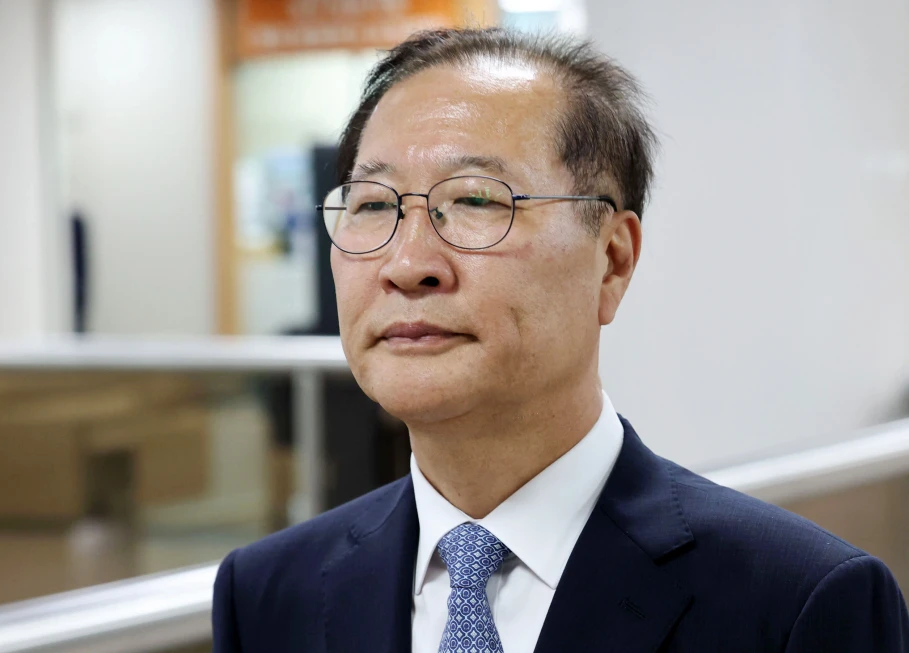
A Seoul court sentenced former Justice Minister Park Sung-jae to 25 years in prison on Monday, finding that he played a key role in the insurrection surrounding former President Yoon Suk Yeol's short-lived martial law declaration in December 2024. The court ordered Park detained on the spot, citing concern that he might destroy evidence.
The term ran five years beyond what prosecutors had requested. Special counsel Cho Eun-suk's team had sought 20 years; the Seoul Central District Court's 33rd Criminal Division, presided over by Judge Lee Jin-gwan, went further, calling the conduct grave enough to warrant a heavier penalty.
What the court found
Park was convicted on charges that included playing a key role in an insurrection and abuse of authority. The court determined that within hours of Yoon's December 3 decree, Park convened senior justice ministry officials and set in motion a series of measures meant to support the martial law command.
According to the ruling, he directed the corrections bureau to confirm whether prisons had the capacity to hold politicians and other figures expected to be arrested, ordered immigration officials to prepare travel bans, and reviewed the dispatch of prosecutors to the martial law command's joint investigation headquarters to support possible cases against Yoon's political opponents. The judge said those steps went beyond the lawful duties of the officials involved, since enforcing an unconstitutional decree did not justify detentions or travel bans.
The court rejected Park's defense that he was simply performing the functions required during a national emergency. Lee said Park had abandoned his constitutional duty as justice minister and chosen to join the effort because he believed martial law might succeed. The judge described Yoon's decree as a "self-coup" by a sitting president seeking to monopolize power, and said Park's part would have been critical had Yoon managed to suppress his opponents and block the National Assembly from voting the order down.
The court also faulted Park for his conduct after the fact, saying he had ordered subordinates to draft documents justifying the martial law to counter Yoon's impeachment, and that he changed his account in court whenever objective evidence surfaced, showing no genuine remorse.
A notebook and a longer timeline
Two findings stood out for their bearing on cases still moving through the courts. The division accepted as evidence a notebook kept by former Defense Intelligence commander Noh Sang-won, treating it as a real-time record of the martial law and insurrection planning. It also concluded that preparations dated back to 2023, pointing to a 2017 Defense Security Command martial law document, the Counterintelligence Command's operational plan, and discussions during the 2023 Ulchi exercise about operating a joint investigation headquarters and detaining civilians.
Both findings cut against earlier rulings. The division handling Yoon's insurrection leadership case had dismissed Noh's notebook, citing unclear timing, conflicting details, and its rough condition, and had judged the preparations too haphazard to suggest a long-planned operation. The case over the alleged drone flights to Pyongyang put the planning closer to September 2024. By pushing the timeline back to 2023 and giving the notebook weight, Monday's ruling diverged from those courts, and analysts said the question of when the plot took shape is likely to become a central issue on appeal.
Charges the court set aside
Not every count stuck. The court dismissed a separate charge that Park had improperly sought details of the prosecution's investigation into former first lady Kim Keon Hee, who was accused of accepting a luxury bag. The judges ruled the matter fell outside the special counsel's mandate, which was tied to the martial law investigation, and noted that it could be pursued later through proper channels.
A perjury charge against former Government Legislation Minister Lee Wan-kyu, accused of falsely testifying that no martial law discussion took place at a post-decree meeting, was likewise dismissed as lying beyond the special counsel's jurisdiction.
Park's lawyers said they would appeal, calling the verdict unsupported by the facts or the law. The special counsel's team signaled it was unlikely to challenge the ruling, saying it had laid out a justice minister's duty to halt an unlawful declaration of martial law and defend the constitutional order.
Part of a widening reckoning
Park is the latest member of Yoon's cabinet to draw a lengthy sentence over the events of that night. Yoon's decree lasted roughly six hours before lawmakers pushed past soldiers he had sent to the National Assembly and voted it down, forcing the cabinet to lift it. The televised announcement triggered protests, sent markets lower, and caught allies including the United States off guard.
Yoon himself was impeached on December 14, 2024, removed by the Constitutional Court in April 2025, and arrested that July. He is serving a life sentence for leading the insurrection and received a separate 30-year term for allegedly ordering drone flights over Pyongyang in October 2024 to manufacture a crisis with North Korea and justify the decree. He has appealed both.
Others have fallen alongside him. Former Defense Minister Kim Yong-hyun drew a 30-year sentence for mobilizing the military to enforce the order, plus another 30 years in the drone case. Former Prime Minister Han Duck-soo was initially sentenced to 23 years for helping lend the decree a veneer of procedural legitimacy, though an appeals court later cut that to 15. Former Interior Minister Lee Sang-min received nine years.
The ruling may also sharpen the inquiry into former Prosecutor General Shim Woo-jung, who is accused of reviewing the prosecutor dispatch on Park's instruction. The court called that instruction a key precondition for suppressing Yoon's opponents, and Shim was set to appear before the comprehensive special counsel team this week for questioning as a suspect. His side maintains the review was a routine, working-level legal matter.
Author

We cover the world’s chaos so you don’t have to scroll twelve feeds to understand it.
Sign up for Atlas newsletters.
Stay up to date with curated collection of our top stories.