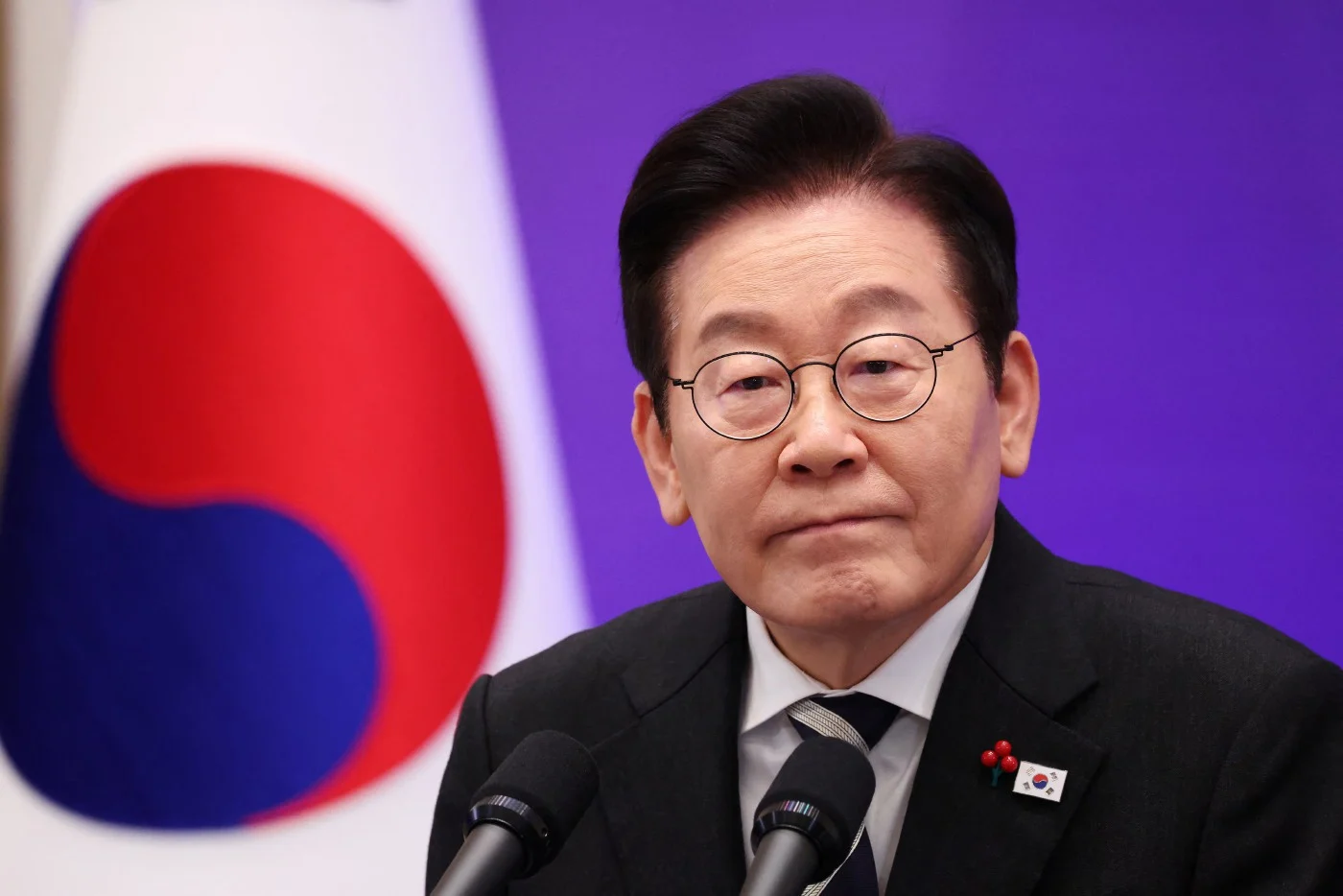
President Lee Jae Myung arrived in New Delhi on Sunday at the start of a three-day state visit, the first by a South Korean president in eight years, with the explicit goal of turning a long-underperforming commercial relationship with India into a central pillar of Seoul's trade strategy.
Lee is scheduled to hold summit talks Monday with Prime Minister Narendra Modi, their third in-person meeting following sideline discussions at last year's G7 in Canada and the G20 in South Africa. The two governments are aiming to upgrade their Comprehensive Economic Partnership Agreement and nearly double bilateral trade to $50 billion by 2030, up from $25.7 billion last year.
Speaking at a dinner with the Korean community in New Delhi on Sunday, Lee did not hide his frustration with the current state of ties. "The level of economic cooperation between South Korea and India is still very low," he said. "Going forward, we will expand that space and make the relationship between South Korea and India completely different from what it is now."
A relationship that has lagged behind its potential
Lee's own numbers made the case more sharply than any diplomatic statement. He noted that about 10,000 South Korean firms operate in Vietnam, compared with roughly 600 to 700 in India. The Korean expatriate population in the country stands at just 12,000, a figure Lee described as strikingly small against India's population of 1.46 billion — the largest in the world.
"India has already surpassed China in population and is the world's fourth-largest economy, expected to soon become the third," Lee said. "Compared with that, the level of economic cooperation with the Republic of Korea is truly very low."
National security adviser Wi Sung-lac said the two governments will use the summit to "comprehensively strengthen the special strategic partnership" established in 2015 and to present a vision for expanding what he called "pragmatic diplomacy centered on national interests." Beyond goods trade, the talks are expected to cover shipbuilding, maritime industries, finance, artificial intelligence, and defense cooperation.
Maeng Hyun-chul, a research fellow at Seoul National University's Asia Center, argued at a parliamentary seminar in Seoul last week that shipbuilding sits at the natural intersection of the two economies — tapping India's drive to generate manufacturing jobs while drawing on South Korea's industrial base. He also pointed to food and consumer goods tied to the popularity of Korean culture as underexploited growth areas, while noting that Indian officials have long complained about a persistent trade deficit with Seoul.
South Korea ran a $12.8 billion trade surplus with India in 2024, on $19.2 billion in exports against $6.4 billion in imports, according to Korea International Trade Association data.
The Middle East war as a forcing function
The timing of the visit is inseparable from the war in Iran. South Korea and India are both heavily exposed to energy imports that move through the Strait of Hormuz, which has cycled between closure and partial opening over the past week.
According to figures from the South Korean presidential office, 61 percent of the country's crude oil imports and 54 percent of its naphtha imports last year transited the strait. India's Ministry of Petroleum and Natural Gas has said roughly 90 percent of the country's LPG imports — which cover about 60 percent of domestic demand — pass through the same waterway. New Delhi has managed to reduce its Hormuz exposure on crude, lifting the share of imports routed outside the strait to roughly 70 percent from about 55 percent previously.
Those numbers have concentrated minds in both capitals. Seoul urgently asked India last month to expand naphtha supplies as a hedge against Middle East disruption. India accounted for about 8 percent of South Korean naphtha imports in 2024. Trade Minister Yeo Han-koo has said that larger Indian shipments of the petrochemical feedstock could also help ease the trade imbalance that remains a sore point in New Delhi.
Lee framed the dynamic directly at the community dinner. "Because supply chain instability and the global economic crisis are becoming a constant reality amid the fallout from the Middle East war, Korea and India will become each other's most important strategic partners," he said. "India, too, like Korea, depends heavily on overseas sources for raw materials and energy. In that sense, there will be considerable room for cooperation between Korea and India."
Kang Jun-young, a professor of international relations at Hankuk University of Foreign Studies, said the combination of global supply chain stress and intensifying U.S.-China rivalry has pushed Lee to "broaden the country's diplomatic horizon and diversify trade partners."
Summit agenda and visiting delegation
Lee's schedule in New Delhi is built around a full state program. In addition to the summit with Modi, it includes a lunch hosted by the prime minister, a state banquet with President Droupadi Murmu, a meeting with External Affairs Minister S. Jaishankar, and a business forum bringing together top corporate executives from both countries. Lee is traveling with first lady Kim Hea Kyung and a delegation of ministers, senior officials, and business leaders.
Ahead of the formal talks, Lee held a closed-door meeting with Jaishankar on Sunday. Afterward, Lee told the Korean community that the two sides had "shared the view that cooperation between the Republic of Korea and India has remained stagnant for quite a long time and is not sufficiently satisfactory." He said Indian officials also agree that the current relationship underperforms given India's potential.
The Indian Ministry of External Affairs, in a statement issued before the visit, described the ties as a "multifaceted partnership rooted in ancient civilizational ties and shared values of democracy and rule of law." Diplomatic relations were established in 1973 and upgraded to a "special strategic partnership" in 2015.
Economic ties gained meaningful traction after the Comprehensive Economic Partnership Agreement came into force in 2010. South Korea is now India's 15th-largest source of foreign direct investment, with inflows totaling $929 million in 2024, and Indian exports to South Korea are led by aluminum, iron, steel, and cereals.
Next stop: Hanoi
Lee will leave India for Vietnam on Tuesday, where he is set to meet President and Communist Party General Secretary To Lam on Wednesday, followed by talks with Prime Minister Le Minh Hung and National Assembly Chairman Tran Thanh Man on Thursday. He will be the first foreign leader received by To Lam since the latter assumed the state presidency earlier this month.
The Hanoi leg is expected to focus on energy supply chains and critical minerals, rounding out a two-country tour that Wi described as aimed squarely at insulating South Korea from a global economic environment that has grown more unpredictable in the wake of the Iran war.
North Korea lent an unwelcome backdrop to Lee's departure, launching multiple short-range ballistic missiles into the East Sea on Sunday morning, according to the South Korean military. The launches came 11 days after the North's previous test and were broadly assessed by analysts as part of Pyongyang's continuing push to expand its nuclear delivery capabilities.
For Seoul, the immediate prize from the Modi summit is a clear deliverable on trade volume and supply-chain coordination. Whether Lee can convert the day's meetings into tangible movement on the CEPA upgrade — and on the naphtha and other flows that matter most in a war-disrupted energy market — will determine how much of his pitch about a "completely different" relationship actually takes shape before the end of the year.
Author

We cover the world’s chaos so you don’t have to scroll twelve feeds to understand it.
Sign up for Atlas newsletters.
Stay up to date with curated collection of our top stories.