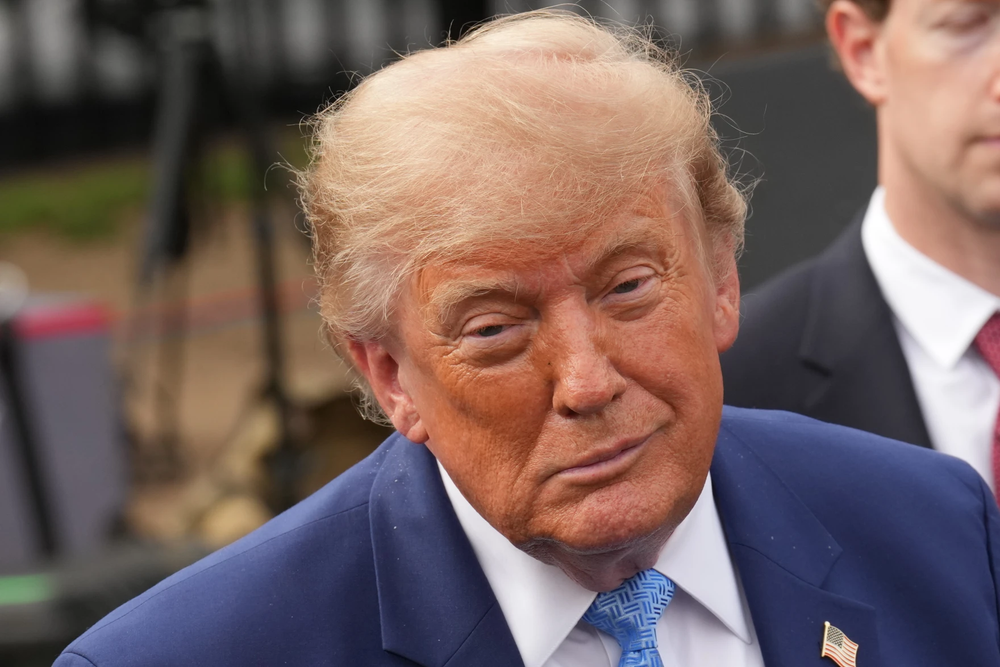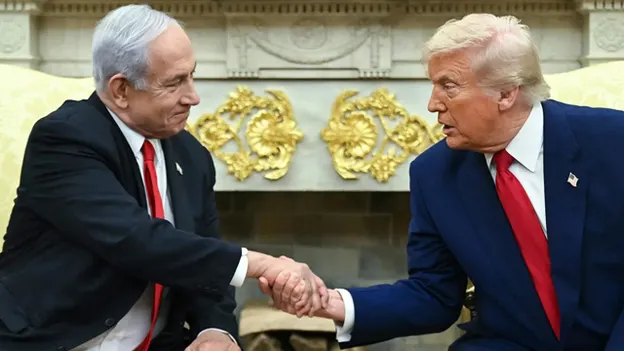
President Donald Trump announced on Monday afternoon that he had brokered a pull-back between Israel and Hezbollah after a phone call with Israeli Prime Minister Benjamin Netanyahu and what he described as a parallel exchange with the Iran-backed Lebanese militia through intermediaries.
"I had a very productive call with Prime Minister Bibi Netanyahu, of Israel, and there will be no Troops going to Beirut, and any Troops that are on their way, have already been turned back," Trump wrote in a post on Truth Social. "Likewise, through highly placed Representatives, I had a very good call with Hezbollah, and they agreed that all shooting will stop — That Israel will not attack them, and they will not attack Israel."
The exchange would mark the first known instance of a sitting U.S. president communicating with Hezbollah, which the United States has designated a foreign terrorist organization. Trump's social-media announcement did not name the intermediaries, but a Lebanese official told Reuters that Hezbollah had transmitted its willingness to halt fire through Lebanese parliament Speaker Nabih Berri, a longtime Hezbollah ally.
The Path to the Call
The Monday announcement closed out a day of rapid escalation. Earlier in the day, Netanyahu and Defense Minister Israel Katz had authorized strikes on Dahiyeh, the dense southern suburb of Beirut where Hezbollah maintains its institutional infrastructure. "The Dahiyeh in Beirut is no different from the communities in northern Israel," Katz said in a statement before Trump's intervention. "If there is no calm in the north, there will be no calm in Beirut." The Israeli military's Arabic-language spokesman warned Dahiyeh residents to evacuate, prompting large columns of cars to leave the area.
The Israeli warning came on the heels of the deepest IDF incursion into Lebanon in 26 years, which culminated Saturday in the seizure of Beaufort Castle and the surrounding strategic ridge. Hezbollah responded over the weekend with rocket fire on northern Israel, including the outskirts of Haifa, and killed an Israeli soldier in a drone attack in the south overnight Sunday into Monday.
Iran briefly entered the public exchange. The Khatam al-Anbiya Central Headquarters, an Iranian command authority, issued a statement urging residents of northern Israel to leave the area in the event of an Israeli attack on Beirut.
According to a statement issued through Lebanon's embassy in Washington, the framework Trump described had been brokered by Secretary of State Marco Rubio earlier in the day: Israel would refrain from striking Beirut and its suburbs, and Hezbollah would halt its attacks on northern Israel. The Lebanese statement made clear the agreement was a "partial ceasefire" and would not end the conflict in southern Lebanon.
Netanyahu's Caveat and Continued Fire
Netanyahu confirmed the call shortly afterward, but framed it as a conditional pause rather than a comprehensive de-escalation. "If Hezbollah does not cease attacking our cities and citizens, Israel will strike terror targets in Beirut," he said in a follow-up statement. "Our firm position." He added that the IDF would "continue to operate as planned in southern Lebanon."
The carve-out is significant. Israeli ground forces are currently advancing toward the Zaharani River, roughly six miles north of the Litani — an objective Israeli officials have described as part of the establishment of a deeper security zone inside Lebanon. The Beaufort Castle ridge captured on Saturday remains under IDF control, with Defense Minister Katz saying soldiers will "remain there as part of the security zone in Lebanon."
Hezbollah's position remained ambiguous. Hezbollah lawmaker Hassan Fadlallah said the group would support a full ceasefire across all of Lebanon as a precursor to the withdrawal of Israeli forces, but did not directly confirm that the group's strikes on Israeli territory would stop. Within hours of Trump's announcement, the Israeli military said it had intercepted two projectiles launched from Lebanon toward northern Israel. No injuries were reported.
Israeli airstrikes overnight on southern Lebanon killed six people, including a Syrian citizen, in a village near Nabatiyeh. A separate strike Monday afternoon caused significant damage to the Jabal Amel Hospital in the port city of Tyre.
The Iran Dimension
The Lebanon fighting has been the most consequential spillover of the wider U.S.-Israeli war with Iran, and the Monday escalation produced an immediate signal from Tehran. Iranian state-affiliated outlet Tasnim reported earlier in the day that the Iranian leadership had suspended indirect peace talks with the United States, citing Israel's strikes on Hezbollah as a violation of the broader ceasefire. Iranian Foreign Minister Abbas Araghchi made the linkage explicit in a post on X: "The ceasefire between Iran and the U.S. is unequivocally a ceasefire on all fronts, including in Lebanon. Its violation on one front is a violation of the ceasefire on all fronts."
Trump's response to the Iranian suspension was measured but skeptical. "I think we've been talking too much, if you want to know the truth," he told NBC News. "I think going silent would be very good, and that could be, that could be for a long time." Speaking to CNBC, Trump said the negotiations had "started to get very boring" and added: "I really don't care, I couldn't care less." He said he was content to maintain the U.S. naval blockade of Iranian ports, which has been in place since April, and noted that Iran had not yet formally communicated that it was ending the talks.
The exchanges of fire have continued in parallel. U.S. forces struck Iranian air defenses, a ground control station near Geruk, and targets on Qeshm Island over the weekend. Iran responded with two ballistic missiles aimed at U.S. Army Central personnel based in Kuwait, both of which were intercepted. The head of Iran's Quds Force, Esmaeil Qaani, threatened to extend Iran's effective blockade of the Strait of Hormuz to the Bab el-Mandeb at the southern entrance to the Red Sea. Oil prices rose roughly 4 percent on Monday.
What Comes Next
Israeli and Lebanese delegations were already scheduled to meet in Washington on Tuesday and Wednesday for the next round of U.S.-mediated talks, the fourth since they began in April. Lebanese officials have said they will press to broaden the partial pause Trump announced into a full ceasefire. Hezbollah has rejected direct participation in those talks.
U.S. Ambassador to the United Nations Mike Waltz told an emergency Security Council session Monday afternoon that de-escalation and peace would come "quickly" if Hezbollah follows through on the halt described by Trump and if the Lebanese government asserts its sovereignty over the south. U.N. Assistant Secretary-General Martha Pobee told the same session that the Israeli ground operation violated Lebanon's territorial integrity and the 2006 Security Council resolution that ended the previous Israel-Hezbollah war. The Lebanese U.N. Ambassador Ahmad Arafa commended the Trump administration for "constructive efforts aimed at giving diplomacy a chance."
For now, the immediate stakes are narrow. Trump has secured a public commitment, in his telling, that Israel will not bomb Beirut and that Hezbollah will not fire across the border. Whether either commitment outlasts Tuesday's Washington talks will determine whether the Lebanon track survives — and, by Tehran's own framing, whether the broader Iran track survives with it.
Author

We cover the world’s chaos so you don’t have to scroll twelve feeds to understand it.
Sign up for Atlas newsletters.
Stay up to date with curated collection of our top stories.