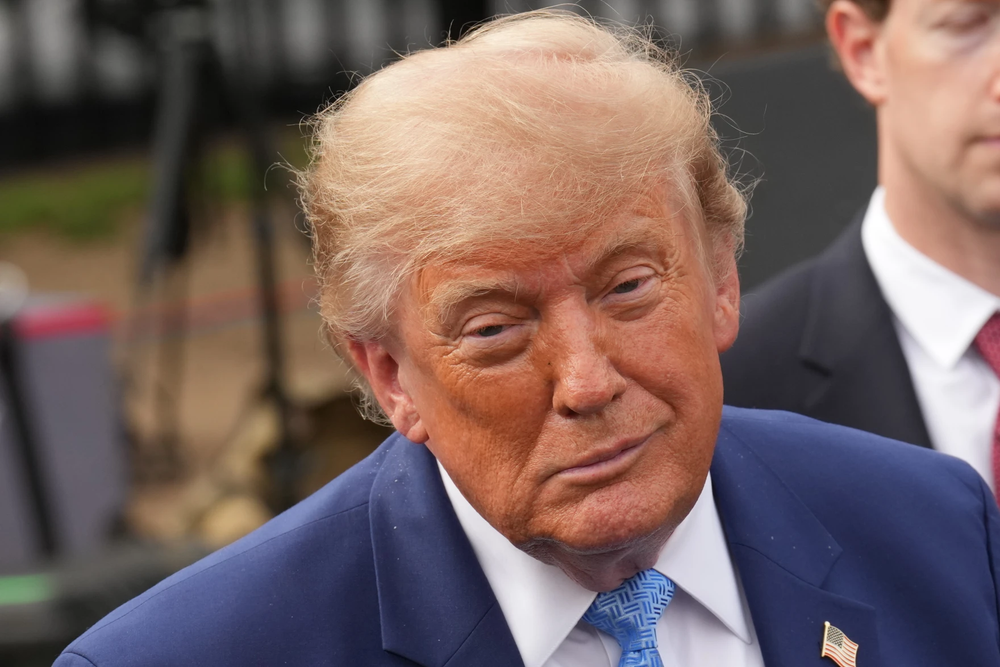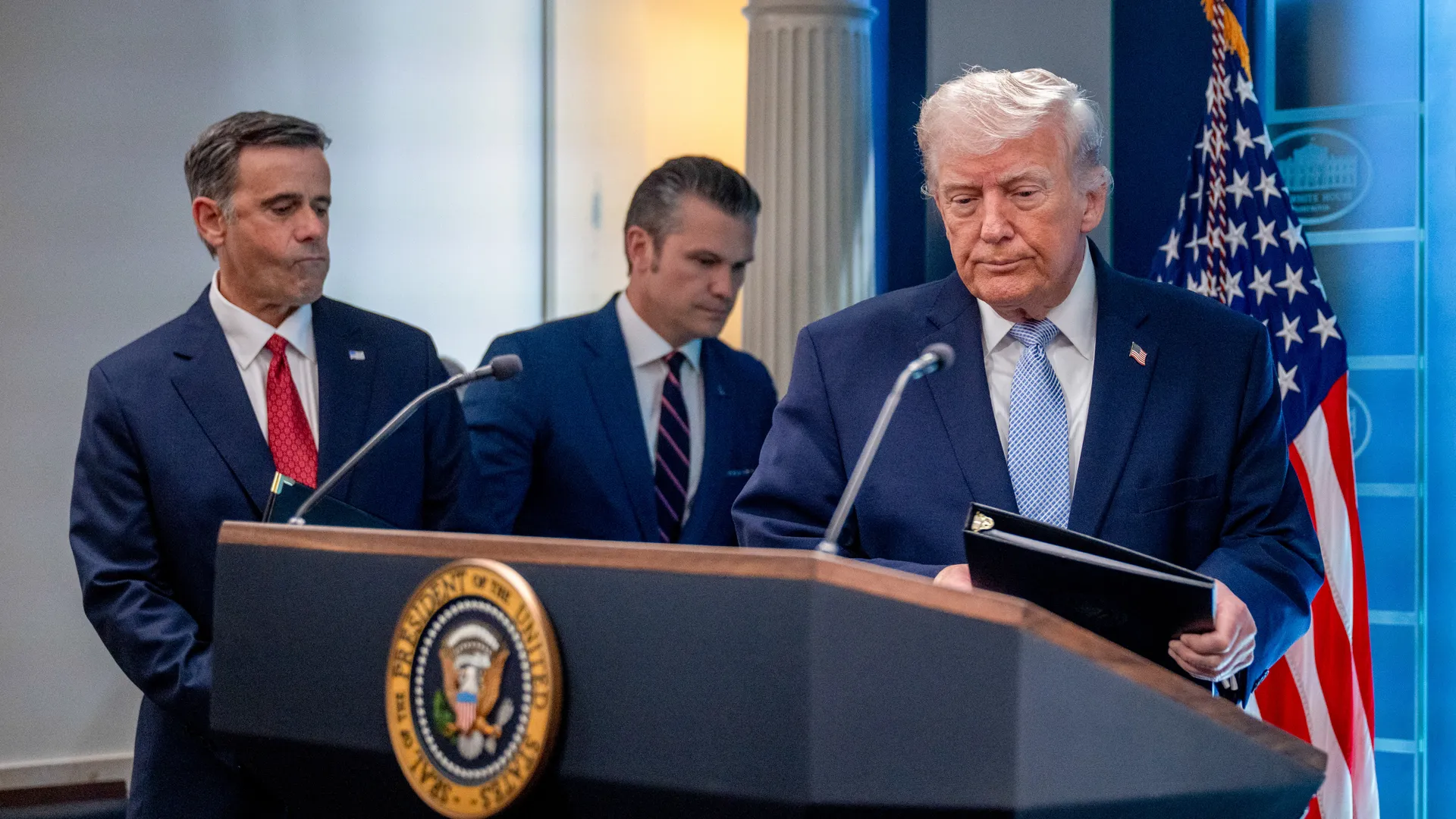
President Donald Trump convened his top national security advisers at the White House on Friday morning to weigh a return to military strikes against Iran, as a six-week-old ceasefire teeters and back-channel negotiations stall.
Vice President JD Vance, Defense Secretary Pete Hegseth, CIA Director John Ratcliffe, and White House Chief of Staff Susie Wiles were among those in the meeting, two U.S. officials told Axios. Secretary of State Marco Rubio, who was in Sweden for a NATO foreign ministers' gathering, and Joint Chiefs Chairman Gen. Dan Caine, who was at the Naval Academy graduation ceremony in Annapolis, did not attend. Trump was briefed on the state of negotiations and the scenarios available to him should the talks collapse.
People who have spoken directly with the president said he is seriously considering launching new strikes against Iran barring a last-minute breakthrough. One source close to the president said Trump has floated the idea of a single "decisive" major operation that he could then frame as a final victory and use to wind down the war. The same sources said no formal decision has been made.
A source close to Trump and a second source with knowledge of the situation said the president had grown increasingly frustrated with the pace of negotiations over recent days. On Tuesday, Trump told Israeli Prime Minister Benjamin Netanyahu he wanted to give diplomacy another chance; by Thursday night, he was leaning toward ordering a strike. Earlier this week, the president said he had been "an hour away" from launching a blitz on Tuesday before pulling back.
Schedule Changes Signal Seriousness
Several hours after the Friday meeting, the White House announced a change to Trump's weekend schedule. Following a planned speech in New York on Friday evening, the president will return to Washington rather than head to his Bedminster Golf Club.
Trump also wrote on Truth Social that he would not attend the wedding of his son Donald Trump Jr. this weekend, citing "circumstances pertaining to Government, and my love for the United States of America." He added: "I feel it is important for me to remain in Washington, D.C., at the White House during this important period of time."
Late Mediation From Pakistan and Qatar
The Friday meeting at the White House unfolded as Pakistan's army chief, Field Marshal Asim Munir, arrived in Tehran in what officials described as an eleventh-hour push to keep the ceasefire intact. Munir is expected to meet Saturday with Gen. Ahmad Vahidi, the commander of Iran's Islamic Revolutionary Guard Corps and a key figure in the Iranian decision-making chain. A Qatari delegation also arrived in Tehran on Friday to support the mediation effort.
Pakistan has been the official mediator throughout the conflict, having hosted the only direct U.S.-Iran negotiations in April. Iranian Interior Minister Eskandar Momeni welcomed Munir alongside Pakistani Interior Minister Mohsin Naqvi, who himself made two trips to Iran in the past week and met with President Masoud Pezeshkian and Foreign Minister Abbas Araghchi.
A U.S. official briefed on the talks called them "agonizing," with drafts moving "back and forth every day" but little visible progress. Iranian Foreign Ministry spokesman Esmaeil Baqaei said the disagreements between the two sides were "deep and extensive" and that Munir's arrival did not mean "we have reached a turning point or a decisive situation." A source close to the Iranian negotiating team told the semi-official Tasnim news agency that "talks over disputed issues are still ongoing and no final result has yet been achieved."
Rubio, speaking in Sweden, said Trump's "disappointment" with NATO allies over what he described as a lack of support for the U.S. campaign would need to be "addressed." He told European counterparts they may need a "Plan B" to force open the Strait of Hormuz if the war drags on. The European Union moved Friday toward fresh sanctions on Iranian officials responsible for blocking the strait.
The Uranium Question
The status of Iran's enriched uranium remains the central sticking point. Iran is believed to possess roughly 900 to 1,000 pounds of near-weapons-grade material, much of which Trump has said is buried beneath rubble from last year's joint U.S.-Israeli airstrikes on Tehran's nuclear facilities. Trump envoy Steve Witkoff has said Iranian negotiators boasted before the war that the stockpile was enough for 11 nuclear bombs.
"We will get it. We don't need it. We don't want it," Trump told reporters at the White House on Thursday. "We'll probably destroy it after we get it, but we're not going to let them have it." He did not specify how the material would be removed or destroyed.
Iran's supreme leader, Mojtaba Khamenei, has reportedly issued a directive that the country's near-weapons-grade uranium cannot be sent abroad, according to two senior Iranian officials. Tehran maintains it has the right to enrich uranium for peaceful purposes. Vance said earlier this week that any agreement would also need to lock in Iran's commitment not to revive the program in the future. Russia has offered to take possession of the material as a face-saving exit for Tehran, but Iranian negotiators have not raised that proposal in formal talks, Vance said.
Blockade Holds as Hormuz Stays Closed
The blockade and counter-blockade at the two ends of the Strait of Hormuz, which once carried about 20 percent of the world's oil, remain in place. Iran has effectively closed the strait to all ships except its own since the war began on February 28, while the United States has been intercepting Iran-linked shipping in the Gulf of Oman.
U.S. Central Command said this week it has redirected or disabled more than 100 ships since the blockade began. Earlier in the week, the U.S. military boarded the Iranian-flagged oil tanker M/T Celestial Sea in the Gulf of Oman — the fifth commercial vessel boarded under the operation — and turned it back from an Iranian port.
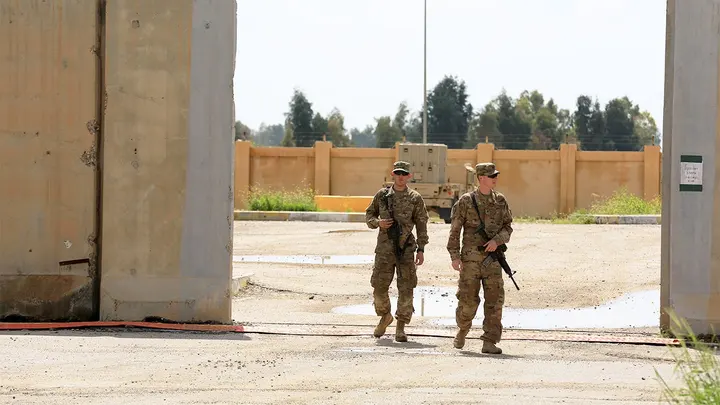
The ceasefire has otherwise mostly held, though attacks on shipping and on Gulf states spiked in early May after Trump briefly announced a naval mission to reopen the strait before calling it off. This week saw a new volley of drones launched at Saudi Arabia and the United Arab Emirates from Iraq, where Iran-allied militia groups operate. Jordan reported shooting down a drone on May 20.
The Islamic Revolutionary Guard Corps warned on May 20 that any new U.S.-Israeli strikes would expand the conflict. "The regional war that was promised will this time be extended beyond the region," the IRGC said in a statement carried by the semi-official Mehr News agency, "and our crushing blows will bring you to ruin in places you cannot imagine."
Author

We cover the world’s chaos so you don’t have to scroll twelve feeds to understand it.
Sign up for Atlas newsletters.
Stay up to date with curated collection of our top stories.