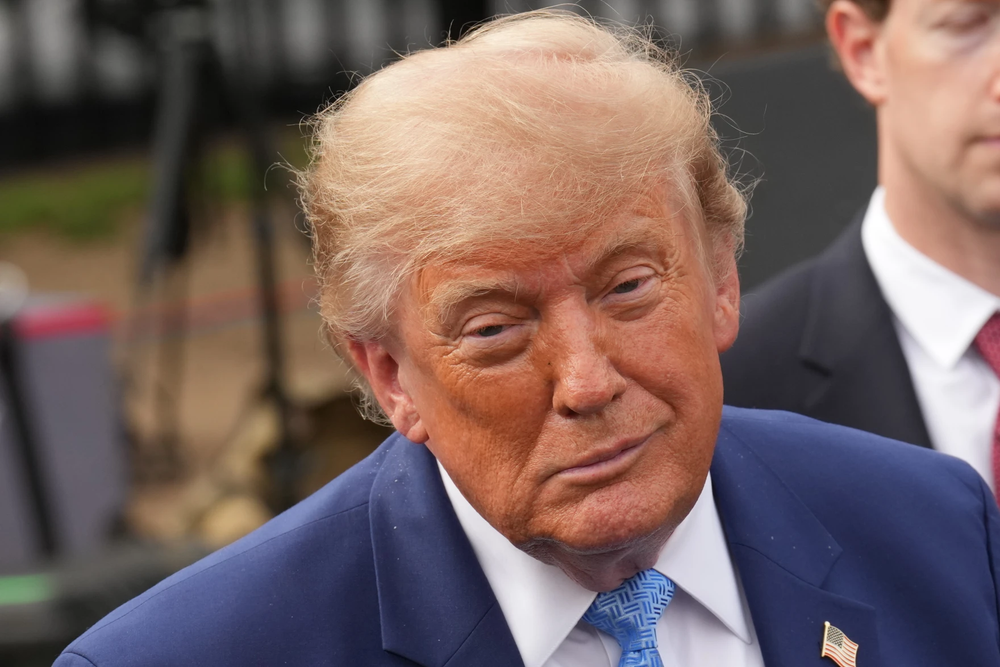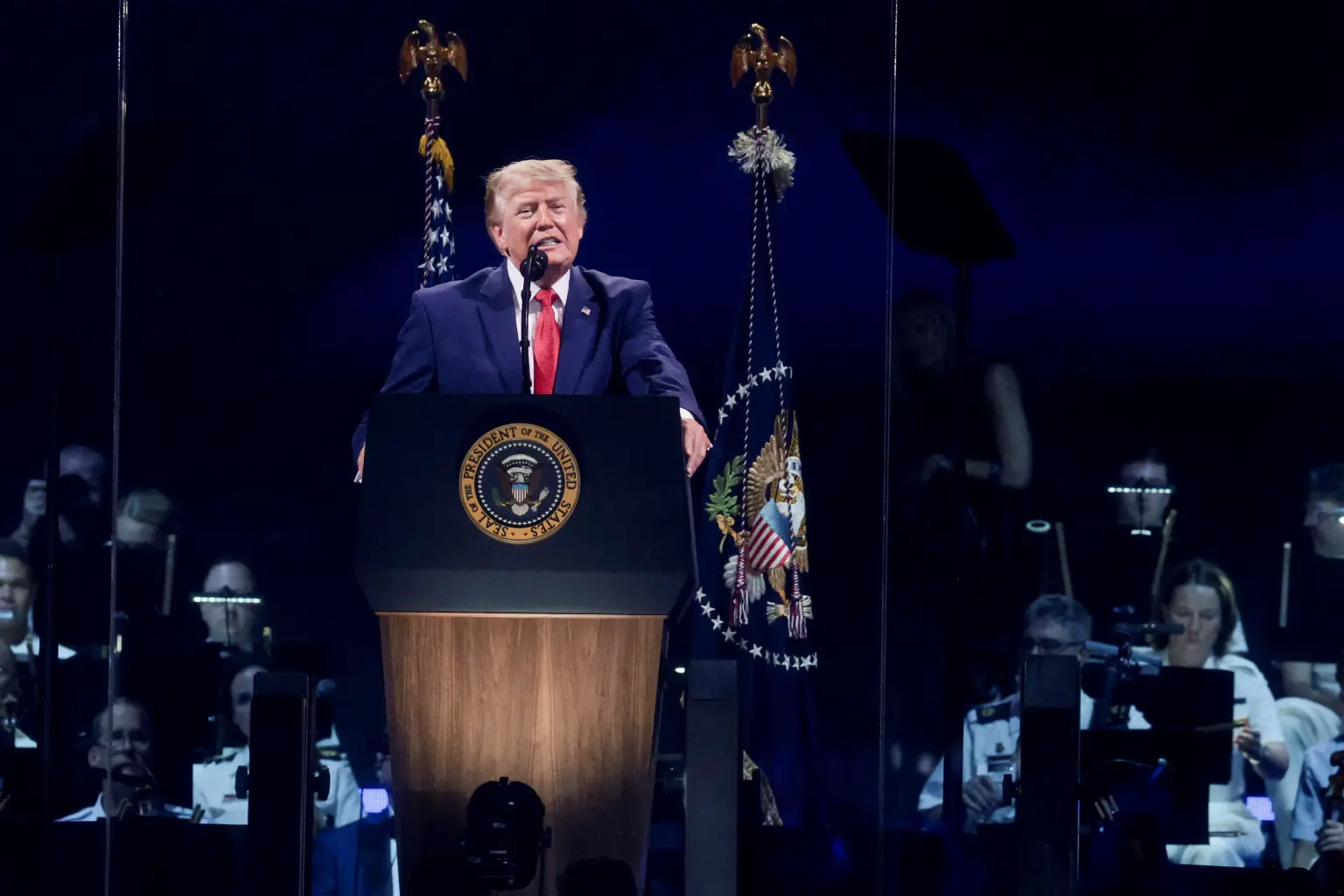
President Trump closed out the nation's 250th Independence Day on Saturday night with a speech on the National Mall that mixed a sweeping tour of American history with sharp warnings about what he called a communist threat rising at home. Delayed nearly two hours by thunderstorms that forced tens of thousands to evacuate, the address ran about 45 minutes and ended just before midnight, capped by a fireworks display the White House billed as the largest in the country's history.
Speaking to a crowd he put at more than 150,000, Trump called the United States "the crowning achievement of human history" and declared the anniversary "only the dawn of the golden age of America." But woven through the patriotic set pieces was a pointed political message aimed squarely at the left, weeks before November's midterm elections.
The Communism Message
The central theme, one Trump has hammered repeatedly in recent days, was communism. "Our warriors did not fight communism on battlefields across the world, only to have that menace rear its ugly head right back here in America," he told the crowd. "We're not going to let it happen." He likened the ideology to a disease: "It's like a cancer, you got to cut it out, you got to cut it out fast."
He returned to the theme several times, vowing that "America will never be a communist country" and calling communism "a loser" that "never worked, and it never will work." At one point, after telling the audience that Americans are "all created in the image of God," he added that communists would never say such a thing.
The rhetoric was not new. A day earlier, at Mount Rushmore, Trump had called communism "a mortal threat to American liberty" and "the greatest threat to our country," comparing it to Pearl Harbor and the September 11 attacks. He has also repeatedly referred to the Democratic Party as the "Communist Party." While he did not name specific opponents on Saturday, the remarks followed a string of primary victories by candidates backed by the Democratic Socialists of America in New York, Colorado, and Texas. Vice President JD Vance struck a similar note at a naval review in New York, criticizing democratic socialism, in what observers read as a coordinated effort to frame the midterms around an ideological divide.
Analysts noted that democratic socialism, which works within democratic and market structures to expand the welfare state, is distinct from communism, but that the administration has sought to blur the two under a single label. The Hill described the strategy as casting far-left candidates as the core of the Democratic Party and a threat to the country.
Military Boasts and Policy Pitches
Trump also used the address to tout recent military actions, folding them into a list of historic American victories. "You look at Venezuela, you look at Iran, we wiped it out, wiped out their military," he said. He compared the sinking of a Spanish fleet at Manila Bay to this year's campaign against Iran, claiming the United States had sent "the entire Iranian navy, 159 ships to the bottom of the sea, all done in just a moment's time."
The war with Iran, launched jointly by the United States and Israel in February, has driven up energy prices and remains a live concern for voters. Trump touched on it only briefly at Mount Rushmore, saying Tehran was "dying to settle" and that Washington had granted "a week off for a funeral because we're nice," a reference to the days-long state funeral for the late Iranian Supreme Leader Ali Khamenei, killed on the first day of the war.
On domestic policy, Trump repeatedly pressed Congress to pass the stalled SAVE America Act, which would require proof of citizenship to register to vote and photo identification at the polls, and would curtail mail-in voting. "We want to keep America great, and we will do so by approving the SAVE America Act," he said. "You won't have cheating on the elections anymore." The bill has repeatedly failed to clear Congress.
Patriotism and Tribute
Much of the speech was devoted to celebrating American history and honoring those who served. The stage featured historic flags marking key moments, from a 1777 banner to the Iwo Jima landing and a checkpoint at the Berlin Wall. Trump recognized Medal of Honor recipients, including retired Colonel Paris Davis, one of the first Black officers to lead a Special Forces team in combat in Vietnam, and paid tribute to William Harvey Carney, who escaped slavery to fight for the Union and became the first Black man awarded the Medal of Honor.
The astronauts of the Artemis II mission appeared on stage, and Trump saluted veterans of World War II, Korea, and Vietnam, casting the latter two conflicts as battles against communism. He closed on an optimistic note, telling the crowd that at 250 years, the country "may be the oldest constitutional republic on earth, but our country is just getting started, because the best is yet to come."
Weather, Politics, and a Divided Backdrop
The evening was shaped as much by the elements as by the message. Temperatures in Washington reached a record 103 degrees for July 4, and severe thunderstorms forced organizers to clear the Mall shortly after 7 p.m., sending thousands to shelter in nearby federal buildings and museums. The Secret Service temporarily halted security screening before reopening the area around 9:45 p.m. Some attendees refused to leave, and others rushed back through magnetometers chanting "U-S-A, open the gates."
Trump insisted on going forward, telling Fox News that if D-Day veterans could brave bad weather, so could he, and joking that he would have spoken at 4 a.m. if necessary. He began around 11:15 p.m., nearly two hours late. On the Mall, at least 51 people were treated for heat-related illness and 34 were taken to hospitals. The fireworks that followed launched more than 800,000 shells from ten locations over roughly 40 minutes, backlit by lightning.
The celebration underscored the country's divisions. Presidents before Trump had largely avoided in-person Fourth of July appearances on the Mall, a line he has crossed, blending official commemoration with campaign-style politics. His administration's Freedom 250 group had sidelined a bipartisan commission set up in 2016 and fenced off much of the Mall for a "Great American State Fair" featuring conservative groups and defense contractors. Several Democratic-led states declined to send delegations, and some performers withdrew. A Reuters/Ipsos poll found most Americans, including large majorities of Democrats and about half of Republicans, believed the anniversary events had become too political. Near Capitol Hill, members of the white nationalist group Patriot Front gathered; police reported no violence.
In New York, progressive Mayor Zohran Mamdani offered a counterpoint at a naturalization ceremony, praising immigrants' contributions and framing dissent as patriotism, a reminder of the competing visions on display as the country marked the milestone.
Author

We cover the world’s chaos so you don’t have to scroll twelve feeds to understand it.
Sign up for Atlas newsletters.
Stay up to date with curated collection of our top stories.