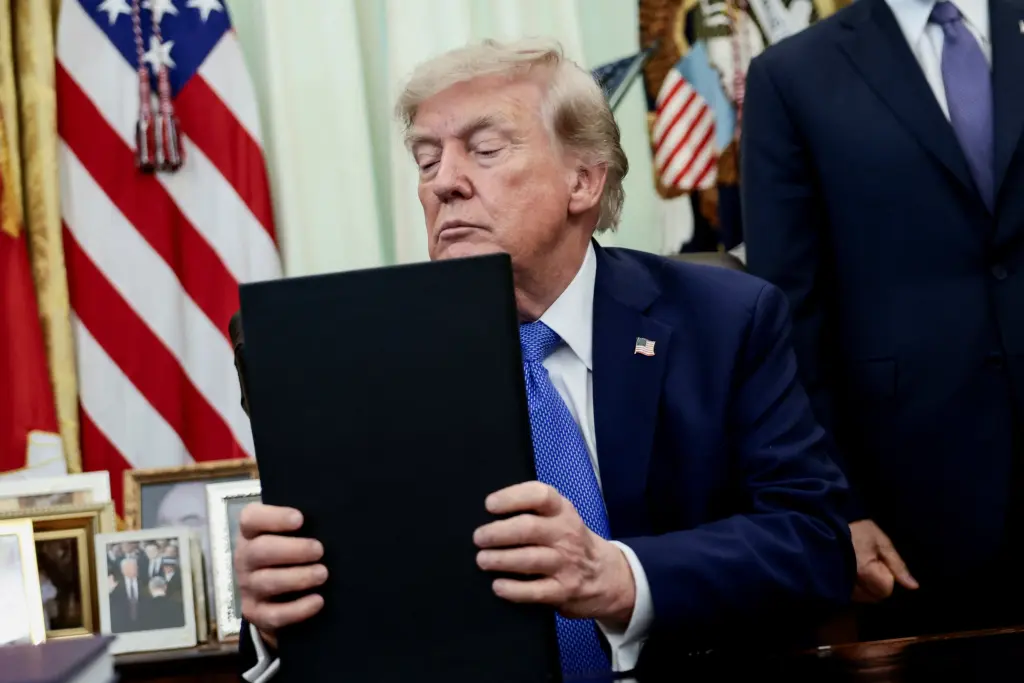
President Donald Trump signed two executive orders Thursday aimed at narrowing who qualifies for automatic US citizenship at birth and banning the practice of "birth tourism," reviving his push to restrict birthright citizenship weeks after the Supreme Court struck down his previous attempt.
"We're making adjustments because it's very unfair," Trump said during a signing ceremony in the Oval Office. "They're building businesses around birthright citizenship. That's not the way it was supposed to work. It's a disgrace. They're buying their way in, and we're not going to let it happen."
The first order expands the categories of people the administration considers ineligible for automatic citizenship, covering children born to adults with connections to foreign embassies or organizations, to anyone deemed an "alien enemy" of the United States, and to members of foreign terrorist organizations. White House deputy chief of staff Stephen Miller said it also reaches "large categories of people who lobby and act on behalf of foreign governments," along with children of parents "engaged in a commercial transaction to purchase or access birthright citizenship" or who "engaged in fraudulent activity to obtain citizenship" — language that extends to cases in which a foreign parent engages a US surrogate.
The second order, Miller said, was issued "for the first time ever in American history to ban birth tourism." Citing Section 215(a) of the Immigration and Nationality Act, he said the administration will deny visas to people seeking to enter the country "to have a child, to make that child an automatic citizen," as well as to those who organize such trips. "Birth tourism is by definition a fraud on the American system, on the American taxpayer," he said.
The orders are not retroactive, a White House official said, and they do not affect children born to illegal immigrants or temporary visitors already in the country.
Working Around the June Ruling
The new approach is a deliberate response to the Supreme Court's decision in June, which rejected the administration's effort to deny automatic citizenship to children born to people in the US illegally or temporarily. The justices held that both categories are protected by the 14th Amendment, which grants citizenship to all children born on US soil and subject to the jurisdiction of the government, with only narrow exceptions — children of foreign diplomats, whose parents fall outside US jurisdiction, and children born to an occupying army.
The new order works within those exceptions rather than against them, expanding the pool of diplomats and foreign government employees whose children can be denied citizenship and equating foreign terrorists with an occupying force. It also purports to deny citizenship to those born in US territories such as Puerto Rico, though only if Congress passes legislation to that effect — a bill has been introduced but is not expected to advance.
"I thought we were going to win it at the Supreme Court. Unfortunately, we had a bad decision, very unfair decision," Trump said. "Our country suffers because of it and we're ending it a different way." Asked whether the new orders would survive court challenges, he replied, "I think it will."
Trump repeated his view that the 14th Amendment, ratified in 1868, was intended only for the children of newly freed slaves. "This wasn't for wealthy multi-millionaires, billionaires coming in and bringing 15, 20, 30 children along with them," he said. "It's become a big business, and we're ending that business." Chief Justice John Roberts rejected that reading in the June decision, noting that citizenship tied to place of birth dates back to English common law.
Senate Democratic leader Chuck Schumer called the new attempts "blatantly illegal." "Trump has just set himself up for yet another loss in the courts," he said. "Democrats will challenge this order, and we will win."
The Business of Birth Tourism
The scale of the targeted practice is modest relative to overall births. The Pew Research Center found that in 2023, some 245,000 children were born to immigrant mothers in the US illegally, while birth tourism — children born to women who entered on legal visas specifically to give birth — accounted for roughly 9,000 cases.
The organized industry around those cases has drawn federal prosecutions. In one Justice Department case, a "maternity house" operation in Rancho Cucamonga, California, called USA Happy Baby Inc. rented apartments to pregnant Chinese women who gave birth and returned to China a month or two later. Operators coached clients to claim tourism on their visa applications, wear loose clothing to hide pregnancies from border officers, understate how far along they were, and choose customs lines staffed by older officers thought to apply less scrutiny. The company charged VIP clients up to $100,000.
White House staff secretary Will Scharf said "criminal rings are setting up a system whereby tens, hundreds, thousands, tens of thousands of people can come to this country in an organized fashion and give birth here purely for the sake of obtaining birthright citizenship." The order, he said, combats those operations through visa denials aimed at both prospective parents and organizers, relying on "legally validated means" that do not conflict with the Supreme Court's ruling. Acting Attorney General Todd Blanche has separately directed the Justice Department to investigate and prosecute birth tourism outfits it can identify.
Enforcement remains the open question. Miller described the targets as those "pretending to be a tourist, pretending to be a visitor, saying they want to go to Disneyland or they want to go visit a monument," when "the real reason they're here is to have a child." But distinguishing intent among pregnant travelers has proven difficult in practice: the first Trump administration issued guidance directing immigration officers to identify and deny such cases, and thousands still entered.
A Broader Vetting Push
The orders arrived alongside a reported expansion of social media vetting for visa applicants. An internal State Department memo outlines plans to require applicants for additional visa categories — including foreign media representatives and some nationals of Mexico and Canada — to set their social media accounts to public, extending a requirement already applied to student visa applicants.
A State Department spokesperson said the department "is constantly reviewing and evaluating screening and vetting procedures worldwide," adding that online presence vetting is "about applicants demonstrating their eligibility to receive a visa under US law." The administration last month finalized rules limiting foreign students to the length of their academic programs up to four years and capping foreign journalists' stays at 240 days, with extensions available.
Legal challenges to Thursday's orders are considered all but certain, and the dispute appears headed back toward the same court that ruled against the administration in June. Whether the narrower drafting — built around the 14th Amendment's recognized exceptions rather than a frontal challenge to its scope — fares differently will determine if the president has found the workaround he described, or teed up another defeat.
Author

We cover the world’s chaos so you don’t have to scroll twelve feeds to understand it.
Sign up for Atlas newsletters.
Stay up to date with curated collection of our top stories.