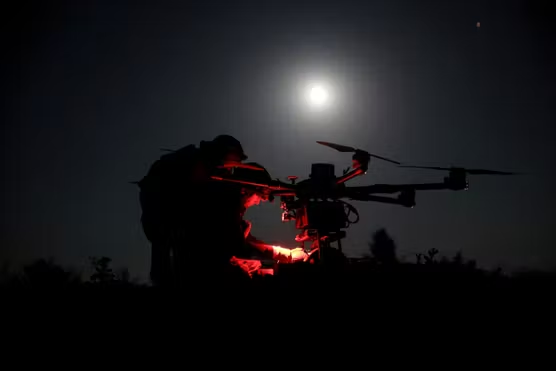
Ukraine launched nearly 600 drones at Russia overnight Saturday into Sunday, in what both sides described as the largest such barrage of the war to date. The strikes killed at least four people, damaged residential buildings in and around Moscow, and hit oil infrastructure and a weapons-related plant in the Russian capital region.
Russia's Defense Ministry said air defenses shot down 556 drones overnight, with another 30 intercepted after sunrise. By midday Sunday, the ministry reported that more than 1,000 drones had been downed or jammed across the country in the previous 24 hours. The interceptions, which usually number in the dozens, were spread across 14 Russian regions, as well as annexed Crimea and the Black and Azov seas.
Moscow itself was hit harder than at any point in more than a year. Mayor Sergei Sobyanin said 81 drones were destroyed on approach to the capital. Drone debris fell on the grounds of Sheremetyevo, Russia's largest airport, without causing damage or affecting flights.
"Our responses to Russia's prolongation of the war and its attacks on our cities and communities are entirely justified," Ukrainian President Volodymyr Zelensky said on X. He noted that the drones had flown more than 500 kilometers — roughly 310 miles — from Ukrainian territory through some of the densest air-defense coverage in the country. "We are clearly telling the Russians: their state must end its war."
Casualties in and Around the Capital
Three of the four deaths were recorded in the Moscow region, according to Governor Andrei Vorobyov. A woman was killed when a drone struck her home in Khimki, northwest of the capital; rescue workers later searched the rubble for another person trapped underneath. Two men were killed in the village of Pogorelki, in the Mytishchi district about six miles north of Moscow, when a drone hit a house under construction.
The Indian Embassy in Moscow said one of the victims was an Indian citizen working in Russia and that three other Indian nationals were hospitalized with injuries.
A fourth person was killed in the Belgorod region, on Russia's border with Ukraine. Local officials said a drone struck a truck in the Shebekino district.
At least 12 people were wounded inside the city of Moscow, mostly construction workers at a site near the entrance to the Moscow Oil Refinery, Sobyanin said. Four more people were injured in Dedovsk, northwest of the capital, when a drone hit an apartment building. Three residential high-rises in central Moscow were damaged. "The hit was so powerful that it almost knocked me out of bed, and I weigh a lot," Konstantin, a 39-year-old resident of the Putilkovo neighborhood outside Moscow, told a reporter. "I opened my window and saw smoke rising."
Oil, Microchips, and the Moscow Refinery
Ukraine's General Staff and Defense Ministry confirmed several of the targets after the fact. The list included the Moscow Oil Refinery, the Solnechnogorsk oil depot, and what officials described as "several microelectronics manufacturing facilities" — the first time those plants have been struck during the war.
A plant in the Moscow region producing components for high-precision weapons and microchips was also hit, the General Staff said. A separate strike took out a command post overseeing Russian drone operations in Russian-occupied Donetsk.
Sobyanin said production at the Moscow refinery was not interrupted. Independent verification of the broader damage is not possible.
"The war is returning to where it came from," Ukraine's Defense Ministry said on social media. Robert Brovdi, who commands Ukraine's Unmanned Forces, said before the strike that Kyiv's priority "remains the consistent build-up in the use of long-range strike capabilities to the fullest extent possible against a wide range of military targets."
Russia's Foreign Ministry called the operation a "mass terrorist attack." Spokeswoman Maria Zakharova, quoted by TASS, said: "To the sound of Eurovision songs, the Kyiv regime, financed by the EU, carried out yet another mass terrorist attack." Both sides deny deliberately targeting civilians.
Retaliation for Kyiv
The barrage came three days after a Russian drone and missile attack on Kyiv killed 24 people and injured around 50, when an apartment complex in the Ukrainian capital was struck. Zelensky had promised retribution on Friday.
It also followed the expiration of a U.S.-brokered three-day truce that both sides had used to mark the May 9 anniversary of the Soviet defeat of Nazi Germany. Each accused the other of breaking the pause.
Nigel Gould-Davies, a senior fellow for Russia and Eurasia at the International Institute for Strategic Studies in London, said the operation read as "the retaliation or revenge that President Zelenskyy promised." It demonstrated, he said, that Ukraine "has the capacity to strike at very significant scale at or around the Russian capital" — a development "most unwelcome" to the Kremlin.
Russia continued to hit Ukraine over the same period. Moscow launched 287 drones at Ukraine overnight, 279 of which Ukrainian air defenses shot down or jammed. Eight people were wounded in the central Dnipropetrovsk region, including in Dnipro and in Kryvyi Rih, Zelensky's hometown.
A Stalled Process, Deeper Strikes
Diplomatic efforts to end the war remain frozen. Kyiv continues to reject Moscow's demand to cede territory in the eastern Donbas. Talks pushed by the United States have slowed since Washington's focus shifted in late February to the U.S.-Israeli war with Iran.
Ukraine has used that lull to widen its long-range campaign against Russian oil infrastructure and military production. The targets are designed to dent the oil revenue that funds the war and, increasingly, the supply chain that produces Russian missiles and drones. The economic effect has been muted in part because higher oil prices tied to the Iran war, along with some easing of U.S. sanctions, have helped offset the lost production.
Gould-Davies said the latest strikes are unlikely to change Russia's negotiating posture. "I see no prospect, in the shorter term, that even these factors together will induce Russia to consider the compromises that will be necessary for peace negotiations," he said. What the strikes do, he added, is "intensify the mix of concerns" already weighing on the Kremlin: battlefield setbacks, economic strain, and a wider crackdown on the Russian internet.
Author

We cover the world’s chaos so you don’t have to scroll twelve feeds to understand it.
Sign up for Atlas newsletters.
Stay up to date with curated collection of our top stories.