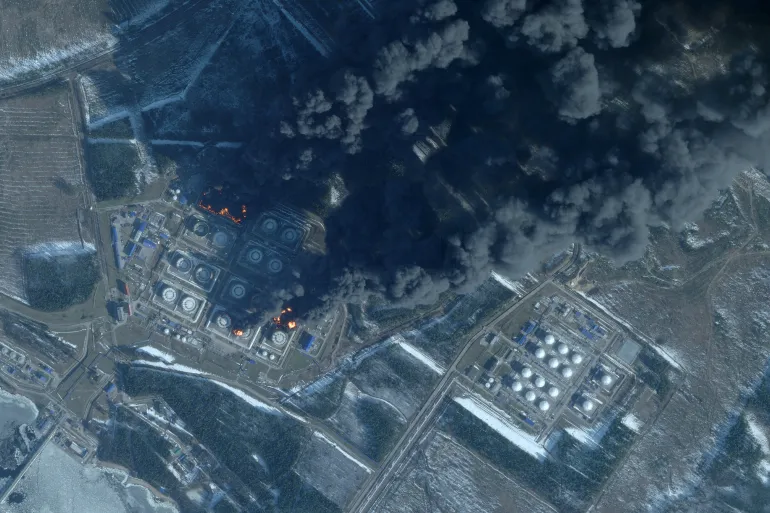
Ukrainian drones struck the Baltic Sea oil terminal at Primorsk overnight into Sunday, sparking a fire at one of Russia's largest export gateways and damaging a Karakurt-class missile corvette, a patrol boat, and an oil tanker tied to Moscow's so-called shadow fleet. Hours earlier, two more shadow fleet tankers were hit at the entrance to the Black Sea port of Novorossiysk, in what Kyiv described as a coordinated escalation of its long-range campaign against Russian energy and naval assets.
President Volodymyr Zelensky confirmed the strikes in a series of Telegram posts, citing Major General Yevhen Khmara on the Primorsk operation and General Andrii Hnatov, chief of Ukraine's General Staff, on the Novorossiysk strikes. The Security Service of Ukraine and the Navy were involved in the Black Sea operation. "These tankers were actively used to transport oil. Now they won't be," Zelensky wrote.
Alexander Drozdenko, the governor of Russia's Leningrad region, said more than 60 drones were shot down overnight in his region. He confirmed the fire at Primorsk had been put out and said no oil spill had been recorded, though he gave no immediate detail on casualties or damage. Russian Defense Ministry figures put the night's total at 334 Ukrainian drones intercepted over Russia and occupied Crimea. Ukrainian forces, in turn, downed or repelled 249 of the 269 drones and one ballistic missile that Russia launched at Ukraine in the same window.
Why Primorsk matters
Primorsk is operated by state pipeline monopoly Transneft and can move up to one million barrels of oil a day. It sits between the Russian-Finnish border and St. Petersburg, more than 1,000 kilometers — about 620 miles — from the closest Ukrainian-held territory. Together with neighboring Ust-Luga, it accounts for roughly 40 percent of Russia's seaborne crude exports.
The terminal has been hit before, including multiple times in March, but Sunday's strike landed harder than most. Independent Russian outlet Astra, citing satellite imagery, said the terminal and a Pantsir air-defense system were both likely struck. Among the assets reported destroyed was what Khmara identified as a Russian Kalibr cruise missile carrier — a meaningful loss, if confirmed, given that Kalibrs have been the backbone of Russian standoff strikes against Ukrainian cities from Baltic waters.
Zelensky has been blunt about the logic. "Russia can end its war at any moment," he wrote Sunday. "Prolonging the war will only expand the scale of our defensive operations." Kyiv's argument, reiterated for months, is that oil revenue funds the invasion, and that hitting the export infrastructure is therefore a direct strike on the war itself.
The shadow fleet comes under fire
The three tankers Ukraine claims to have struck — one at Primorsk, two at Novorossiysk — were identified as part of Russia's shadow fleet, the network of aging vessels Moscow has stitched together since 2022 to move sanctioned oil around the world. The fleet relies on shell companies, frequently switched flags, and disabled tracking transponders to keep ownership and routing opaque.
Zelensky posted night-vision footage purporting to show a naval drone closing on one of the tankers near Novorossiysk. Moscow did not publicly acknowledge either strike.
Novorossiysk has grown in importance to the Russian Navy as Ukrainian attacks on occupied Crimea have forced the Black Sea Fleet to relocate. The port now serves as both a primary energy export node and a working naval hub, which is partly why a strike at its mouth carries weight beyond the loss of two ships.
European pressure on the same network has been building in parallel. Sweden's Coast Guard detained a suspected shadow fleet tanker in the Baltic on Saturday — its fifth such intervention in recent months — and European authorities continue to probe suspected sabotage of undersea cables involving vessels in the same orbit.
Civilians killed on both sides
The night's exchanges produced confirmed civilian deaths in both countries.
In Russia's Belgorod region, Governor Vyacheslav Gladkov said a drone struck a car and killed a 21-year-old man and his father on the spot. Moscow regional Governor Andrei Vorobyov reported that a 77-year-old man was killed near the town of Volokolamsk, roughly 75 miles west of the capital, and that six drones were downed across the region. Mayor Sergei Sobyanin said at least five more were shot down on the approach to Moscow itself. In the western Smolensk region, three people including a child were injured when drone debris fell on an apartment block, Governor Vasily Anokhin said.
In Ukraine, two people were killed and three wounded in the southern Odesa region, where Russian drones damaged three residential buildings and port infrastructure. Six were wounded in the central Dnipropetrovsk region. A passenger bus carrying 40 children was damaged, but no one on board was hurt. One person was killed in the frontline Kherson region, and another in a strike on Dnipro, where photographs showed the roof of a five-story apartment block torn open and the top-floor units partially collapsed.
The combined civilian death toll from the weekend's strikes reached at least eight, the heavier share falling on Ukrainian cities — a familiar pattern after nearly four years of full-scale war.
Moscow's response, and what comes next
The Kremlin's public reaction was conspicuously unbothered. Spokesman Dmitry Peskov told Russian state television that continued Ukrainian strikes on Russian energy infrastructure might actually push prices up enough to offset the volume losses.
"If additional volumes of our oil are dropped from the market, prices will rise further from current levels, which are already above $120 a barrel," Peskov said. "That would mean that even with lower export volumes, our companies would earn more money and the state would receive more revenue."
That math is being shaped less by Ukraine's drones than by the U.S.-Iran war and the effective closure of the Strait of Hormuz, which has sent benchmark crude to four-year highs. Russian oil has become more valuable per barrel even as the physical export side comes under new pressure — a backdrop that complicates Kyiv's theory of attrition through energy strikes, even as the strikes themselves grow more ambitious.
The picture on the ground is also less favorable to Ukraine. Kyiv's top army officer said Saturday that Russian forces were inching toward Kostiantynivka in eastern Donetsk. The trajectory of the front, where Russia is grinding forward, sits awkwardly alongside the long-range successes Ukraine keeps stacking up at sea and against Russian infrastructure.
That gap — slow Russian gains on the ground, expanding Ukrainian reach against Russian assets at depth — has come to define Kyiv's strategy. With U.S.-mediated peace talks stalled and Washington's attention pulled toward the Middle East, Ukrainian officials have signaled that long-range strikes are now central to whatever leverage they can still bring to bear.
"Ukraine's long-range capabilities will continue to be developed comprehensively — at sea, in the air, and on land," Zelensky wrote Sunday. Three tankers, an oil terminal, a missile corvette, and a patrol boat in a single 24-hour window were, for now, the clearest demonstration of what he meant.
Author

We cover the world’s chaos so you don’t have to scroll twelve feeds to understand it.
Sign up for Atlas newsletters.
Stay up to date with curated collection of our top stories.