Guyana opened a week of oral hearings at the International Court of Justice in The Hague on Monday, asking the United Nations' top judicial body to confirm that an 1899 arbitral award establishing the boundary with Venezuela remains legally valid — and to put to rest a dispute over a 62,000-square-mile stretch of territory known as the Essequibo that has shadowed Georgetown since independence.
Foreign Minister Hugh Hilton Todd, leading Guyana's delegation, told the panel of fifteen judges in the Great Hall of Justice that the case has "an existential quality" for his country and that Venezuela's claim threatens more than 70 percent of Guyana's sovereign territory. "This has been a blight on our existence as a sovereign state from the very beginning," Todd said, calling the case "as straightforward as it is consequential."
Venezuela's foreign minister, Yván Gil, attending the hearings, told state television upon leaving the court that Caracas does not recognize the ICJ's jurisdiction and that any resolution will have to come through bilateral negotiation. "The only path, we repeat, is direct negotiation, and sooner or later Guyana is obliged to sit down and negotiate with us," Gil said. Venezuela is scheduled to present its arguments Wednesday, with Guyana to return on Friday and Venezuela delivering closing arguments on May 11.
The territory and what is at stake
The Essequibo region runs west of the river of the same name and makes up roughly two-thirds of modern-day Guyana. It is mostly jungle, but it sits on top of substantial mineral wealth — gold, diamonds, bauxite, and timber — and lies adjacent to one of the most consequential oil discoveries of the past decade.
The offshore Stabroek Block, where ExxonMobil leads production, is estimated to hold more than 11 billion barrels of recoverable oil. Guyana now produces roughly 750,000 barrels per day, and that output has driven extraordinary GDP growth — 63 percent in 2022 and 43 percent in 2024 — turning what was, two decades ago, one of South America's smallest economies into one of its fastest-expanding.
Todd told the court that the prospect of dismemberment was not abstract. "It is tragic even to think about having our country dismembered by stripping from us a vast majority of our land, together with its people, its history, its trade, and its customs," he said. He also pointed to what he described as a recent expansion of Venezuelan military activity along the border — new bases, new airfields, and the deployment of aircraft, heavy weapons, and troops — as evidence that Venezuela's intentions had moved beyond rhetorical claims.
The 1899 award and how the dispute got here
The boundary at the center of the case was drawn by a five-member tribunal of British, American, and Russian arbitrators in October 1899, under the terms of the 1897 Treaty of Washington. The arbitration followed years of escalating tension over British colonial expansion westward and was, at the time, a Venezuelan initiative — pushed by Caracas with U.S. backing against a British government that had for decades resisted submitting the dispute to outside adjudication.
The tribunal's unanimous award placed most of the disputed territory inside what was then British Guiana. A 1905 boundary agreement between Britain and Venezuela faithfully implemented the line, and Venezuela accepted and complied with the award for more than sixty years. It was not until 1962, on the eve of Guyana's independence, that Caracas formally challenged the validity of the award, alleging collusion among the British and Russian arbitrators.
That reversal led to the 1966 Geneva Agreement, signed by Britain, Venezuela, and the soon-to-be-independent Guyana. The agreement did not redraw the border. It established a process for seeking a peaceful settlement, and after decades of unproductive bilateral talks and U.N.-led mediation, the U.N. Secretary-General referred the matter to the ICJ in 2018.
Paul Reichler, one of Guyana's lead counsel, walked the court through that history Monday. He told the judges that Venezuela's current arguments — that the Treaty of Washington was tainted by fraud, or that the United States colluded with Britain at Venezuela's expense — were "illogical, counter-factual and baseless." He cited an April 1897 speech by Venezuelan President Joaquín Crespo praising the treaty and thanking the United States for the role it had played in negotiating it. "None of these facts, none of them are or can legitimately be disputed," Reichler said, quoting Crespo.
Pierre d'Argent, also on Guyana's team, told the judges that Venezuela was recycling claims the court had already disposed of. "These arguments are not new in any way and have already been rejected by the Court," he said. Alain Pellet, another Guyanese counsel, urged judges to evaluate the arbitration "in the light of the law contemporary with it" — by the standards of the late nineteenth century rather than modern expectations about reasoning or transparency.
Provisional measures, a referendum, and a captured president
The ICJ has already ruled twice on threshold questions. In December 2020, it confirmed it had jurisdiction. In April 2023, it rejected Venezuela's preliminary objection to admissibility. The current hearings address the merits.
The court has also intervened twice in the political situation on the ground. In December 2023, after Venezuela's government held a referendum claiming 98 percent public support for asserting sovereignty over the Essequibo, the ICJ ordered Caracas to refrain from any action that would alter Guyana's administration of the territory. Venezuela proceeded anyway. In April 2024, then-President Nicolás Maduro signed an "Organic Law in Defense of Guayana Esequiba," purporting to incorporate the region into Venezuela and to create administrative bodies for oil and mineral exploitation. In May 2025, after Venezuela announced plans to elect a governor and legislature for the region, the court issued a second provisional measures order prohibiting that vote.
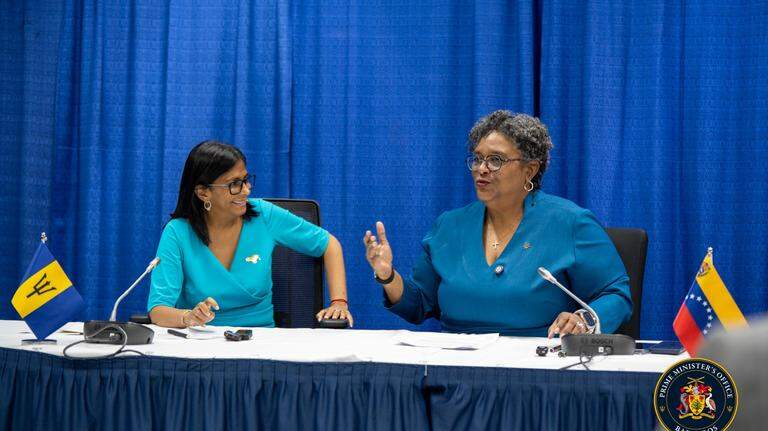
Venezuela's posture toward the court was abruptly disrupted by an unrelated event. In January, Maduro and his wife were captured in a U.S. military operation in Caracas. The interim government that took power, led by acting President Delcy Rodríguez, has continued the territorial claim. Rodríguez has worn a brooch in the shape of the Essequibo region during state visits to Grenada and Barbados — appearances that prompted a formal complaint from Guyanese President Irfaan Ali to the chairman of the Caribbean Community. Ali called the gesture "a calculated and provocative assertion of a claim that Guyana has consistently and lawfully rejected." CARICOM cautioned member states against allowing diplomatic engagements within the bloc to legitimize claims pending before the court.
What a ruling will and will not do
A final judgment is months away — probably late 2026 or early 2027. ICJ rulings are binding and not subject to appeal, but the court has no enforcement mechanism of its own. Compliance, where it cannot be secured politically, falls ultimately to the U.N. Security Council.
That gap between authority and enforcement matters here. Rodríguez stated last August that Venezuela would ignore the court's final ruling, and the interim government's actions since January suggest little appetite for retreat from the territorial claim. Caracas's position remains that the 1966 Geneva Agreement requires bilateral negotiation and that the ICJ has no standing to settle the matter.
International support has lined up firmly behind Guyana. CARICOM, the Commonwealth, the European Union, and the Organization of American States have publicly backed Georgetown's territorial integrity and the judicial process. Washington has gone further. Secretary of State Marco Rubio warned earlier this year that any Venezuelan move against Guyana or its offshore oil operations would be "a very bad day" for the Venezuelan government — a posture that has hardened further since the U.S. military operation that removed Maduro.
For Guyana, the calculation is straightforward: a definitive ruling from the world's highest judicial authority, even one Caracas refuses to honor, would shore up the legal position that has underwritten more than $40 billion in foreign oil investment and would make any future Venezuelan move against the territory considerably more costly diplomatically. For Venezuela, even a loss in The Hague does not extinguish a claim its political class — opposition and government alike — has treated as a non-negotiable element of national identity for more than half a century.
The hearings continue Wednesday with Venezuela's first round of arguments. Whatever the panel decides, the answer to the question that has hung over the South American continent's smallest English-speaking nation since 1962 — whether a colonial-era map drawn in The Hague still controls the border — is now, for the first time in more than 125 years, on the verge of being settled.
Author

We cover the world’s chaos so you don’t have to scroll twelve feeds to understand it.
Sign up for Atlas newsletters.
Stay up to date with curated collection of our top stories.