The World Health Organization on Sunday declared the Ebola outbreak in the Democratic Republic of Congo and Uganda a public health emergency of international concern, citing more than 300 suspected cases and 88 deaths since the first laboratory confirmation on Friday.
WHO Director-General Tedros Adhanom Ghebreyesus said the outbreak does not meet the criteria for a pandemic emergency — the level used for COVID-19 — and the agency advised against the closure of international borders. But Tedros warned that the data "all point toward a potentially much larger outbreak than what is currently being detected and reported, with significant local and regional risk of spread."
As of Sunday, 10 cases had been confirmed in a laboratory and 336 were under investigation. The Africa Centres for Disease Control and Prevention put the death toll in Congo at 88, with four of those among healthcare workers. Two cases, including one death, have been confirmed in Uganda, both involving travelers from Congo.
The outbreak is the 18th recorded in the Democratic Republic of Congo since Ebola was first identified there in 1976. The most recent previous outbreak in the country ended in December.
A Strain Without Vaccines
The current outbreak is being driven by the Bundibugyo virus, a rare orthoebolavirus that has been detected only twice before — once in Uganda's Bundibugyo district in 2007 and 2008, where it killed 37 of 149 people infected, and once in Isiro, Congo, in 2012, with 29 deaths among 57 cases.
There are no FDA-approved therapeutics or vaccines for Bundibugyo. The two licensed Ebola treatments, Inmazeb and Ebanga, work only against the Zaire strain. The Ebola Zaire vaccine is also strain-specific.
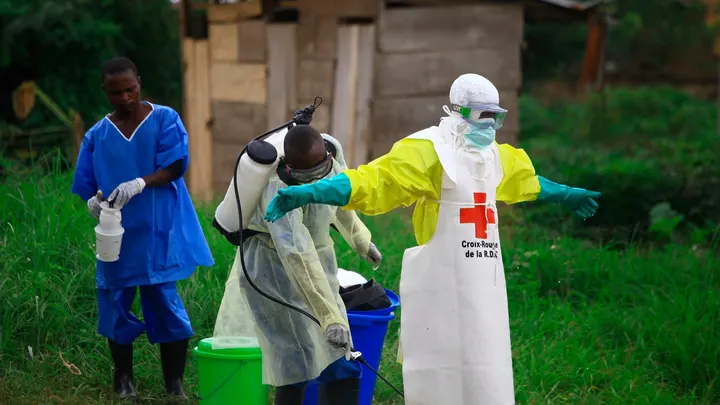
That leaves containment dependent on the older playbook: isolation of confirmed cases, contact tracing, intensive supportive care, rehydration, and safe burials. The WHO has advised that confirmed patients be released only after two consecutive negative Bundibugyo-specific tests taken at least 48 hours apart.
The disease spreads through direct contact with the blood, vomit, feces, or other bodily fluids of infected people, living or deceased. Symptoms typically appear two to 21 days after exposure and begin with fever, fatigue, aches, and sore throat before progressing to vomiting, diarrhea, and in some cases internal and external bleeding. Patients are infectious only once symptoms appear.
Past Bundibugyo outbreaks have killed roughly 30 percent of those infected. Ebola disease overall has a fatality rate of around 50 percent.
The Geography of an Expanding Outbreak
The epicenter is Ituri province in eastern Congo, on the border with Uganda and South Sudan. Three health zones in the province are affected, including Bunia, the provincial capital, and the gold-mining towns of Mongbwalu and Rwampara. Africa CDC officials say the largest concentration of active community cases is in Mongbwalu, where the first cases were reported.
Cases have already moved well beyond the province. One laboratory-confirmed case has been recorded in Kinshasa, roughly 1,000 kilometers from Ituri — a patient who had traveled to the eastern province. A second confirmed case has been reported in Goma, eastern Congo's largest city, involving the wife of a man who died of Ebola in Bunia. The Goma case is significant because the city is currently under the control of the Rwanda-backed M23 rebel group, whose 2025 offensive displaced hundreds of thousands of people.
Suspected cases have also been reported in North Kivu, one of Congo's most populous provinces. Across the border in Uganda, both confirmed cases were detected in Kampala, the capital, in patients who had traveled from Congo.
WHO officials emphasized that the index case has not been identified. The earliest known suspected patient was a 59-year-old man who developed symptoms on April 24 and died in Ituri on April 27. By the time authorities were alerted to the outbreak on May 5 — via social media — at least 50 deaths had already been recorded. Initial laboratory testing at the Congolese National Institute of Biomedical Research produced a positivity rate of eight out of 13 samples.
The WHO has airlifted five metric tons of supplies and deployed a 35-person team to Bunia.
U.S. Response and Americans Affected
The U.S. Centers for Disease Control and Prevention said it is coordinating "the safe withdrawal of a small number of Americans who are directly affected" by the outbreak. Reporting from STAT News indicates that at least six Americans in Congo have had exposure to suspected cases, several classified as high-risk, and that at least one may have begun to show symptoms.
The U.S. government has been working to move those individuals out of Congo, possibly to a U.S. military base in Germany.
"The risk to Americans is low," said Dr. Satish Pillai, the CDC's Ebola response incident manager, on a Sunday call with reporters. Pillai noted that Ebola spreads through bodily fluids, not respiratory droplets like SARS-CoV-2. He said he was unaware of any infected travelers having boarded international flights. Outbound passengers from Congo and Uganda are being screened.
The CDC, which keeps about 30 personnel at its office in Congo, is sending additional staff this week. The agency has issued a Level 2 travel notice for the country urging "enhanced precautions"; the State Department lists Ituri province as a Level 4 "do not travel" zone. For Uganda, the State Department advisory is Level 3 — "reconsider travel."
Conflict, Mining, and a Race Against Time
Public health officials say a long list of complicating factors is making containment unusually difficult. The WHO cited "ongoing insecurity, humanitarian crisis, high population mobility, the urban or semi-urban nature of the current hotspot and the large network of informal healthcare facilities" as drivers of the spread risk.
Ituri's gold-mining economy creates near-constant population movement, both within Congo and across the Ugandan border. Armed conflict with militants — including groups tied to the Islamic State — has stretched local health infrastructure thin and disrupted access for response teams. The M23 conflict in North Kivu and around Goma adds another layer of difficulty.
Regional neighbors are tightening surveillance. Rwanda's health ministry said it would strengthen screening along its border with Congo as a precautionary measure and put response teams on alert. Uganda has implemented contact tracing and screening at the hospital where the Congolese patient died, and President Yoweri Museveni said the situation is "under control."
Dr. Jean Kaseya, the head of Africa CDC, said the late detection is the central problem. "This outbreak started in April. So far, we don't know the index case. It means we don't know how far is the magnitude of this outbreak."
Author

We cover the world’s chaos so you don’t have to scroll twelve feeds to understand it.
Sign up for Atlas newsletters.
Stay up to date with curated collection of our top stories.