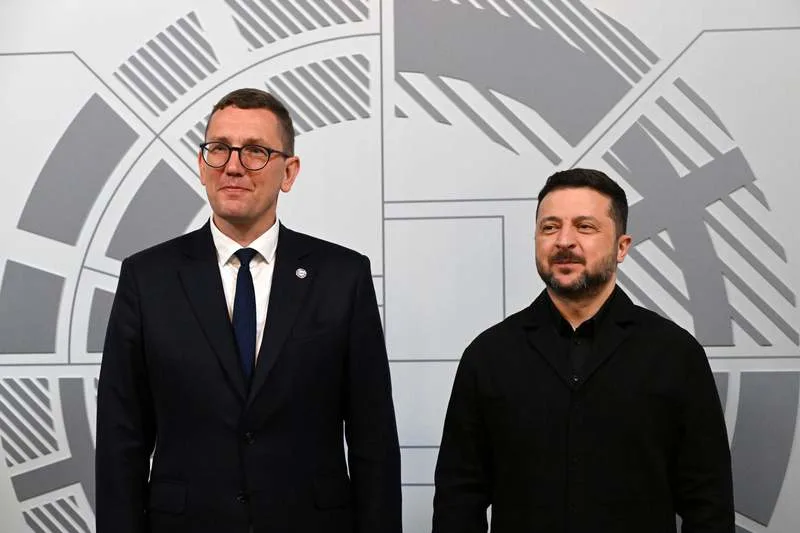
Ukrainian President Volodymyr Zelensky met with Nordic and Baltic leaders in Tallinn on Tuesday, using a summit of some of Kyiv's staunchest backers to offer up the one thing Ukraine now has in abundance: hard-won expertise in shooting down drones.
The gathering brought together the prime ministers of the eight-nation NB8 bloc, which groups the five Nordic countries with Estonia, Latvia, and Lithuania. Estonia, holding the group's rotating presidency, hosted, and Zelensky attended as a guest alongside bilateral meetings with President Alar Karis and Prime Minister Kristen Michal. French President Emmanuel Macron joined part of the discussion by video.
The bloc has been among Ukraine's most committed supporters. By Estonia's accounting, the eight countries have provided more than €42 billion in aid since Russia's full-scale invasion began more than four years ago, the largest contribution in the world measured per capita.
A drone problem on the doorstep
The visit came with an awkward backdrop. In recent months, Ukrainian drones have repeatedly drifted off course into the region, crashing into the chimney of an Estonian power plant, striking empty fuel tanks in Latvia, and drawing fire from Romanian jets stationed in Lithuania. A NATO fighter shot one down over southern Estonia in May, and another was downed over Latvia on Monday.
Ukrainian officials have apologized for the strays, saying the drones were aimed at military targets inside Russia but were knocked off their paths by Russian electronic interference. Karis said he expects more to cross into Baltic skies as the war drags on, and urged the public to stay calm.
Turning a liability into an offer
Rather than dwell on the friction, the two sides turned it into the basis for cooperation. Karis said Estonia had proven it could knock the drones down with fighter jets, but that doing so was expensive, and he wanted Ukraine's help finding a cheaper way.
Zelensky said Kyiv was ready to provide it. Ukraine, he noted, had already done similar work abroad, sending teams to train forces in the Middle East to shoot down drones. "We did this in the Middle East, and it worked," he said. He offered the low-cost interceptor drones Ukraine fields at home as the basis for an inexpensive shield against Russian attacks, and said Kyiv could dispatch experts to its European partners "at any moment."
The summit produced concrete steps on that front. Ukraine and Latvia signed a deal to deepen joint defense work and co-production, and Zelensky and Michal issued a declaration committing Estonia and Ukraine to share battlefield experience, build defense industry ties, and work together on air defense, including against ballistic missiles, partly through a format they call the "Drone Deal." Zelensky later presented Michal with a Ukrainian state order in thanks for Estonia's support.
The framing fit a theme several leaders echoed: that the relationship is no longer one-directional. Norwegian Prime Minister Jonas Gahr Støre said cooperation with Kyiv had become "much more of a two-way street," calling Ukraine's military "perhaps the strongest army in Europe" and crediting it with an unusual capacity to innovate.
EU bid and pressure on Moscow
Beyond defense, Zelensky pushed on diplomacy and Ukraine's path into the European Union. He said Kyiv had met the conditions to open its accession negotiations and pressed the bloc to approve them over the summer, insisting there were "no obstacles" to opening all six negotiating clusters.
In Brussels, European Commission President Ursula von der Leyen said Ukraine was "making extraordinary progress" on the reforms required for membership and that it was "high time" for the bloc to deliver, though the process of clearing 35 policy chapters can take years. Karis backed an immediate start, calling Ukraine's place in the EU and NATO a justified expectation rather than a distant hope.
Zelensky also pressed for tougher sanctions, singling out Russia's shadow fleet of oil tankers. Von der Leyen, for her part, laid out proposals for a new round of measures targeting Russia's energy, financial, and trade sectors, including a first-ever ban on Russian fish such as cod and a bar on EU entry for anyone who has served in the Russian armed forces since the war began. The package still needs the approval of all 27 member states.
The war keeps grinding
The diplomacy unfolded against another night of fighting. In the Kharkiv region, three people were killed and 25 wounded, among them three children, over 24 hours, regional officials said, with three more wounded in the Dnipropetrovsk region. Ukraine's air force said Russia launched 166 long-range drones and two guided missiles overnight and that 146 of the drones were intercepted. Russia, in turn, reported downing 140 Ukrainian drones and said a woman was killed when one struck an apartment building in the Belgorod region.
Zelensky tied the diplomacy directly to the state of the front. Partners now recognize that Ukraine's battlefield positions are markedly stronger, he said, and Kyiv's diplomatic push should proceed from that footing. Russia, he argued, was trying to offset heavy battlefield losses by striking Ukrainian cities and civilian infrastructure.
He also pointed to recent contact with Washington. On Monday, during a stopover at the airport in Moldova's capital, Zelensky said he held what he called positive talks with U.S. envoys Steve Witkoff and Jared Kushner, focused on ending the war and on the diplomatic landscape ahead of this month's Group of Seven summit. With EU, G7, and NATO meetings all approaching, he said the next stretch could prove pivotal, telling the leaders in Tallinn that June and July "may determine a lot."
Author

We cover the world’s chaos so you don’t have to scroll twelve feeds to understand it.
Sign up for Atlas newsletters.
Stay up to date with curated collection of our top stories.