Ukrainian President Volodymyr Zelensky used a Sunday television interview to press for a renewed push toward peace talks with Moscow, arguing that the window for productive negotiations will remain open only until the onset of winter and that the United States and its partners must apply substantially more pressure on Russian President Vladimir Putin to bring him to the table
"I think we need more sanctions. I think we need more pressure," Zelensky said in an interview with CBS "Face the Nation" that was taped May 29 and broadcast Sunday. "More sanctions, more pressure, they will be ready for the dialogue."
The Ukrainian president argued that the period between now and the next winter offered the strongest leverage for Kyiv since the war began. He told the program that the U.S. focus on the Iran war had created an opening for Russia to recover, and that he had communicated the urgency directly to Washington as early as January. "United States moved and shift their focus on the Middle East, and because of this, I think Middle East is a priority," Zelensky said. "That's why we have some pauses in our diplomatic negotiations."
The Battlefield Window
Zelensky's argument for renewed diplomacy rests on what he described as a measurable shift on the battlefield. "It began in December 2025, Russia began to lose initiative on the battlefield," he said. The Ukrainian president said he had shared the analysis with American partners in January and warned that a tactical opening had emerged.
The Ukrainian claim is supported by independent assessments. In early March, Commander-in-Chief Oleksandr Syrskyi said that during the previous month Ukrainian forces had recaptured more territory than Russia had occupied, the first such reversal since Kyiv's failed 2023 counteroffensive. The Institute for the Study of War said in a May 25 analysis that "Russian forces' rates of advances are stagnating while Ukrainian forces are employing novel tactics and operational concepts in efforts to break out of positional warfare." The think tank added that Ukraine "likely has a unique and time-constrained opportunity to exploit its current initiative while Russian forces remain vulnerable."
Brigadier General Andriy Biletsky, commander of Ukraine's Third Army Corps, told Reuters last week that Kyiv had a roughly six-month window to consolidate the battlefield position before Russia recovered. Biletsky described the Russian army as "exhausted and incapable of making major breakthroughs."
Zelensky offered his own casualty estimate for the Russian side, telling CBS that Moscow was losing up to 35,000 soldiers a month. "They are on the way to the big crisis with the people," he said. Russia does not publish official casualty figures, and the Ukrainian estimate cannot be independently verified.
The Patriot and Drone Deal Asks
Zelensky used the interview to press two specific requests with the Trump administration. The first concerned ballistic missile interceptors. Russia has dramatically escalated its long-range air campaign in recent weeks, including a single overnight strike last weekend that involved roughly 600 drones and 90 missiles. The pace of incoming ballistic threats has outstripped Ukraine's ability to intercept them with the Patriot systems Kyiv currently fields.
"Sixty, 65 missiles per month for today's challenges, it's nothing," Zelensky said of the current production rate of Patriot interceptors. "We need to increase the production. I know all the companies in the United States, huge companies, great companies, but only United States can produce such number." He confirmed that he had sent a formal letter to the White House and Congress over the Memorial Day weekend requesting an expanded supply.
Defense Secretary Pete Hegseth, asked about the request at a defense forum in Singapore last week, told reporters the United States would "find a way" to help Ukraine but did not commit to specifics. The administration has not publicly responded to the letter.
The second request involved a bilateral drone deal. Ukraine has emerged as one of the most experienced battlefield operators of unmanned systems in the world and is on track to produce roughly 7 million drones in 2026. Zelensky said Kyiv had already concluded drone agreements with Middle Eastern and European partners and was negotiating a broader deal with the European Union, but had not yet finalized an agreement with the United States. "American technological companies, they have a lot of different interesting AI technologies, what we don't have," he said. "And we have a lot of things they don't have, because of our experience. I think this cooperation can be huge and the most powerful in the world."
Ukrainian Strikes and the Zaporizhzhia Dispute
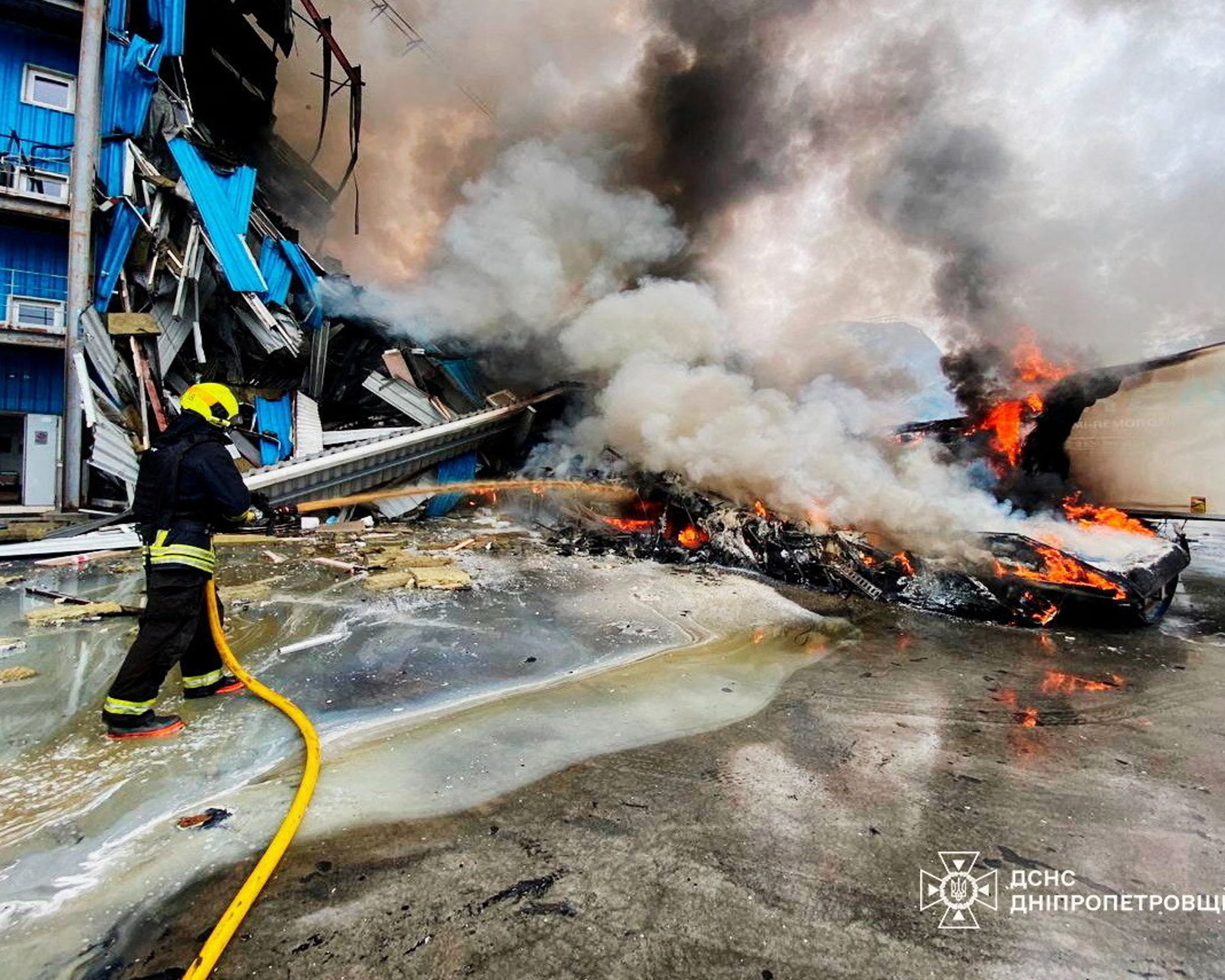
The Ukrainian campaign against Russian energy infrastructure continued through the weekend. Kyiv said it struck the Saratov oil refinery, a Rosneft facility in southwestern Russia roughly 700 kilometers from the front line, causing a large-scale fire. Local Russian authorities confirmed damage but did not characterize the extent. The Ukrainian general staff also said it struck the Lazarevo pumping station in Russia's Kirov region, more than 1,200 kilometers from Ukrainian-controlled territory, which it described as part of the network shipping Russian oil from Siberia to Belarus. A separate drone strike set fire to a fuel depot in the town of Matveev Kurgan in Rostov region.
The strikes are part of a broader campaign Ukraine has accelerated this year to degrade Russian refining capacity. "Tonight, our soldiers applied Ukraine's long-range sanctions against an oil refinery in Saratov, Russia," Zelensky posted on social media on Sunday.
Russia, separately, claimed that a Ukrainian kamikaze drone had struck the turbine hall of the occupied Zaporizhzhia nuclear plant on Saturday. Rosatom CEO Alexei Likhachev accused Ukraine of a "deliberate attack" and said the drone exploded after piercing the wall of Power Unit 6's turbine hall, though no damage to core equipment was reported. Ukraine's military denied any involvement, calling the claim "yet another propaganda ploy." International Atomic Energy Agency Director General Rafael Grossi voiced "serious concern," and IAEA inspectors at the site said they had observed damage to the exterior of a turbine building "consistent with the impact" of a drone. Radiation levels at the plant remained normal. The IAEA has requested access to the interior of the hall.
The Diplomatic Stall
The last formal round of Ukraine-Russia talks took place in February in Geneva. Secretary of State Marco Rubio acknowledged on May 12 that the U.S.-mediated track had stalled. Zelensky said Sunday he hoped Special Envoys Steve Witkoff and Jared Kushner would visit Kyiv within the next two weeks. A White House official told CBS that a trip had been discussed but not scheduled.
Zelensky outlined three possible formats for resuming talks: trilateral negotiations with the United States, a European-led track, or direct bilateral discussions with Russia. He said he was "ready to meet with Putin if he will be ready," but argued that none of those formats would produce results without renewed pressure on Moscow. The Trump administration has not announced new sanctions on Russia in recent months. Treasury Secretary Scott Bessent, asked last week about additional measures, said "this administration has put the hardest sanctions on Russia of any country."
For Kyiv, the calendar is the central concern. "Before the winter, we need to find a way, diplomatic way, to sit and to speak," Zelensky said. The next round of large-scale Russian aerial attacks is expected within days, with Zelensky warning that Ukrainian civilians should "use bomb shelters" overnight Sunday and Monday.
Author

We cover the world’s chaos so you don’t have to scroll twelve feeds to understand it.
Sign up for Atlas newsletters.
Stay up to date with curated collection of our top stories.