Russian Bombs Hit Aid Site And Shelter In Ukraine’s Komyshuvakha, Killing 31 With Dozens Still Missing
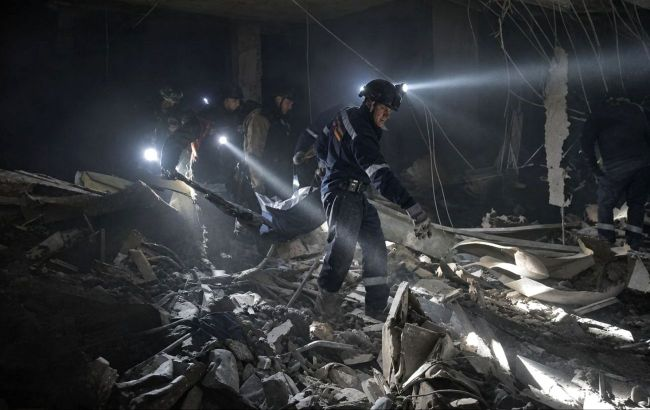
The death toll from Russian airstrikes on a humanitarian aid site and a nearby shelter in the southern Ukrainian village of Komyshuvakha rose to 31 on Tuesday, with nearly 50 people still missing under the rubble, the region’s top official said.
Mykhailo Semikin, acting head of the Zaporizhzhia Regional Military Administration, gave the new figures at 12:12 p.m. Tuesday, Kyiv time (4:12 a.m. CST). “According to the latest data, the figure has increased – 31 people are currently considered dead, five are injured, and nearly 50 people remain missing,” he said on Telegram.
The toll in Komyshuvakha
The dead include four police officers and two rescue workers who responded after the first strike and were killed when the site was hit again. At least five people were injured, and emergency services said two more rescue workers were being treated in the hospital. Search and rescue work was continuing Tuesday.
The figures have shifted as the search goes on. On Monday evening, Ukraine’s emergency services and President Volodymyr Zelenskyy put the dead at 26. At 9:07 a.m. Tuesday, Kyiv time (1:07 a.m. CST), Semikin reported 29 dead and 48 missing, according to Interfax-Ukraine. In his update about three hours later, he said 31 were dead and “nearly 50” missing. Separately, Regina Kharchenko, secretary of the Zaporizhzhia City Council, said 27 people were missing, Reuters reported.
Officials in the Zaporizhzhia region declared three days of mourning, from Nov. 3 through Nov. 5.
How the attack unfolded
The strikes on Monday first hit a school building used to hand out humanitarian aid, where residents had gathered to collect packages. Classes were not being held there because the village lies too close to the front line. People then took cover in an underground shelter, which was struck in turn.
Semikin said Russian forces carried out at least nine airstrikes on the village Monday, “precisely at the time when people were receiving humanitarian aid at the resilience center.” “They started with KAB-500 guided aerial bombs and then used FAB-3000 bombs,” he said in a televised interview, adding that a FAB-3000 carries 1.5 metric tons of explosives and is designed to destroy reinforced concrete bunkers. “Following a direct hit, the concrete structure inside the building collapsed and a fire broke out,” he said. Interfax-Ukraine reported that the follow-up strike on the shelter consisted of nine aerial bombs.
Rescue efforts Monday evening were hindered by further Russian drone attacks on the area, Semikin said.
Matthias Schmale, the United Nations humanitarian coordinator for Ukraine, condemned the strikes. “Civilians seeking support and first responders coming to the rescue must never be a target,” he said in a statement Tuesday. “People living close to the front line already endure immense hardship. The possibility of being killed while seeking essential assistance or shelter is horrifying,” he said.
Moscow’s account
Russia’s Defense Ministry offered a different account. In a statement Tuesday, it said the attack had targeted Ukrainian military units around Komyshuvakha and two other settlements in the Zaporizhzhia region, and claimed that up to 25 Ukrainian servicemen had been killed and 15 vehicles and an electronic warfare station destroyed, Reuters reported. Both countries deny deliberately targeting civilians.
A nationwide barrage overnight
The bombing came as Russia launched one of its larger overnight attacks across the country. Zelenskyy said Russia fired 289 attack drones, 17 ballistic missiles and 59 cruise missiles at nine regions overnight into Tuesday, striking power plants and triggering emergency power cuts.
In the Dnipro area, an attack killed one person and wounded 17, local officials said. Rescuers pulled a woman alive from the rubble there Tuesday morning.
In the northeastern Kharkiv region, a combined missile and drone attack wounded at least 62 people and damaged a medical facility, regional authorities said. The strike hit the Nemyshlianskyi district, shattered windows in four apartment buildings and damaged cars, and more than 200 patients were moved to other medical facilities, said Oleh Syniehubov, head of the regional military administration.
Zelenskyy noted that the barrage coincided with Election Day in the United States. “The Russians think America won’t notice this signal of theirs,” he said. “But we need to notice and stop such terror. We need to help Ukraine defend its skies; otherwise, Russia will never stop its missile strikes.”
Talks planned in Abu Dhabi
Zelenskyy said Russia could not have been unaware that residents gathered at the Komyshuvakha site each week for aid. He tied the strike to the six-day ceasefire that allowed an evacuation of the Russian-occupied city of Oleshky and expired Sunday. That truce was the most significant pause in fighting in months, and both sides credited U.S. first lady Melania Trump and Pope Leo with it. “If Russia genuinely wanted de-escalation, there was an opportunity following the situation in Oleshky to continue taking humanitarian steps. We proposed this. But Russia continues to kill people,” he said.
The Kremlin said no similar humanitarian missions were being planned “at the moment.”
White House envoy Steve Witkoff said Monday that U.S.-mediated talks between Russian and Ukrainian delegations will be held in Abu Dhabi on Nov. 10 and 11, covering “post-war security agreements, de-escalation, humanitarian measures, and ending the war.” Witkoff and Jared Kushner are expected to represent the United States, a senior U.S. official told Reuters. Kyiv has not announced who will lead its delegation. Rustem Umerov, secretary of Ukraine’s National Security and Defense Council, headed it at the Abu Dhabi round in January.
Author

We cover the world’s chaos so you don’t have to scroll twelve feeds to understand it.
Sign up for Atlas newsletters.
Stay up to date with curated collection of our top stories.