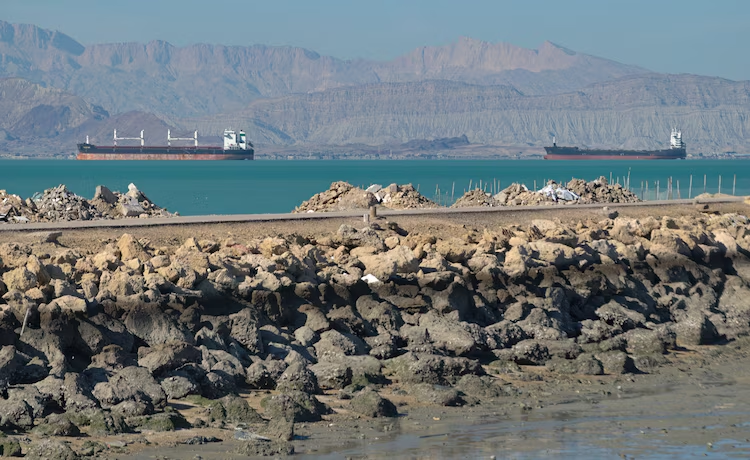
The United States carried out what officials called “defensive” strikes on Iran’s Qeshm Island in the Strait of Hormuz late Monday, even as Qatari mediators shuttled between Doha and Tehran on a draft agreement to end the war.
A U.S. official said the strikes targeted surface-to-air missiles that Iranian forces had used against U.S. assets. It was the first attack on Qeshm since June. Iran’s state news agency IRNA said several explosions came in rapid succession on the island, and witnesses told the agency they saw two planes overhead.
Mediators say both sides are reviewing proposals
A Qatari mediation team traveled to Tehran on Monday night for talks with Iranian Foreign Minister Abbas Araghchi on a version of a draft U.S.-Iran deal that has been under negotiation for eight days, according to Reuters. The team has since returned to Doha.
On Tuesday, a spokesperson for Qatar’s Foreign Ministry said developments had been made with both sides, though differences remained. “Both parties are reviewing suggestions we as mediators proposed,” the spokesperson said, adding that talks were continuing.
Tehran struck a harder note. A senior Iranian official told Reuters on Tuesday that the two countries remain far from a deal. “Tehran’s conditions must be met if the US wants Hormuz reopened,” the official said, adding that nuclear talks could begin only afterward and that Iran would not accept Washington’s “excessive demands.”
Parliament Speaker Mohammad Bagher Qalibaf, whom Iranian officials describe as the country’s chief negotiator, said Tuesday that Tehran had delivered a “firm and rational response” to Washington and that “the ball is now in America’s court” to prevent renewed fighting, Iran International reported.
He also warned that Iran’s answer to any U.S. “miscalculation” would be unpredictable. “The enemy seeks to force the Iranian nation into submission through threats and military action, but they are sorely mistaken; Iran will not submit,” he said.
What the draft reportedly contains
The terms under discussion have not been published. A diplomat familiar with the negotiations told The Times of Israel on Monday that the agreement would see Iran swiftly reopen the Strait of Hormuz in exchange for U.S. sanctions relief, followed by comprehensive talks on Tehran’s nuclear program.
Axios, citing regional sources, reported that the Qatari draft lays out a three-day sequence of confidence-building measures aimed at resuming direct U.S.-Iran negotiations.
Iran’s Foreign Ministry spokesperson, Esmaeil Baghaei, said Monday that the plan Iran submitted in September remains the focus of talks and could be shortened and carried out in two days, including reopening the strait.
Araghchi told IRNA on Monday that consultations through the mediators were “very intensive.” “We have presented our conditions and proposals, and everything depends on the political rationality of Washington,” he said.
Iran’s armed forces chief, Ali Abdollahi, set out five conditions for lasting regional security, including the lifting of sanctions, the release of frozen assets, war reparations and recognition of Iranian authority over the Strait of Hormuz, according to Iran International.
Washington weighs its options
President Donald Trump told Axios in a phone interview Monday that he was “in no rush” to decide whether to resume strikes. “One way or the other, we will do something, but there is no rush. We crippled them financially. They have no money, no gasoline and their people are getting very tired of it,” he said.
Reuters reported that Trump raised doubt Monday about whether he would follow through on a threatened resumption of strikes after Tuesday’s midterm elections. Hours after the interview, he wrote on Truth Social: “Iran wants a settlement, as soon as possible. It could happen!”
Axios also reported that Trump’s advisers are divided into three camps. According to the report, Vice President JD Vance and White House envoy Steve Witkoff favor a deal; Secretary of War Pete Hegseth, along with Israeli Prime Minister Benjamin Netanyahu, favors renewed military action; and Treasury Secretary Scott Bessent, CIA Director John Ratcliffe and Secretary of State Marco Rubio favor keeping economic pressure in place without either war or a deal. The CIA declined to comment.
Vance told reporters Monday, hours before the Qeshm strikes, that the administration had “certainly made some progress.” “The president and I both feel pretty good about the prospects for potentially coming to a negotiated settlement,” he said.
Oil markets moved sharply on the diplomacy. Front-month Brent crude futures settled Monday at $104.77 a barrel, down 7.63%, and U.S. West Texas Intermediate crude futures settled at $96.46, down 7.36%. For both benchmarks, it was the largest one-day percentage drop since July 27.
Competing claims over the strait
Iran’s Revolutionary Guard made two separate claims overnight that have not been confirmed by the U.S. military. In one statement, the Guard said its air defenses destroyed a U.S. MQ-9 Reaper drone over the eastern Strait of Hormuz, which Tasnim described as the 55th downed over Hormuz. The United States has not acknowledged losses on that scale. In another, the Guard said electronic warfare systems brought down two smaller U.S. MQM-170 reconnaissance drones south of Qeshm Island.
An Indian sailor killed off Oman
An Indian-flagged vessel, the MSV Al Jusufi, was struck by what India’s shipping minister, Sarbananda Sonowal, called “an unidentified aerial object” near Limah, Oman, on Monday afternoon, according to his post on X.
India’s Ministry of External Affairs condemned the attack. The vessel carried 14 Indian seafarers. Oman’s coast guard rescued 13 of them, and one, Gandhar Nahim Ajij of Gujarat, was killed, Sonowal said.
Where the talks stand
Qatar’s Foreign Ministry said Tuesday that both sides were still reviewing the mediators’ proposals and that the talks were continuing.
Author

We cover the world’s chaos so you don’t have to scroll twelve feeds to understand it.
Sign up for Atlas newsletters.
Stay up to date with curated collection of our top stories.