The Supreme Court on Monday evening turned away the Trump administration’s last request to make California set aside mail ballots from people the administration says are likely noncitizens. The decision leaves the state free to process and count those ballots like any others as Election Day voting gets underway.
The justices acted just hours after the Justice Department filed its emergency application, and less than a day before polls opened across the country. For now, the order ends a dispute that moved through a federal trial court and two rounds of appeals in the last weeks of the midterm campaign.
A one-line order with no noted dissents
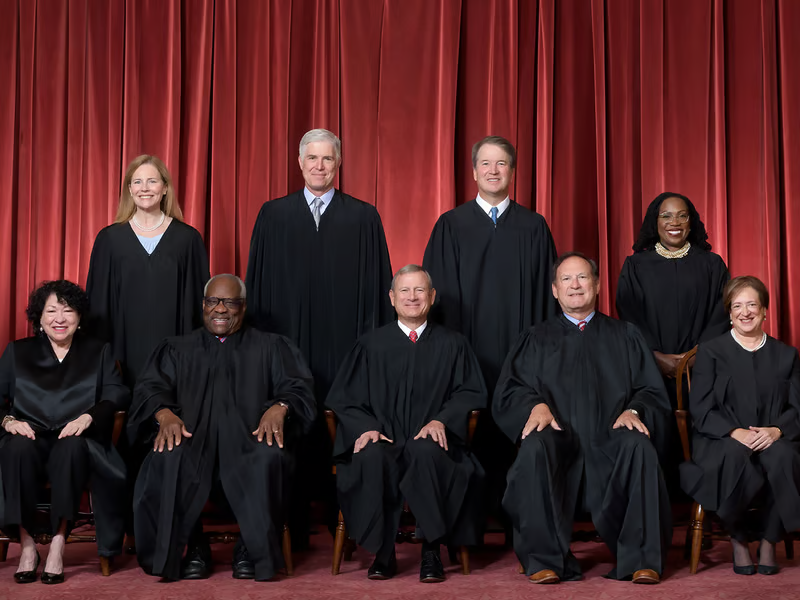
The order was brief. It read in full: “The application for injunction pending appeal presented to Justice Kagan and by her referred to the Court is denied.”
The case, United States v. California, was docketed as 26A624. Justice Elena Kagan handles emergency matters from the 9th Circuit, and she sent the request to the full court. The order was unsigned, and no justice noted a dissent.
The court ruled on the administration’s filing alone. It did not ask California officials to respond first.
What the administration asked for
The Justice Department wanted state and Los Angeles County election officials to separate ballots cast by people on a federal list and hold them uncounted until their citizenship could be confirmed. The administration says the list contains about 20,000 likely noncitizens.
The dispute built over several months. According to 9th Circuit rulings in the case, the secretary of homeland security contacted California officials in July about a list of registered voters federal agencies had labeled likely noncitizens. The state mailed ballots to all registered voters on Oct. 1, as state law requires. In mid-October, the administration sent a list of more than 20,000 names and asked the state to set aside ballots from those people until their citizenship could be verified.
The administration later sent letters to all 58 California counties with lists of people it says are noncitizens on their registration rolls. California has more than 23 million registered voters. The Justice Department then sued state officials and Dean Logan, the Los Angeles County registrar-recorder and county clerk, seeking a court order to segregate the ballots.
It is a federal crime for noncitizens to vote in federal elections, and confirmed cases are rare. President Donald Trump has repeatedly said large numbers of noncitizens vote.
What the lower courts found
U.S. District Judge David Carter, an appointee of President Bill Clinton, rejected the department’s request for a temporary restraining order last week. He wrote that the administration’s process for identifying noncitizens was “rife with uncertainty and errors” and described the department’s conduct as “a broad, ongoing pattern of attempted election interference by federal officials.”
The same three-judge 9th Circuit panel heard the case twice. On Oct. 26, it dismissed an earlier appeal, finding it had no jurisdiction because the government had gone to the appeals court before Carter ruled. After Carter denied the order, the panel rejected the government’s emergency request on Friday, Oct. 30, by a 2-1 vote.
Judge Mark Bennett, a Trump appointee, and Judge Gabriel Sanchez, a Biden appointee, formed the majority. “[T]here is a material risk that granting the United States its requested relief would result in disenfranchisement and could jeopardize the County’s entire election,” the ruling said. The majority relied on the principle that courts should not change election rules on the eve of a vote, as well as the Constitution’s grant of election authority to the states. Judge Patrick Bumatay, also a Trump appointee, dissented, calling the government’s proposal a “modest” remedy.
The number of ballots actually in dispute is likely far smaller than the administration’s figure. County officials have found that many people on the list had no active registration and were never mailed a ballot.
Researchers at the UCLA Voting Rights Project, who gained access to the list through a court order in a separate lawsuit, reported over the weekend that 42% of the names do not appear on California’s current voter roll. They also found naturalized citizens on the list.
A wider fight over election rules
The California case is one of several the Justice Department has pressed in the run-up to the election. Federal prosecutors asked Washington Secretary of State Steve Hobbs to set aside mail ballots from more than 400 people they say are noncitizens. Hobbs said the list included “many” U.S. citizens.
A federal judge on Sunday dismissed a separate Justice Department suit that sought to block Alaska from certifying its Senate result if Sen. Dan Sullivan, a Republican, loses to Democrat Mary Peltola.
In San Francisco, a federal judge late Friday temporarily barred the administration from threatening, intimidating or coercing election officials to make them stop processing ballots from registered voters it says are ineligible. The government has appealed that order.
Election Day in California
Polls in California are open from 7 a.m. to 8 p.m. Pacific time, which is 9 a.m. to 10 p.m. CST. Counties begin reporting results when polls close. Mail ballots postmarked by Election Day count if they arrive within seven days, and counties have until Dec. 3 to certify their results.
Nationally, more than 57 million early votes had been cast by Monday afternoon, according to the University of Florida Election Lab. In California, where voting began in early October, more than 6 million mail ballots had already been returned to county election offices, CBS News reported.
Author

We cover the world’s chaos so you don’t have to scroll twelve feeds to understand it.
Sign up for Atlas newsletters.
Stay up to date with curated collection of our top stories.