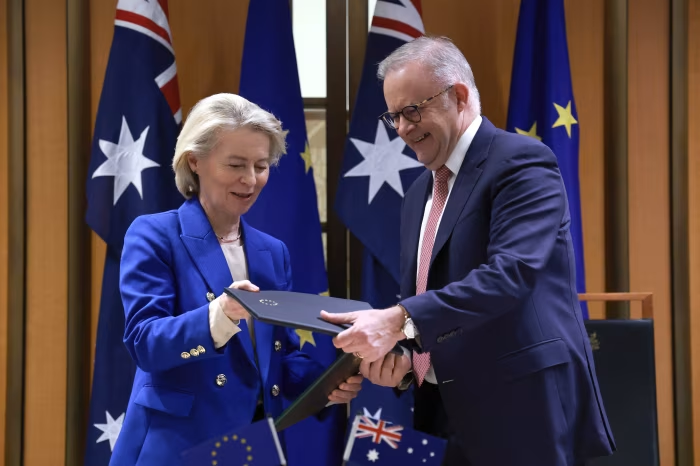
The European Union and Australia formally concluded a landmark free trade agreement on Tuesday in Canberra, wrapping up nearly a decade of talks that twice came close to collapse and finalizing a pact that covers tariffs on goods, services, critical minerals, agriculture, and a new security and defense partnership.
European Commission President Ursula von der Leyen and Australian Prime Minister Anthony Albanese signed the agreement at Parliament House after negotiations that began in 2018, stalled in 2023, and revived under pressure from the global trade disruptions triggered by U.S. tariffs and China's restrictions on critical mineral exports. "The EU and Australia may be geographically far apart but we couldn't be closer in terms of how we see the world," von der Leyen said after the signing. Albanese called the deal "comprehensive, balanced and commercially meaningful."
The agreement will eliminate tariffs on more than 99 percent of EU goods exported to Australia, cutting roughly €1 billion per year in duties for European companies. The European Commission projects that the deal will increase EU total exports to Australia by up to 33 percent over the next decade, with the strongest gains expected in dairy, motor vehicles, and chemicals. Two-way trade in goods and services between the EU and Australia was valued at approximately €65 billion annually as of the most recent data. Australia is the EU's 20th-largest trading partner; the EU is Australia's third-largest two-way trading partner and second-largest source of foreign investment.
The deal must now go through legal translation and ratification by EU member states, the European Parliament, and Australia's federal parliament before it takes effect. The agreement also included a separate security and defense partnership, which EU foreign policy chief Kaja Kallas and her Australian counterpart had already signed virtually on March 18.
The Terms: Agriculture, Cars, and Critical Minerals
Agriculture had been the primary obstacle throughout negotiations. Talks broke down entirely in 2023 over Australia's demand for more access to the European beef market. In the agreement signed Tuesday, the EU agreed to open two tariff rate quotas totaling 30,600 metric tons of Australian red meat annually — well below Australia's original ask of 50,000 tons. Of that total, roughly 55 percent will enter duty-free, while the remaining volume will face a reduced tariff of 7.5 percent. The quota will be phased in over five years to give EU farmers time to adjust. Sheep and goat meat will be capped at 25,000 tons annually, phased in over seven years, with 27 percent limited to frozen product and all imports required to be grass-fed.
The deal also includes a Mercosur-style safeguard mechanism that allows the EU to intervene if Australian agricultural exports surge unexpectedly — a clause added to reassure the bloc's farm lobby, which has already been pushing back against additional market access granted under the EU's agreement with the Mercosur trading bloc.
On the EU side, Australian tariffs will drop to zero immediately for wine, sparkling wine, fruits and vegetables, and chocolates. Cheese tariffs will be phased out over three years. European companies will also gain expanded access to Australia's services market, including telecoms and financial services.
On automobiles, Australia stopped short of scrapping its 33 percent luxury car tax — a threshold Germany had sought to eliminate — but agreed to raise the exemption threshold for electric vehicles to AUD $120,000 (roughly €72,000), which EU Trade Commissioner Maros Sefcovic said would exempt approximately 75 percent of European-made electric cars sold in Australia. The 5 percent across-the-board tariff on European cars into Australia will be eliminated.
Critical minerals were among the most strategically significant elements of the deal for Brussels. Australia holds substantial reserves of lithium, cobalt, rare earths, manganese, and aluminium — resources Europe needs for its green energy transition and for reducing its dependence on China, which has been restricting exports of some key materials. The agreement will lower Australian tariffs on critical mineral imports and ban export taxes, making pricing "much more predictable and stable" for European companies, the Commission said. Australia retained the right to apply dual pricing policies that charge foreign buyers more than domestic ones, but the deal includes a rebalancing mechanism allowing the EU to suspend tariff concessions if such policies are enacted.
Geography, Prosecco, and the Name Problem
One long-running dispute in the talks involved geographical indications — EU-protected product names that designate food and beverages tied to specific regions. The negotiations had previously stalled over Australia's use of names like prosecco, parmesan, feta, and gruyere on domestically produced goods.
Under the final agreement, Australian producers will be allowed to keep using some geographical names, including feta and gruyere, where those names have been in use for at least five years. However, Australian winemakers who produce sparkling wine under the prosecco label will be required to stop using that designation for exports ten years after the agreement takes effect. The compromise addressed a key European demand while giving Australian producers a long transition period.
The Broader Trade Strategy
The Australia deal is the third major trade agreement the EU has concluded in a short span, part of what von der Leyen has described as a "trade trilogy." The EU and India sealed a deal on January 27 after nearly 20 years of negotiations, creating a trading framework between two regions that together account for a quarter of global GDP. The EU-Mercosur agreement — linking 27 EU member states with Argentina, Brazil, Uruguay, and Paraguay in a combined market of more than 700 million people — is set to take effect provisionally on May 1 after Paraguay's parliament completed ratification, allowing the Commission to proceed without waiting for the European Parliament, whose members had voted to refer the deal to the European Court of Justice.
The EU's accelerated push for trade agreements since 2025 is directly tied to the tariff policies of the Trump administration. European Commission officials have stated plainly that Brussels is working to diversify trade relationships in order to reduce vulnerability both to U.S. protectionism and to China's growing use of export controls on critical raw materials as a geopolitical tool. The International Energy Agency's executive director, Fatih Birol, has also underscored the urgency of securing alternative supply chains for resources that underpin both the green transition and defense manufacturing.
Von der Leyen, speaking in Canberra ahead of the signing, framed the effort as foundational. "In a world marked by conflict and economic coercion," she said, the EU was seeking to build "solid and diversified partnerships with trusted allies." She noted that Australia, as a reliable democracy, fit squarely within that framework. The deal with Canberra was not the last one on Brussels' list — talks are ongoing with the Philippines, Thailand, Malaysia, the United Arab Emirates, and several countries in Eastern and Southern Africa.
Trade groups in the EU's agricultural sector pushed back regardless. Massimiliano Giansanti, president of Copa-Cogeca, the collective of European farm unions, warned that "agriculture cannot once again be treated as a bargaining chip to secure gains in other sectors" — a criticism that has followed each major trade deal the EU has concluded in recent months.
Author

We cover the world’s chaos so you don’t have to scroll twelve feeds to understand it.
Sign up for Atlas newsletters.
Stay up to date with curated collection of our top stories.