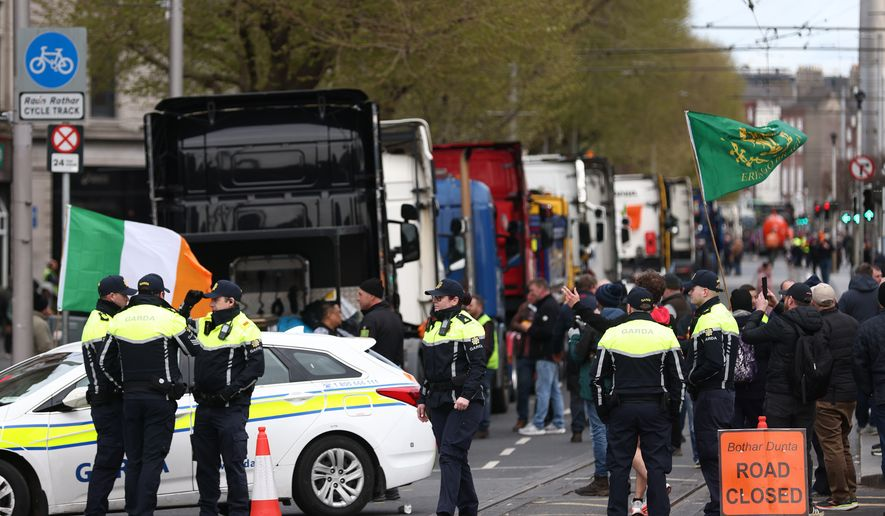
Ireland's government announced more than €505 million in fuel tax cuts and spending increases at an emergency cabinet meeting Sunday, attempting to end six days of protests by truckers, farmers, and contractors that had blockaded the country's only oil refinery, shut down fuel depots, and left more than a third of the nation's gas stations dry.
Prime Minister Micheál Martin said the package — which includes a 10-cent-per-liter reduction on both petrol and diesel, a delayed carbon tax increase, and a new fuel subsidy for farming and fisheries — was designed to ease cost-of-living pressures that have intensified since the U.S.-Israeli war on Iran led to the effective closure of the Strait of Hormuz and sent global oil prices surging. Diesel prices in Ireland have risen more than 20 percent since the conflict began.
"As a Government, we hear you," Finance Minister Simon Harris said at a press conference. "We have acted and we are taking further action today."
The relief package, which requires emergency parliamentary approval on Tuesday, comes on top of a €250 million set of tax cuts Dublin had already introduced in March — before any protests began. Martin rejected the suggestion that the new measures amounted to a reward for the disruptive tactics that had paralyzed much of the country over the preceding week.
Six Days of Disruption
The protests began last Tuesday with slow-moving convoys on motorways and restricted access to Dublin's busiest streets. They escalated rapidly as word spread through social media, drawing truckers, agricultural contractors, taxi operators, and farmers who said fuel costs were threatening to drive them out of business.
By midweek, protesters had partially blockaded Whitegate Refinery in County Cork — Ireland's only oil refinery — and restricted access to fuel depots in Galway and Foynes in County Limerick. Tractors and heavy trucks blocked O'Connell Street, Dublin's central thoroughfare, for days. The disruption choked fuel distribution across the country.
By Saturday, roughly 600 of Ireland's 1,500 filling stations had run dry. Bus services were disrupted nationwide. Tram services in Dublin were affected. Officials at Galway's port warned it was nearing capacity and that ships might have to anchor offshore or divert entirely. Martin said the country had been "on the brink" of having oil tankers redirected to other nations and its refinery shut down.
"It made absolutely no sense what was going on," he said. "Higher fuel scarcity and higher fuel prices would actually have been the inevitable outcome of these blockades."
Police and Military Move In
The government's patience ran out Saturday. Police, backed by armed forces personnel, deployed public order units to clear the blockade at Whitegate Refinery, using pepper spray and making arrests to reopen access. National broadcaster RTE showed officers dragging a protester from a tractor.
Irish police chief Justin Kelly said the action was taken as a last resort and condemned the refinery blockade as "illegal activity" by people determined to "hold the country to ransom." He said the blockading of critical infrastructure had "resulted in fuel shortages that are directly impacting on emergency services such as hospitals, the ambulance service, and the fire service."
Overnight into Sunday, police cleared O'Connell Street, ordering trucks and tractors to move out of the capital. On the other side of the country, a military vehicle was used to knock down a makeshift barrier at Galway docks, where police clashed with demonstrators.
Justice Minister Jim O'Callaghan called the continued protests "unacceptable." "While we all acknowledge the impact of higher fuel prices, and seek to minimize that impact, no groups are entitled in our republic to hold our people to ransom in such a manner," he said.
Christopher Duffy, a farmer who had become a spokesman for the Dublin protesters, said their peaceful protest had been "ambushed" by police overnight and that they had no choice but to move their vehicles because the equipment was too expensive to risk being towed.
The Economic and Political Fallout
The protests exposed deeper frustrations beyond the immediate spike in fuel prices. Agricultural contractors complained that the government's initial March package included only a 3-cent-per-liter cut on green diesel — the fuel used by farm machinery — which they considered negligible given the scale of the price increases. Hauliers said the earlier rebate scheme was insufficient.
The government's difficulty was partly structural. Much of the tax on green diesel consists of carbon tax rather than traditional excise duty, and Dublin has been reluctant to cut carbon levies because the revenue — more than €1.1 billion annually — is specifically earmarked for environmental programs, retrofitting, welfare supports, and green farm schemes. Cutting that revenue means finding replacement funding elsewhere.
Sunday's package addressed some of those concerns. The planned May 1 increase in carbon tax will now be postponed until October's budget. The excise cuts on petrol and diesel, combined with those from the March package, will run through the end of July. Harris said Ireland would seek European Commission approval for the temporarily higher discount on diesel excise.
A poll published in the Sunday Independent showed 56 percent of voters surveyed supported the protesters, though most supporters of the two governing coalition parties opposed them. Sinn Féin, the largest opposition party, announced it would call for a no-confidence vote in the government over its handling of the crisis. The Social Democrats said they would support the motion.
"They have lost the confidence of the public," Sinn Féin leader Mary Lou McDonald said. "It is clear that they still are not listening and do not accept the scale of this fuel and cost-of-living crisis."
Whether It's Enough Remains Unclear
Martin conceded Sunday that there were no guarantees the package would end the protests, which have been organized largely through social media and WhatsApp groups rather than through Ireland's official trucking and farming organizations. Several scattered road blockades, mainly targeting rural motorways, continued Sunday even as the major chokepoints were cleared.
Protesters at the Foynes fuel depot in County Limerick voted to end their action Sunday, and demonstrators at Rosslare Europort agreed to begin releasing trapped cargo. But the government's emergency coordination group warned that much of the economy and public services — including healthcare — would face heightened disruption into the coming week even if every remaining blockade were lifted immediately. Officials estimated it could take up to 10 days for fuel supply to fully recover.
The crisis also drew attention from foreign actors. Reports surfaced that social media accounts linked to Iran, Russia, and China had been amplifying content related to the Irish protests — a development that added another layer of concern to a situation the government was already struggling to contain.
Martin stressed that the measures were negotiated in cooperation with Ireland's official representative bodies for hauliers and farmers, not with the protest leaders themselves. "You can't negotiate with a WhatsApp group," one government source put it. Whether the WhatsApp group agrees with that assessment will determine what Monday looks like on Ireland's roads.
Author

We cover the world’s chaos so you don’t have to scroll twelve feeds to understand it.
Sign up for Atlas newsletters.
Stay up to date with curated collection of our top stories.