John Healey quit as defense secretary in June with a letter saying Britain must set a 2030 date for spending 3% of GDP on defense. He is now chancellor and delivers the Budget Wednesday. The government has said it will set a target date for 3% at next year’s spending review.
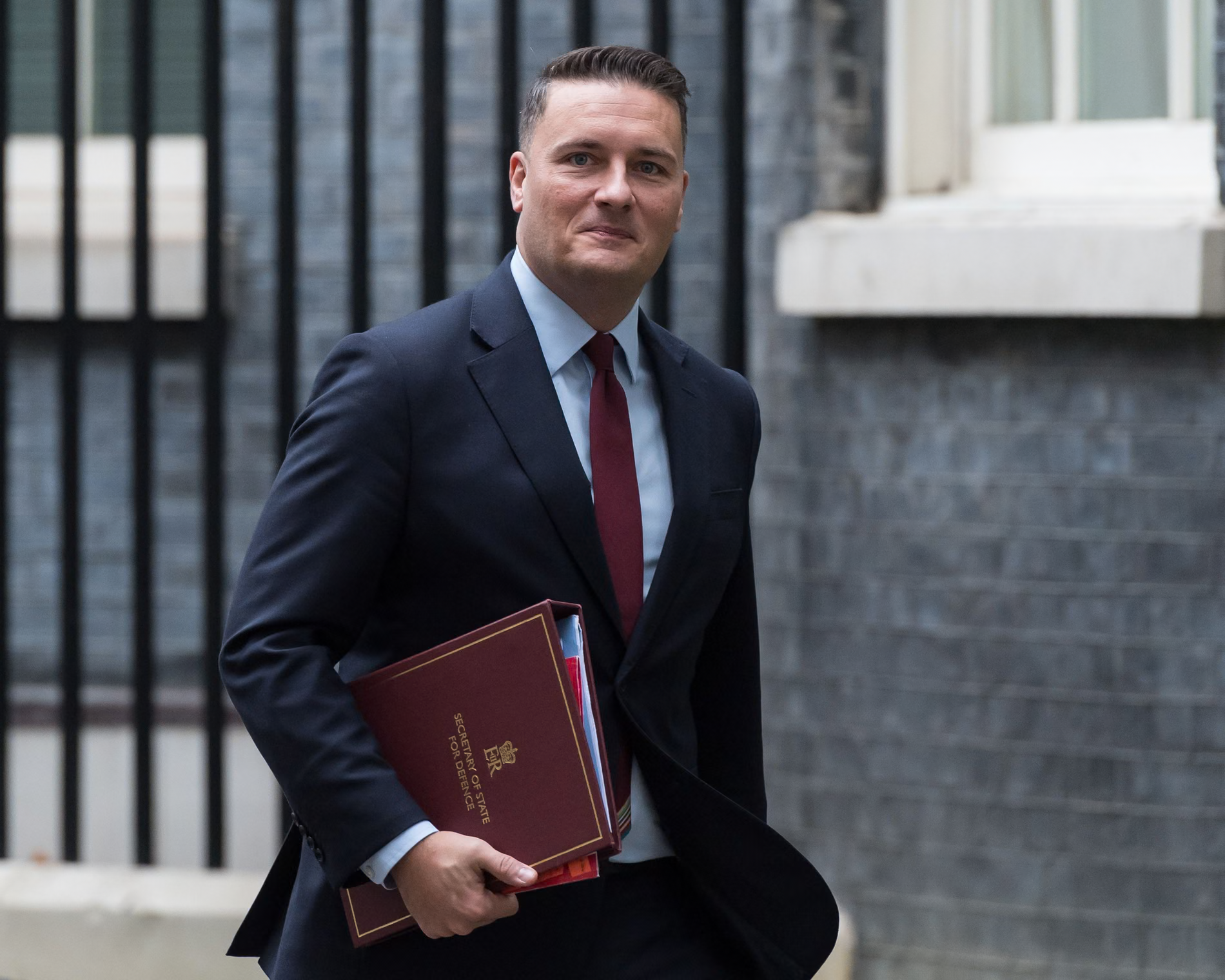
Wes Streeting, who now holds the defense post, wrote in The Telegraph, in remarks the paper reported Saturday, that by 2030 the force strength and war economy of Britain’s adversaries “could put them in a position to attack.” He said that gives the country “a little over 1,000 days” to be “ready with our allies to fight and win.”
The reversal
Healey’s resignation letter said the government’s Defense Investment Plan “falls well short of what is required for defense and the country at this dangerous time.” He wrote: “I am certain that a headmark date for 3% of GDP on defense in 2030 is what Britain must set.”
Prime Minister Keir Starmer announced 11 days later that he would quit as Labour leader. Andy Burnham, the only candidate to succeed him, became prime minister July 20. Healey became chancellor, succeeding Rachel Reeves, and Streeting became defense secretary. Dan Jarvis held the defense post in between. The Telegraph describes Healey’s resignation as “a move which ultimately led to Sir Keir’s downfall,” which is the paper’s framing.
On Aug. 28, a government spokesperson said, as quoted by the Guardian: “At the spending review we will set out a pathway to meet our NATO commitment of 3.5% of GDP on defense by 2035 and will set a target date to hit 3% on that path.” The Financial Times separately reported that Healey “will shelve” his own 3% by 2030 target.
The Royal United Services Institute wrote Monday that Healey has said the spending review is where he will set out “a clear path” to the 2035 commitment and a target date for 3%.
Burnham and No. 10 on 3% by 2030
Asked Monday on ITV’s “Good Morning Britain” whether Wednesday’s pathway would include 3% by 2030 and 3.5% by 2035, Burnham said: “It is, and we will set out a plan as to how we think is the right way to do that.”
LBC reported Tuesday that officials “have now clarified that the Prime Minister misspoke” and that plans for the targets will come at next year’s spending review. LBC did not name the officials.
Politico reported Monday that Healey is “set to deliver an unexpected increase in defense spending.” It said more money beyond filling a £4.7 billion gap was “briefed to the media in recent days as a ‘down payment’ towards spending 3% on defense by 2030.” Two unnamed government officials told Politico the path to 3.5% would come at the spending review, not the Budget.
Shadow chancellor Andrew Griffith said Healey “must have fully funded 3 per cent defense spending, or resign” by the end of his Budget statement, the Telegraph reported.
What Streeting is telling the country
Streeting wrote: “Our adversaries’ willingness to harm us is not new. What has changed is their capacity.” He also said the strategic objective of preparing for war was being lost “amidst a fixation with percentages and dates.” The Telegraph called that “the strongest signal yet” that Healey would not commit to 3% by 2030 in the Budget. Streeting wrote that he is “100 per cent confident that under this Labour Prime Minister and Chancellor we will meet our NATP spending target.”
What Washington is asking
Streeting met U.S. Secretary of War Pete Hegseth at the Pentagon on Oct. 15. The Department of War readout says Hegseth “encouraged the United Kingdom to continue increasing defense spending further and faster to advance a fairer, stronger, and more sustainable NATO 3.0.” It says the two discussed the Review of U.S. Force Posture and Basing in Europe.
The readout also says Hegseth “urged Secretary Streeting to continue supporting President Trump’s objective of a durable peace in Ukraine and global security in the Strait of Hormuz.” It does not define support.
Britain’s Hormuz role is a defensive multinational mission that “would become operational when conditions allow,” the government said May 12. Healey, then defense secretary, announced a British package with £115 million in new funding and called the mission “defensive, independent, and credible.” In an Oct. 23 written answer, Armed Forces Minister Louise Sandher-Jones said the UK is “co-leading planning efforts with the French.”
Streeting told the BBC in July that Britain has “not joined and will not join offensive US military action in Iran,” but on securing maritime freedom and free commercial shipping in Hormuz, “that’s where we are absolutely aligned.” Politico reported in April that Britain’s decision to stay out of offensive missions in the U.S.-Israel war with Iran had angered President Donald Trump.
What the Budget has to pay for
NATO-qualifying spending is 2.6% of GDP in 2026-27 and 2.7% from 2027-28. The government has committed to 3% in the next Parliament and 3.5% by 2035, and its funding explainer lists £4.7 billion as “to be funded at Budget 2026.”
City AM reported that the Treasury is “reportedly preparing” £20.4 billion for the National Wealth Fund and British Business Bank from 2028-29, with the defense share unconfirmed.
Two cost estimates are circulating, on different measures. The Royal United Services Institute said reaching 3% by 2030-31 would require around £11 billion more that year than keeping spending at 2.7%. LBC and City AM, citing the Office for Budget Responsibility, gave an estimate of an additional £17.3 billion in 2029-30 to reach 3%, with no baseline.
Healey delivers the Budget statement Wednesday after Prime Minister’s Questions, at about 12:30 p.m. London time (7:30 a.m. CT).
Author

We cover the world’s chaos so you don’t have to scroll twelve feeds to understand it.
Sign up for Atlas newsletters.
Stay up to date with curated collection of our top stories.