The partial shutdown of the Department of Homeland Security crossed into its 44th day on Sunday, officially surpassing the 43-day record set during last fall's government-wide funding lapse. Congress left Washington for a two-week Easter and Passover recess without a deal, meaning the standoff will stretch well past 50 days before lawmakers return the week of April 13.
The department has been without funding since February 14. In the six weeks since, nearly 500 TSA officers have quit, airport security lines have reached the longest wait times in the agency's 25-year history, and tens of thousands of federal employees across DHS have worked without pay. The impasse has outlasted every prior shutdown in the country's history, and the two chambers of Congress left town backing incompatible plans that neither side will accept.
The House passed a 60-day stopgap on Friday night to fund the entire department by a 213-203 vote. Senate Minority Leader Chuck Schumer declared it "dead on arrival." The Senate had passed its own bill hours earlier — a measure that funded all of DHS except Immigration and Customs Enforcement and Border Patrol — by unanimous voice vote. House Speaker Mike Johnson called that bill "a joke" and refused to bring it to the floor.
Both plans now sit in the opposing chamber with no path forward.
How the Stalemate Hardened
The shutdown traces back to early February, when Congress failed to pass a DHS spending bill before the funding deadline. Democrats held up the legislation after federal immigration officers fatally shot two U.S. citizens — Renee Good and Alex Pretti — during enforcement operations in Minnesota in January. Democrats demanded structural reforms to how ICE and Customs and Border Protection conduct operations before they would agree to fund those agencies.
Their demands included mandatory body cameras for immigration officers, a ban on face masks during enforcement actions, prohibitions on raids near schools and churches, and a requirement that judges — rather than agency supervisors — sign warrants before agents enter private homes.
Republicans resisted attaching conditions to a funding bill. Seven previous attempts to pass DHS funding failed before the Senate's eighth try succeeded early Friday morning. That compromise funded eight of the department's ten agencies but left out ICE and Border Patrol entirely.
House Republicans found that unacceptable. House Majority Leader Steve Scalise said the Senate bill defunded 25 percent of the department's operations "at a time when we're at a heightened threat level." Rep. Chip Roy of Texas called the Senate deal "absolutely offensive" to his constituents in Border Patrol who have been missing paychecks.
Democrats countered that ICE and Border Patrol agents have been paid throughout the shutdown using $75 billion in funding that Republicans secured through last year's reconciliation bill. Rep. James McGovern of Massachusetts told colleagues to "stop the misinformation that somehow ICE is not being funded." Rep. Henry Cuellar of Texas, the lead Democratic appropriator for DHS, said the administration has the authority to use existing reconciliation funds to pay ICE and CBP support staff. "They can do that anytime they want to," he told reporters.
Airports Bear the Visible Cost
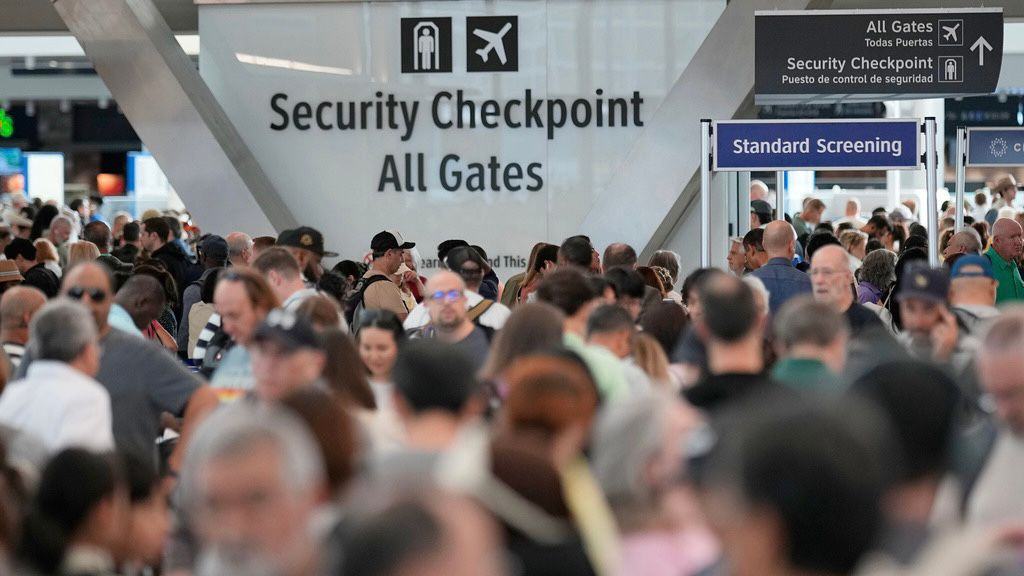
The most public consequence of the shutdown has played out at security checkpoints across the country. On Friday alone, more than 3,560 TSA officers called out of work — 12.35 percent of the agency's total workforce. Individual airports reported far worse numbers. At JFK in New York, 33.6 percent of scheduled officers did not show up. At Baltimore-Washington International, the figure hit 37.4 percent.
Wait times at some airports exceeded four hours. Houston's George Bush Intercontinental saw some of the worst delays in the country. Travelers at multiple hubs faced lines that wrapped outside terminal buildings. DHS said roughly 500 TSA officers have resigned since mid-February because they could not afford basic expenses — gas, groceries, rent, childcare.
President Trump signed an executive order on Friday directing Homeland Security Secretary Markwayne Mullin to use available funds to pay TSA employees immediately. Paychecks were expected to begin arriving as early as Monday. White House border czar Tom Homan said Sunday that TSA agents should start receiving pay early in the week, but cautioned that thousands of other DHS employees remain unpaid.
Homan also said ICE agents deployed to airports earlier in the week to help backfill missing TSA staff would remain in place "until the airports feel like they're 100%" and are "in a posture where they can do normal operations."
Beyond the Airports
The TSA crisis has dominated headlines, but the shutdown's effects extend across the department. The U.S. Coast Guard has been working without pay since February. Vice Admiral Thomas Allan testified to Congress last week that the funding lapse is causing severe financial hardship for military families and eroding mission readiness. He warned that the inability to pay for parts and services risks triggering stop-work orders that could worsen the Coast Guard's existing maintenance backlog.
The Cybersecurity and Infrastructure Security Agency has scaled back proactive assistance to state and local governments aimed at protecting critical infrastructure. Acting Director Nicholas Andersen said the agency continues responding to imminent threats but warned that reduced capacity could create openings for adversaries.
FEMA announced last month that it was pausing "all non-emergency recovery work," affecting communities still rebuilding from prior disasters. A grant program that provides additional security funding to houses of worship and nonprofits has also been disrupted. Victoria Barton, a FEMA associate administrator, said nearly all of the agency's training programs — including anti-terrorism preparedness courses — have been postponed.
All of this is occurring against the backdrop of an active war with Iran, which has heightened the domestic threat environment and placed additional strain on the very agencies going without funding.
Two Chambers, Two Bills, Zero Resolution
The core dispute has not moved. Democrats will not fund ICE and Border Patrol without enforcement reforms. Republicans will not accept conditions on those agencies. The Senate passed a bill that funds everything else. The House passed a bill that funds everything for 60 days. Neither chamber will accept the other's version.
Sen. Mike Lee of Utah urged his colleagues to return to Washington and resolve the impasse. "If you don't want to fight fires, don't become a firefighter," he said. "If you don't want to take grueling votes at difficult hours and sometimes have to work longer than you want to, maybe you shouldn't become a United States senator."
Johnson said Saturday that he hoped "Democrats finally come to their senses and put the safety of American citizens first, but we're not holding our breath." Schumer said Democrats "will not give a blank check to Trump's lawless and deadly immigration militia without reforms."
Some Republicans have floated using a second budget reconciliation bill to backfill any ICE and CBP funding missing from the Senate's partial measure — a move that would require only Republican votes. Johnson has been pushing that idea for months but acknowledged Friday that it is "a very difficult task" and "a high-risk gamble."
Rep. Carlos Gimenez of Florida, who voted for the House stopgap despite private reservations, told reporters he believed there was a better path. "But then the speaker called the play," he said. "He's quarterback, and I'll follow him."
Everett Kelley, president of the American Federation of Government Employees, did not mince words about the recess. "No check. No relief. No apology as Congress packed their bags and left these American families to struggle alone," he said. "Come back to Washington. Honor your oath. Do your job."
The shutdown will continue for at least two more weeks. When lawmakers return, it will be approaching day 60.
Author

We cover the world’s chaos so you don’t have to scroll twelve feeds to understand it.
Sign up for Atlas newsletters.
Stay up to date with curated collection of our top stories.