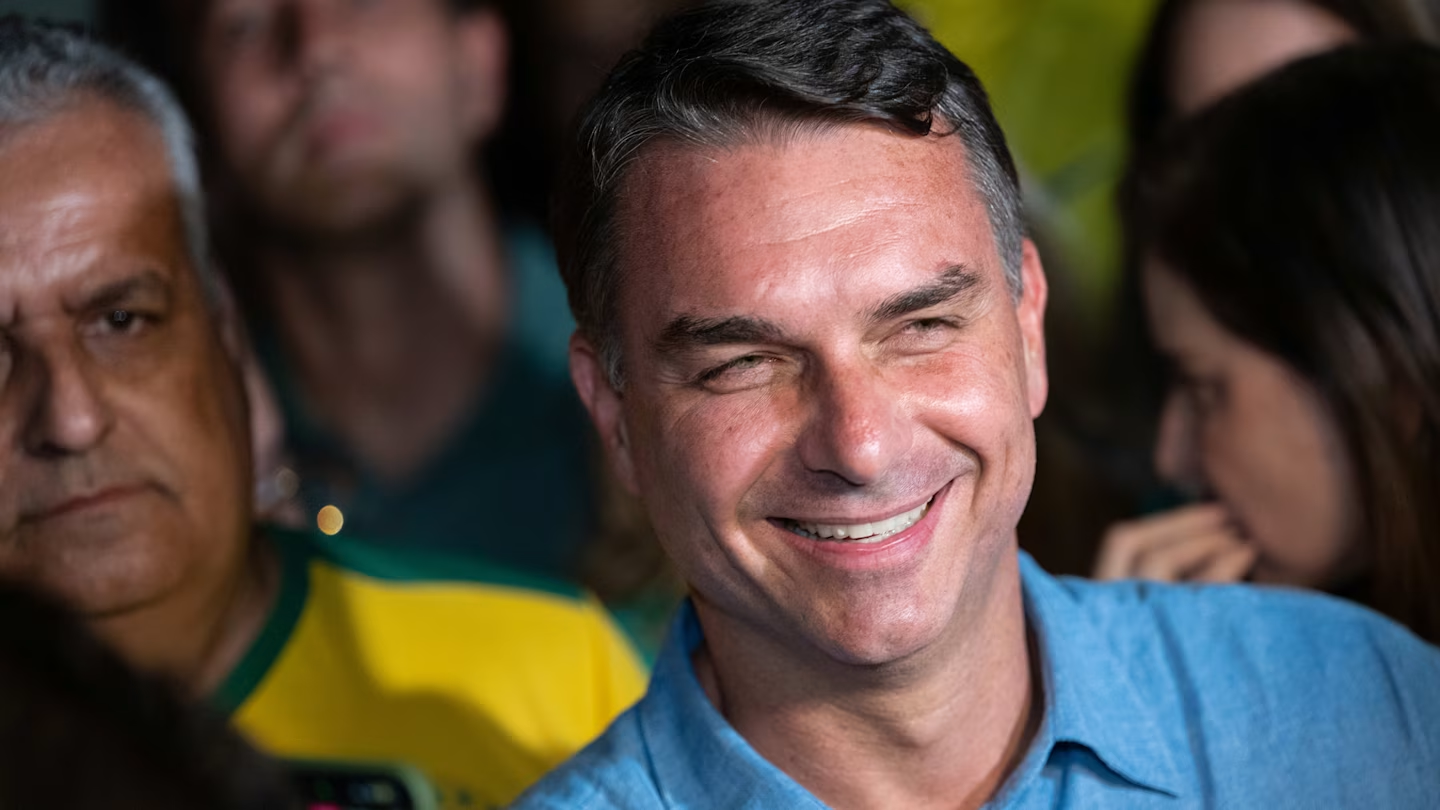
Brazil's presidential race is headed to a runoff after Sen. Flávio Bolsonaro of the Liberal Party finished ahead of President Luiz Inácio Lula da Silva on Sunday without clearing the absolute majority needed for an outright win. With the full count complete early Monday, Bolsonaro held 47.03 percent of valid votes to Lula's 45.16 percent. Voters will decide the presidency on Oct. 25.
Bolsonaro's 47.03 percent topped his father's first-round shares in 2018 (46.03 percent) and 2022 (43.2 percent). The electoral court's tally made a second round mathematically certain at about 8:57 p.m. Brasília time (6:57 p.m. CT).
The final count
At 100 percent of ballot boxes, Bolsonaro had 56,104,503 valid votes and Lula 53,879,538, a gap of about 2.2 million. The 1.87-point margin is the narrowest between the top two finishers in a presidential first round since direct elections resumed in 1989. In 2022, Lula led Jair Bolsonaro 48.4 percent to 43.2 percent before winning a narrow runoff.
Twelve candidates were on the ballot. Augusto Cury of Avante finished third with 2.89 percent, followed by Renan Santos of Missão with 2.24 percent, Ronaldo Caiado of the Social Democratic Party with 2.18 percent and Romeu Zema of Novo with 0.27 percent. Six minor candidates split the rest. Together, the ten eliminated candidates drew about 7.8 percent of valid votes, the pool both finalists now need.
Abstention ran at about 21.1 percent, against 20.9 percent in the 2022 first round. Voting is compulsory for most adults, but millions stayed home. Superior Electoral Court President Kassio Nunes Marques said Sunday that international observers reported no indication of foreign interference in the vote.
Washington watches the runoff
The United States has a visible stake. President Donald Trump called Jair Bolsonaro's coup-plot prosecution a "witch hunt" and in 2025 cited it in imposing a 50 percent tariff on many Brazilian goods and sanctioning Supreme Court Justice Alexandre de Moraes, who oversaw the case. Those sanctions were later lifted.
This July, a separate 25 percent tariff took effect after a U.S. trade-practices investigation under Section 301. In May, Flávio Bolsonaro met Trump, Vice President JD Vance and Secretary of State Marco Rubio in Washington, and the United States soon designated Brazil's two largest gangs, the PCC and Comando Vermelho, as terrorist organizations, a step he had sought.
Trump did not endorse either finalist but said last week he was following the race "very closely." Lula campaigned on sovereignty and warned against U.S. interference; the White House called such claims "nonsense."
Reactions on the night
Lula, 80, is seeking a fourth term after nonconsecutive presidencies that began in 2003 and resumed in 2023. Speaking in São Paulo, he called the outcome unexpected.
"I admit I was convinced I would win in the first round," he said. Framing the next three weeks in soccer terms, he added: "The game is about to start. We are in extra time." He said his campaign would work to convince Brazilians and that he is "very good" in knockout-style contests. He also said he would work to bring absent voters back.
Flávio Bolsonaro, 45, a senator from Rio de Janeiro and the former president's eldest son, said he was "very happy" with voters' confidence and with "the real possibility that, three weeks from now, Brazil will give a definitive answer by choosing a modern government."
His father was barred from running and is serving a sentence of 27 years and three months, under house arrest in Brasília, for plotting to overturn the 2022 result. The younger Bolsonaro has pledged amnesty for his father and for those involved in the Jan. 8, 2023, attacks on government buildings in Brasília.
Polls and the surprise
Final surveys had Lula slightly ahead on valid votes: Quaest at 46 percent to 45 percent and Datafolha at 45 percent to 42 percent, each with a margin of error of about 2 points. Neither anticipated a Bolsonaro lead of nearly two points.
Head-to-head simulations were already close. In late September, Quaest showed a 42–42 runoff tie and Datafolha showed Lula at 47 percent to Bolsonaro's 45 percent, within its 2-point margin.
Santos, Caiado and Zema ran to Lula's right; Cury cast himself as a pacification alternative outside the Lula–Bolsonaro binary. Zema said that wherever the Workers' Party is in a runoff, he will be against it. Cury, Santos and Caiado did not endorse either finalist on election night, and Caiado's Social Democratic Party said it would stay neutral nationally.
During the campaign, Lula framed the choice as democracy versus "barbarism," while Bolsonaro said he wanted to "free the Brazilian people." Crime, the economy and corruption dominated the race.
Path to October 25
The runoff is a straight majority contest between the top two finishers.
The Liberal Party ran strongly down the ballot, emerging with the largest Senate bloc in early tallies; former first lady Michelle Bolsonaro won a Senate seat representing the Federal District. Lula's Workers' Party held governorships mainly in the Northeast.
Governor races in Acre, Amazonas, Espírito Santo, Rio de Janeiro, Rio Grande do Norte and Tocantins, and in the Federal District, also go to Oct. 25 runoffs.
Author

We cover the world’s chaos so you don’t have to scroll twelve feeds to understand it.
Sign up for Atlas newsletters.
Stay up to date with curated collection of our top stories.