French households are more pessimistic than at any point in more than 13 years, just as the government tries to push a deficit-cutting budget through a divided parliament while bond investors and rating agencies look on.
INSEE, the national statistics agency, reported at 2:45 a.m. Central time Tuesday that its household confidence index fell five points in October to 80, from a September reading since revised to 85. That is the lowest level since June 2013, when the index also stood at 80. Economists had expected 85. The long-term average, going back to 1987, is 100.
One caution frames what follows. INSEE’s survey of about 2,000 households, conducted by phone, ran from Sept. 25 to Oct. 19. It closed two days after the Oct. 17 riots, and before the bond-market peak, the Moody’s decision and the mass marches described below. Most households answer in the first two weeks of the window, INSEE says. The survey shows the mood going into the turmoil. It does not show that the turmoil caused the drop.
What households told INSEE
Prices were the loudest worry. The share of households saying prices rose over the past year jumped again, to 42 on INSEE’s balance-of-opinion scale, after a six-point rise in September. Its long-term average is minus 12.
Work and money followed. Fear of unemployment rose to 61, against an average of 33. Households’ view of their own finances over the past year fell six points to minus 32, and their outlook for the year ahead fell nine points to minus 24. Opinion of France’s past living standards sank to minus 85, the lowest since the survey began in October 1972.
Then comes the twist. Households still say they can save. Their reported capacity to save held at 17, above its long-term average of 10, and INSEE’s savings climate stood at 118, well above 100. Families are anxious about prices and jobs, yet say they still have room to set money aside.
A bond market under strain
The government’s borrowing costs are the other half of the story. On Thursday, Oct. 22, the yield on France’s 10-year bond peaked at 5.14%, the highest since July 2002, and its premium over German bonds was the widest since 2011.
By 5 a.m. Central time Tuesday, the French 10-year yield was 4.95% against 3.35% for the German Bund, a gap of about 160 basis points.
European Central Bank President Christine Lagarde said on Oct. 14 that “the primary and first solution lies at home in France. And it has to do with fiscal policies.”
A rating held on a condition
Moody’s left France at Aa3 with a negative outlook on Friday. S&P Global and Fitch both rate the country A+. The finance ministry has said both outlooks are stable; neither agency has issued a release saying so since Fitch’s last review on Aug. 28. S&P’s next scheduled review is Nov. 27.
“The Aa3 rating assumes that a deficit-reducing budget for 2027 will be adopted, while financing costs and social tensions will abate somewhat in the next few months,” Moody’s said.
That is a demanding condition. Prime Minister Sébastien Lecornu leads a minority government with no majority in the National Assembly. His 2027 budget aims to cut the deficit to 5.0% of economic output, from 5.4% this year, with 54 billion euros in total deficit-reduction effort, of which 43 billion is new 2027 measures. Public debt stood at 119.0% of output at the end of June.
The Assembly rejected the revenue section of the separate social security budget, 115 votes to 1, on Oct. 23. Presidential elections follow in April and May 2027.
The streets and the view from Washington
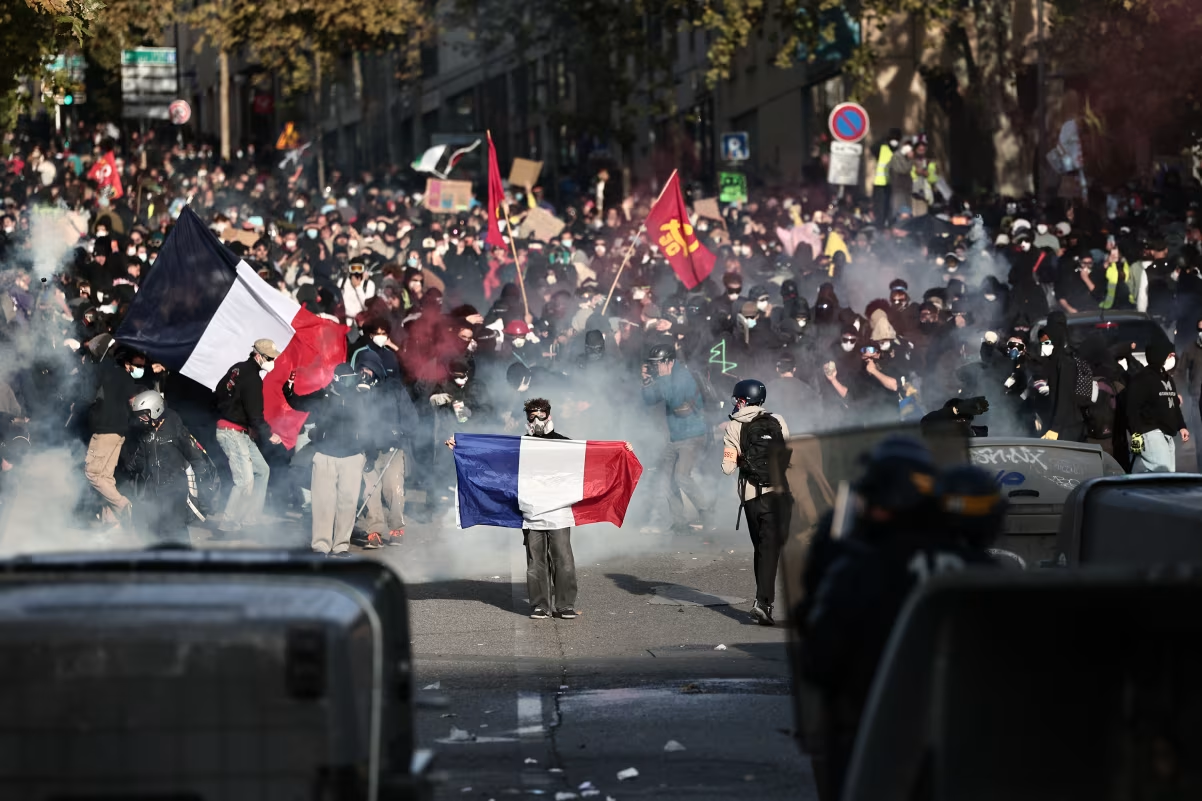
The unrest began in mid-September with school blockades over conditions and university admissions, then widened into complaints about the cost of living. On Saturday, Oct. 24, authorities counted 410,000 marchers nationwide, while the CGT union claimed nearly 800,000. Interior Minister Laurent Nuñez said Monday that 1,435 people were arrested that day. He said organized far-right gangs had confronted, in Nice and Montpellier, what he called the “ultra-left.”
Lecornu offered students a package on Monday that includes replacing the Parcoursup admissions system in 2028 and adding 15,000 higher education places. Student leaders said it fell short. “Not all our demands were met,” Louis Letoublon, a high school student representative, told France 24. “We’ll go on for as long as it takes.” Manon Moret, secretary-general of the UNEF student union, said the government’s strategy is “to answer with crumbs, but we won’t settle for them,” in our translation of her remarks to BFM.
The turmoil has registered in the United States. On Oct. 22 at 10:30 a.m. Central time, the French 10-year yield stood at 5.07%, above the 5.02% on the U.S. 10-year. French fiscal troubles, wrote Axios’s Neil Irwin, have made a “significant pool of global safe assets look significantly less safe” and U.S. debt “comparatively attractive.”
In a Truth Social post on Oct. 19, President Donald Trump called France a nation “being conquered, looted, and burned to the ground by migrants, jihadists, and Communists.” Speaking during a visit to Qatar on Oct. 21, President Emmanuel Macron said foreign disinformation had “prompted comments that were as unacceptable as they were stupid from many people, including foreign leaders.” Asked whether he meant Trump, he answered: “Among others.”
The calendar ahead
More rallies are planned for Saturday, Oct. 31, and unions have called a national day of action for Nov. 5. The European Central Bank meets Thursday.
The National Assembly takes its vote on the revenue section of the 2027 state budget on Nov. 3. If the section is rejected, the Assembly does not examine the spending side, and the Senate takes up the government’s text. Parliament has until Dec. 17 to adopt the budget.
Author

We cover the world’s chaos so you don’t have to scroll twelve feeds to understand it.
Sign up for Atlas newsletters.
Stay up to date with curated collection of our top stories.