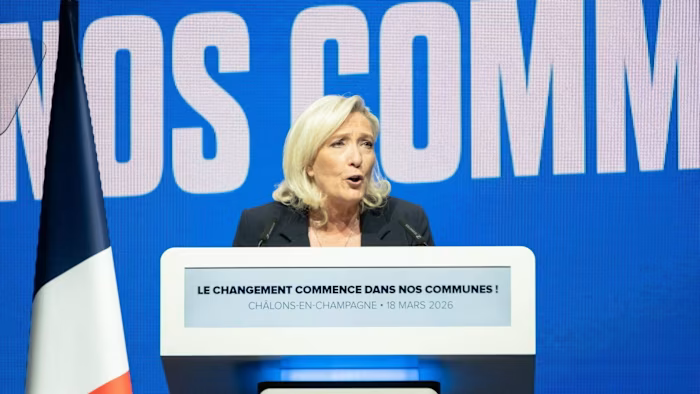
France's second-round municipal elections on Sunday produced a fragmented map of gains and losses across the political spectrum, with the left holding Paris and Marseille, the far-right National Rally capturing Nice, and the mainstream conservative Les Républicains picking up a string of smaller cities — results that left every major party with something to claim heading into the final year before the 2027 presidential election.
Voter turnout told its own story. By 5 p.m. Sunday, only 48.1 percent of registered voters had cast ballots, slightly below the first-round figure of 48.9 percent at the same point in the day. It marked another low in a decades-long trend of declining participation in French local elections, with turnout in the second round falling more than four points compared to the equivalent moment in the 2014 municipal vote.
Paris and Marseille Stay Left
Socialist candidate Emmanuel Grégoire won the Paris mayoral race decisively, defeating conservative rival Rachida Dati and extending the left's unbroken run atop the French capital's city hall to 25 years. Grégoire, 48, ran a list that united the Socialists, the Greens, and the Communists. Dati acknowledged defeat Sunday evening after projections placed Grégoire well ahead.
Grégoire had notably refused to strike a second-round deal with the hard-left France Unbowed party — a strategic decision that analysts said served him well, allowing him to consolidate the left-of-center vote without the political baggage attached to France Unbowed leader Jean-Luc Mélenchon. He succeeds Anne Hidalgo, who had chosen not to seek a third term after leading the city through the 2015 attacks and the 2024 Paris Olympics.
In Marseille, France's second-largest city, incumbent Socialist Mayor Benoît Payan held off National Rally candidate Franck Allisio, winning with roughly 54 percent of the vote. The outcome came as a setback for the RN, whose candidate had polled neck-and-neck with Payan after the first round. Payan's hard-left rival withdrew between rounds to consolidate opposition to the far right — a move that proved decisive. Payan adopted the same approach as Grégoire in Paris: he did not formally ally with France Unbowed but benefited from the consolidation of anti-RN voters behind his candidacy.
Nice Goes to the Far Right
The night's clearest far-right victory came in Nice, France's fifth-largest city, where Eric Ciotti defeated longtime incumbent Christian Estrosi. Ciotti, who was ousted from the leadership of the center-right Les Républicains in 2024 after attempting to forge an alliance with Marine Le Pen's party, ran as an RN ally. His win gives Le Pen's political orbit control of a major Mediterranean city for the first time.
National Rally president Jordan Bardella called it "the greatest breakthrough in the party's entire history," pointing to gains in dozens of smaller municipalities where the RN had no prior presence. The party also held Perpignan in the first round and won several smaller cities in the French heartland, including left-wing bastions Vierzon, Liévin, Carcassonne, and Castres.
But the bigger urban targets slipped away. The RN lost in Toulon despite leading by 13 points after the first round — a result that illustrated the durability of the so-called "Republican Front," the informal coalition of rival parties that bands together between rounds to block far-right candidates. The party also failed in Nîmes. RN officials rejected the characterization that Sunday represented a glass ceiling, but the defeats in Toulon, Nîmes, and especially Marseille gave mainstream parties a concrete rebuttal to the narrative of inevitable far-right advance.
Le Havre and the Presidential Backdrop
Former Prime Minister Édouard Philippe won re-election as mayor of Le Havre in a three-way race that he had framed as a prerequisite for his presidential ambitions. Philippe had publicly conditioned his entry into the 2027 race on holding his hometown — a test he now passed. Opinion polls currently show him as the candidate most likely to advance to the presidential runoff, where he would likely face the National Rally.
"There were reasons to be hopeful," Philippe said Sunday night, arguing the results showed French voters would "beat back extremist forces."
Macron's centrist Renaissance party, which has struggled to build local infrastructure since its founding, picked up Bordeaux through candidate Thomas Cazenave, a former minister, who defeated the Green incumbent. A centrist candidate with Macron's backing also won in Annecy.
The Left's Internal Fractures
The election exposed deep tensions within the French left over whether the Socialists should work with France Unbowed. Where the two parties allied, the results were largely poor.
In Toulouse, LFI's François Piquemal lost to incumbent conservative Jean-Luc Moudenc by 53.9 to 46.1 percent, despite a combined left-wing first-round total of 52.5 percent — the alliance failing to hold its arithmetic together in the runoff. Left-wing incumbents who had allied with Mélenchon's party were also beaten in Clermont-Ferrand, Limoges, Brest, Poitiers, and Besançon.
Les Républicains' leader Bruno Retailleau was quick to claim those defeats as evidence that alliances between the Socialists and France Unbowed — which he had labeled "shameful alliances" throughout the campaign — cost the left cities it had held for decades. Clermont-Ferrand, a Socialist stronghold since 1944, flipped to the right through just such a dynamic.
Former Socialist President François Hollande warned Sunday that "unity for the sake of unity" would lead the left to "an impasse," calling for the party to clarify its strategy toward Mélenchon's movement before the presidential campaign begins in earnest.
The question of whether and how France's left can cohere — with or without France Unbowed — is now directly tied to the party's viability in the 2027 race. So too is the question for Les Républicains of whether it will accept alliances with the far right along the lines of what Ciotti executed in Nice, or pursue what Retailleau described Sunday as an "alternative path" — autonomous, centrist, and distinct from both the hard left and the National Rally. The party's working group on candidate selection is set to present its conclusions Tuesday, with members expected to choose between a closed primary, a semi-open primary, or direct designation by the party president in April.
Author

We cover the world’s chaos so you don’t have to scroll twelve feeds to understand it.
Sign up for Atlas newsletters.
Stay up to date with curated collection of our top stories.