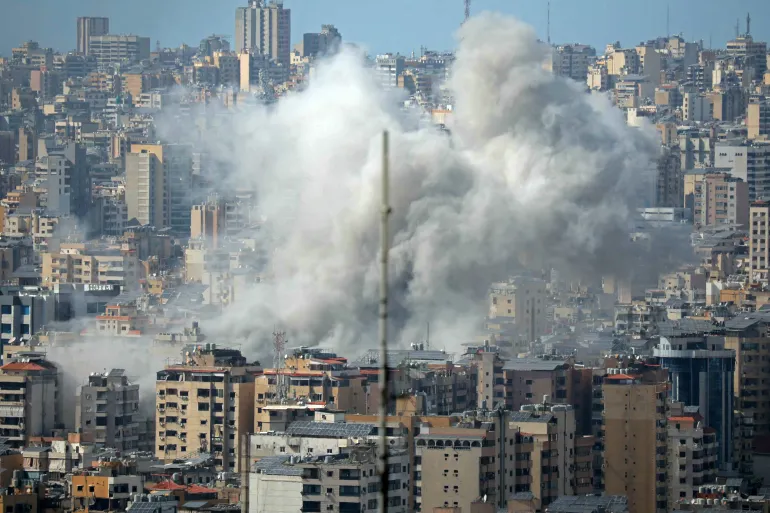
Israeli airstrikes hit multiple parts of Lebanon on Easter Sunday, killing civilians in Beirut and southern districts and widening a campaign that has increasingly extended beyond the areas that had absorbed most of the earlier fighting. By the end of April 5, the reported death toll from the day’s strikes had reached at least 11 in some counts and 14 to 15 in others, depending on whether later strikes east of Beirut and in other southern localities were included in the running total. What was not in dispute was the basic pattern: strikes hit the Jnah area of Beirut, the southern town of Kfar Hatta, and several additional sites across the country as low-flying aircraft passed over the capital during Easter services.
The most widely cited incidents were in Jnah, near Beirut’s southern suburbs, and in Kfar Hatta near Sidon. Lebanese health officials said the Jnah strike killed at least four people and wounded 39, while the Kfar Hatta strike killed seven, including a 4-year-old girl. Some later reporting from the same day also described an apartment strike in Ain Saadeh east of Beirut that killed three people, including Pierre Maawad, a local Lebanese Forces official, which appears to explain why some tallies moved beyond the initial 11 dead.
The timing added to the visibility of the attacks. Lebanon’s Christians, who make up roughly a third of the population, were marking Easter Sunday as the bombardment intensified. In Beirut, worshippers and residents reported hearing the sound of aircraft overhead through the day, while southern suburbs of the capital were hit in repeated waves.
The Jnah strike and the Beirut front
In Beirut, the deadliest strike hit the Jnah neighborhood, an area adjacent to the southern suburbs that are commonly associated with Hezbollah’s presence but that also contain apartment blocks, civilian traffic, and medical facilities. Lebanese officials said the strike landed roughly 100 meters from Rafik Hariri University Hospital, the country’s largest public hospital. Hospital officials reported fatalities, injuries, broken glass, and panic among patients after the blast. In one account from the hospital, the dead included three Sudanese nationals and a 15-year-old girl.
The Jnah strike also drew attention because one attack came with prior warning while another nearby strike did not. A three-story building in the neighborhood sustained heavy damage, and local reports described residents still inside when the blast hit. Israel said it had begun striking Hezbollah infrastructure sites in Beirut and had earlier issued evacuation warnings for parts of the Dahiyeh area, though the strike that produced the deaths in Jnah was described in one account as having come without warning shortly after an earlier warned strike.
Israeli statements framed the Beirut attacks as part of a broader effort against Hezbollah infrastructure. Lebanese reporting, meanwhile, reflected the practical impact on civilians living or sheltering near the target zones. Around the capital, southern suburbs were hit eight times over the course of the day in one account, reinforcing the sense that this was not a single isolated attack but part of a broader air operation over Beirut and its outskirts.
Kfar Hatta and the southern toll
South Lebanon accounted for the other major cluster of deaths. In Kfar Hatta, a strike killed seven people after the Israeli military had issued an evacuation order for the village the previous night. Lebanese civil defense officials said a displaced family of six was waiting for a relative to pick them up when the strike hit. The relative also died. Accounts from the scene described multiple homes destroyed.
The Kfar Hatta strike was not the only southern incident. A Lebanese soldier was reported killed in a separate Israeli strike in southern Lebanon, and other attacks were reported in places including Toul, Maaroub, Haris, Shahabiya, Srifa, Shaaitiyeh, Siddiqine, and Abbassiyeh. In Toul, one drone strike hit a car and killed two members of the same family, while in Ain Saadeh east of Beirut another strike killed Pierre Maawad and critically injured his wife. These additional incidents pushed the day’s casualty picture beyond the two most heavily reported strike sites.
By this stage of the war, civilian displacement was already extensive. Lebanese authorities said more than one million people had been displaced since the start of the campaign, and one later figure put the number at over 1.1 million. Kfar Hatta itself was hosting displaced residents from farther south, which helps explain why people who were already uprooted were among those killed on Easter Sunday.
A wider military and political message
The Easter strikes took place inside a wider military escalation that has linked Lebanon directly to the broader U.S.-Israeli war with Iran. Hezbollah entered the conflict on March 2 by firing rockets at Israel in support of Tehran, and Israel responded with airstrikes across Lebanon and a ground invasion in the south. By April 5, Lebanese health ministry figures cited in several reports said more than 1,400 people had been killed in Lebanon since the campaign began, with one count listing 1,461 dead and 4,430 wounded.
The same day, Israel also pressured a major civilian artery linking Lebanon and Syria. After warning that it would strike the Masnaa border crossing on the grounds that Hezbollah was using it for military purposes, Israel prompted the crossing’s closure. Lebanese and Syrian officials moved traffic away, and Syria temporarily suspended use of the crossing, redirecting travelers to other routes. That threat mattered beyond its immediate tactical significance because Masnaa is the principal land gateway between the two countries and a critical route for commerce and civilian movement.
Hezbollah, for its part, said it had fired a cruise missile at an Israeli naval vessel off the Lebanese coast. Israeli officials said they were not aware of such an incident. On land, Israel’s military chief, Lieutenant General Eyal Zamir, visited troops in southern Lebanon and pledged intensified operations against Hezbollah.
Lebanon’s response and the direction of the war
Lebanon’s political response on Easter was shaped by the scale of the destruction and the sense that the conflict was moving deeper into the country. President Joseph Aoun used a televised Easter address to defend his push for negotiations with Israel, arguing that talks were the only available route to stop the military campaign and prevent broader destruction. He framed the choice in practical rather than ideological terms, saying Lebanon had to avoid a situation in which its south was destroyed before diplomacy began.
That message reflected the broader reality of April 5. The day’s strikes were not confined to a single front-line belt. They reached Beirut, areas east of the capital, and multiple southern localities. They hit neighborhoods near hospitals, struck displaced families, and forced the closure of a major border crossing. On Easter Sunday, the war in Lebanon presented itself not as a contained exchange at the frontier, but as a campaign spreading across the country with civilian movement, public services, and religious observance all unfolding under the sound of aircraft and repeated strikes.
Author

We cover the world’s chaos so you don’t have to scroll twelve feeds to understand it.
Sign up for Atlas newsletters.
Stay up to date with curated collection of our top stories.