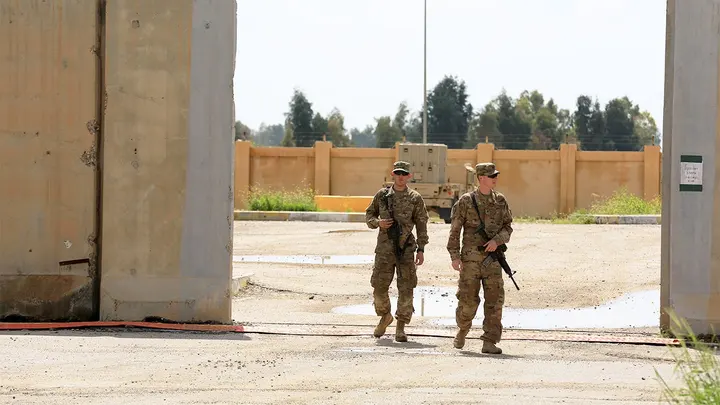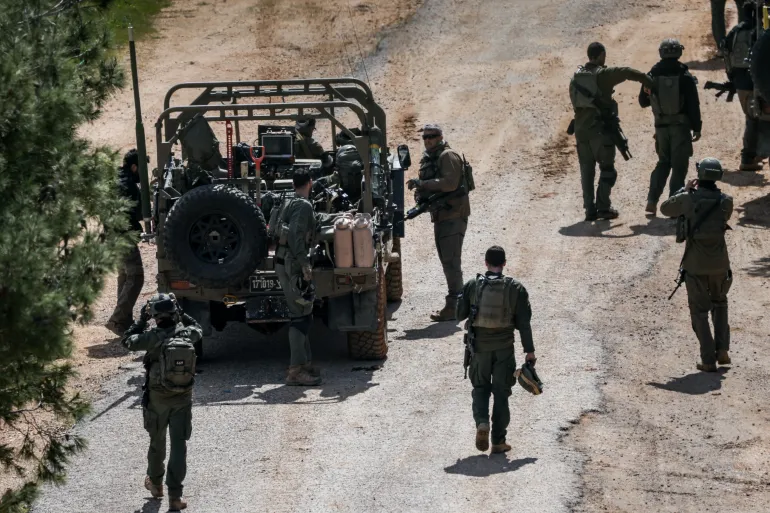
Benjamin Netanyahu stood at the Israeli Northern Command on Sunday and gave an order that will reshape the map of southern Lebanon. The prime minister instructed the IDF to widen its ground campaign beyond the buffer zone already carved out over the past four weeks — a push aimed at driving Hezbollah's anti-tank fire and rocket launchers further from the Israeli border.
He did not say how far the expansion would go. His office declined to elaborate, and the security cabinet had not formally discussed the directive. What is clear is that Israeli forces are now operating at or near the Litani River, about 30 kilometers north of the border, with no stated timeline for leaving. Defense officials have told reporters the military expects to remain in southern Lebanon "for at least several months and possibly years," even if a ceasefire takes hold.
"We are determined to fundamentally change the situation in the north," Netanyahu said. He tied the Lebanon front directly to the ongoing war with Iran, describing a multi-front campaign against Tehran and its allied groups. The IDF, he said, had already destroyed a vast portion of Hezbollah's arsenal. But the group retains what he called "a residual capability to launch rockets at us."
That residual capability showed itself clearly last week. Between Wednesday and Thursday alone, Hezbollah fired roughly 600 projectiles at Israel in a single 24-hour stretch. One Israeli was killed. Israel's air defenses and years of civilian shelter drills absorbed most of the rest.
What Four Weeks of Fighting Have Produced
The ground campaign in southern Lebanon has been methodical and grinding. Israeli troops have advanced through villages and hillsides under persistent indirect fire — rockets, artillery, drones, anti-tank missiles — while Hezbollah has largely avoided direct engagement. Soldiers on the ground describe seconds of warning for incoming rounds, diving behind armored vehicles or whatever cover they can find.
More than 400 Hezbollah fighters have died since March 2, according to sources familiar with the group's internal tally. Five Israeli soldiers have been killed and more than 30 wounded. On the Lebanese side, authorities say the overall death toll exceeds 1,200, including 124 children, with more than 3,500 wounded. Lebanon's Health Ministry does not separate civilian casualties from combatants in its figures.
The destruction is visible from orbit. Satellite imagery shows whole residential blocks leveled across southern Lebanon, with a growing network of Israeli military positions now established in the area. The IDF has demolished at least five bridges over the Litani. Defense Minister Israel Katz said last week that the military intends to control the remaining crossings and secure the entire zone south of the river.
Overnight Saturday, Israeli forces struck weapons depots and operational buildings in Beirut's southern suburbs and across the Beqaa Valley, dismantling a loaded rocket launcher aimed at Israel. The military said it would keep hitting sites used by Hezbollah to plan and execute attacks.
A Country Coming Apart at the Seams
Lebanon is absorbing the consequences. The United Nations puts the number of displaced at more than 1.2 million. The burden has fallen overwhelmingly on the country's Shiite population, which dominates the south and the Beirut neighborhoods Hezbollah controls. Displaced families have poured into Christian, Druze, and mixed-sect communities — and the friction is building.
Local councils in some receiving areas have started requiring strict rental agreements from newcomers. Christian lawmakers have warned that Hezbollah's constituency is being pushed into areas where their presence could ignite old sectarian fault lines. Lawmaker Wael Abu Faour called the growing political divisions a "ticking bomb" for Lebanon's social fabric.
A UNIFIL peacekeeper was killed Sunday after a projectile struck a site near Adchit al-Qusayr in southern Lebanon. Another was critically injured. UNIFIL said it could not confirm the origin of the projectile and launched an investigation.
Prime Minister Nawaf Salam's government has openly opposed Hezbollah's military actions and pushed for diplomatic engagement with Israel — a stance that has cracked open a confrontation between the state and the militant group that has been decades in the making. Hezbollah leaders have responded by likening the government to Vichy France, a comparison designed to delegitimize Salam's authority among the group's base.
The underlying math hasn't changed. Hezbollah's military arsenal still outstrips the Lebanese Armed Forces in key areas. The LAF deployed more than 9,000 soldiers south of the Litani earlier this year and claimed to have established a monopoly on weapons in the zone. Then Hezbollah launched rockets at Israel on March 2 — and that claim evaporated.
Iran's Hand on the Controls
Western and Israeli officials increasingly see the IRGC, not Hezbollah's political wing, as the real decision-maker behind the group's military operations. IRGC-Quds Force commanders are reportedly on the ground in Lebanon, advising Hezbollah fighters and in some cases directly operating weapons systems.
The collapse of the Assad regime in Syria shut down what had been the most reliable overland corridor for Iranian arms shipments into Lebanon. But the pipeline has not dried up. Alternative routes through Iraq and maritime smuggling channels continue to function. Israeli officials say Hezbollah has received fresh Iranian weapons in recent months, even as the group absorbs heavy losses.
For Israel, this presents a structural problem that no buffer zone can fully resolve. Hezbollah's relationship with Iran is not incidental — it is the foundation of the organization's existence. As long as the Islamic Republic stands and seeks to project power through proxies, Hezbollah will have a patron willing to rebuild what Israel destroys.
The United States has given Israel relative freedom of action in Lebanon while Washington's attention is consumed by the Iran front and the Strait of Hormuz standoff. Western diplomats say the main American condition has been that Israeli strikes avoid civilian infrastructure, though the scale of destruction documented by humanitarian organizations suggests that line has blurred considerably.
The Ghost of 1982
Nobody in the Israeli defense establishment has forgotten what happened last time. In 1982, the IDF pushed all the way to Beirut and succeeded in driving the PLO out of Lebanon. It was a clear military win. What followed was a disaster. The Israeli occupation of the south radicalized Lebanon's Shiite community and gave birth to Hezbollah — a force that proved far more dangerous, far more entrenched, and far more difficult to dislodge than the PLO ever was. Former Defense Minister Ehud Barak put it starkly: "It was our presence there that created Hezbollah."
The Israeli military has studied that history. The question is whether the political leadership has absorbed its lesson. Military officials have called on politicians to secure a deal that leads to Hezbollah's disarmament. But few people in Jerusalem, or anywhere else, believe the Lebanese government has the ability or the will to carry that out. The LAF is underfunded, underequipped, and includes a large Shiite contingent whose loyalties in a forced disarmament scenario are uncertain at best. U.S. Special Envoy Tom Barrack has acknowledged publicly that the LAF is "not well equipped" and that Hezbollah fighters earn more than Lebanese soldiers.
Lebanon's May 2026 parliamentary elections loom over the entire calculation. If Hezbollah and its allies perform well at the polls, the already narrow political window for disarmament could slam shut. But continued Israeli bombing risks undermining the very government that is supposed to be the partner in replacing Hezbollah's presence in the south. A Lebanese state seen as a foreign instrument will fail. Analysts say that is not a prediction — it is a pattern.
Netanyahu has made his position plain. Israel will act as it sees fit, for as long as it sees fit, regardless of what happens on the diplomatic track with Iran. The IDF is digging in deeper. Over a million Lebanese are displaced. Hezbollah is battered but still firing. And the fundamental question — what comes after the shooting stops — has no answer anyone in Jerusalem, Beirut, or Washington is prepared to give.
Author

We cover the world’s chaos so you don’t have to scroll twelve feeds to understand it.
Sign up for Atlas newsletters.
Stay up to date with curated collection of our top stories.