Japan crossed a line on Tuesday that it had drawn for itself eight decades ago. For the first time since the end of World War II, the country's military deployed domestically built long-range missiles capable of striking targets in neighboring countries — a development that gives Tokyo offensive firepower it has deliberately avoided possessing for its entire postwar history.
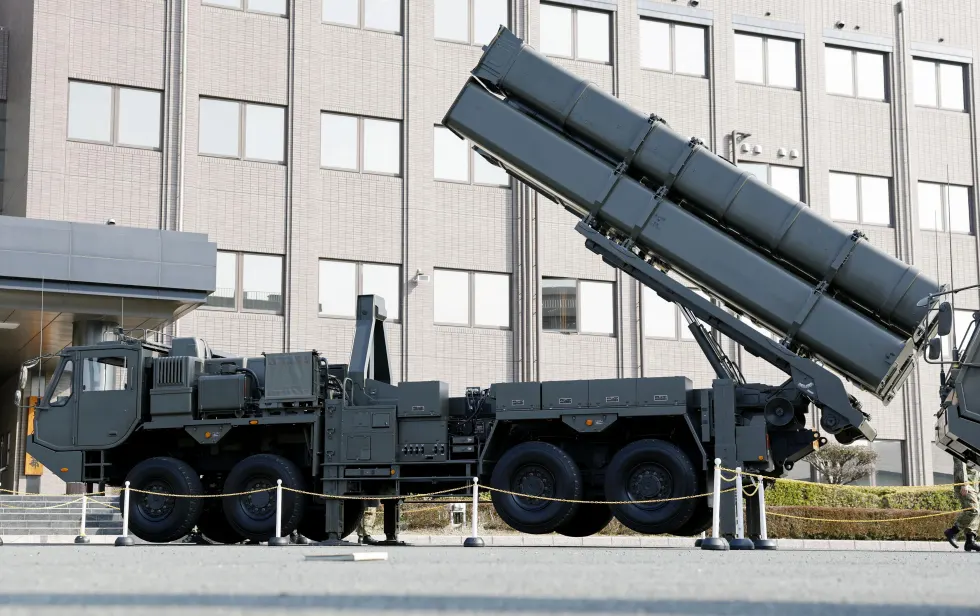
The Ground Self-Defense Force stationed upgraded Type-12 surface-to-ship missiles at Camp Kengun in Kumamoto prefecture on the island of Kyushu. The same day, a separate weapon system — the Hyper Velocity Gliding Projectile for island defense — was deployed to Camp Fuji in Shizuoka prefecture, west of Tokyo. Both systems received new designations: Type-25 surface-to-ship missile and Type-25 HVGP.
"As Japan faces the most severe and complex security environment in the postwar era, it is an extremely important capability to strengthen Japan's deterrence and responsiveness," Defense Minister Shinjiro Koizumi told reporters. "It demonstrates Japan's firm determination and capability to defend itself."
The upgraded Type-12 missile, developed and produced by Mitsubishi Heavy Industries, has a range of roughly 1,000 kilometers — five times the 200-kilometer reach of the original version. From Camp Kengun, that range covers nearly the entire East China Sea, large portions of the Chinese coastline, waters northeast of Taiwan, and most of North Korea.
Outside the camp's gates, residents held placards reading "We don't need missiles" and "We oppose the deployment."
What Changed and Why
Japan's pacifist constitution, imposed after its defeat in 1945, has defined the country's military posture for generations. The Self-Defense Forces existed to do exactly what the name implied — defend Japanese territory. Striking enemy bases, projecting power beyond its borders, and maintaining offensive weapons were all considered off-limits.
That framework held for decades. Then the security environment around Japan started shifting faster than the policy could accommodate.
China now fields an estimated 2,000 ground-launched missiles with ranges between 1,000 and 5,500 kilometers — far more than both Japan and the United States have in the region. Beijing has expanded its aircraft carrier operations near Japanese territory, with two carriers spotted operating simultaneously near Japanese remote islands in the Pacific last June. North Korea has continued developing increasingly sophisticated ballistic missiles, firing as many as 10 in a single salvo in March.
In December 2022, Japan revised its three core security documents — the National Security Strategy, the National Defense Strategy, and the Defense Buildup Program — formally introducing the concept of "counterstrike capabilities." The government defined this as the ability to strike enemy missile launch sites or military targets if Japan comes under attack or an attack is imminent.
Japanese officials stress the capability remains defensive in nature. The government has long held that counterstrikes are constitutional so long as three conditions are met: an armed attack has occurred or is imminent, there is no other means to halt it, and the use of force is limited to the minimum necessary.
Critics inside and outside Japan are not reassured. China's People's Liberation Army newspaper condemned the deployment, accusing Japan of creating a "kill network" capable of targeting both coastal and inland areas of neighboring countries.
The Weapons
The two systems deployed Tuesday serve different purposes. The Type-25 surface-to-ship missile is designed primarily to hit hostile naval vessels — aircraft carriers, amphibious assault ships, and other platforms that could threaten Japanese territory or its southwestern island chain. Its extended range also gives it the ability to strike land-based targets such as missile launch facilities, making it a core component of the new counterstrike doctrine.
The Type-25 HVGP operates differently. It is launched from the ground, reaches a high altitude, then separates from its booster and glides toward its target at supersonic speeds along unpredictable trajectories. That combination of speed and irregular flight path makes it extremely difficult for missile defense systems to intercept. The current version has a range in the hundreds of kilometers. Japan plans to develop a variant with a range of roughly 2,000 kilometers.
The HVGP is intended primarily for defending Japan's remote islands — a mission that has grown more urgent as tensions over the Senkaku Islands in the East China Sea have intensified. China claims the islands, which it calls the Diaoyu, and has stepped up military and coast guard activity in the surrounding waters.
Both weapons are being assigned initially to training and doctrine development units. The HVGP in particular represents an entirely new category of weapon for the Ground Self-Defense Force, and the military needs time to work out operational tactics and procedures.
Tomahawks and What Comes Next
The homegrown missiles are only part of a broader buildup. Japan is also acquiring foreign weapons to fill out its long-range strike capability.
The Maritime Self-Defense Force announced Monday that its Kongo-class destroyer JS Chokai has completed modifications to carry and launch American-made Tomahawk cruise missiles — the first Japanese warship to receive that capability. Live-fire testing is planned for this summer in the United States, with the ship expected to return to Japan around September.
Japan has ordered 400 Tomahawk missiles from RTX Corporation — 200 Block IVs with a range of roughly 1,600 kilometers and 200 Block Vs with an expected range beyond that. Deliveries have already begun. The MSDF plans to eventually equip all eight of its Aegis destroyers with Tomahawks.
The Air Self-Defense Force has also started receiving Norwegian-made Joint Strike Missiles, with a range of about 500 kilometers, for mounting on its F-35A stealth fighters. Ship-launched and aircraft-launched variants of the Type-25 missile are expected to enter service in fiscal year 2027, a year ahead of the original schedule.
Additional deployments of the ground-based systems are planned across Japan. The HVGPs at Camp Fuji will be joined by operational units at Camp Kamifurano in Hokkaido and Camp Ebino in Miyazaki prefecture in fiscal 2026. Prime Minister Sanae Takaichi's cabinet approved a record defense budget exceeding 9 trillion yen — roughly $58 billion — for the fiscal year beginning in April, with counterstrike capability and coastal defense as top priorities.
Japan has also announced plans to deploy medium-range surface-to-air missiles on Yonaguni Island, just 110 kilometers east of Taiwan, by fiscal 2030. Defense Minister Koizumi last week established a new office dedicated to studying China's Pacific military activity.
Local Opposition and Strategic Tensions
The deployments have not gone smoothly at the local level. Residents near Camp Kengun staged protests after missile-related equipment was trucked into the base on March 9 without prior notification to the community. The camp sits in a densely populated area of central Kumamoto — 1.5 kilometers from the prefectural government office, adjacent to a city hospital, and roughly 200 meters from residential homes. Local officials said 29 childcare facilities, 12 elementary schools, and multiple high schools fall within a 2-kilometer radius.
Kumamoto Mayor Kazufumi Onishi said the Defense Ministry's handling of the process undermined public trust. The ministry held a closed equipment exhibition and question-and-answer session for local government leaders on March 17 but has not conducted a public briefing. Koizumi told reporters Tuesday that while no public briefing is currently planned, the ministry could consider holding one.
Tensions with Beijing, meanwhile, are likely to sharpen. Japan's 2022 strategy documents explicitly identify China as the primary driver of the changing security environment. Takaichi said in November that any Chinese military action against Taiwan could constitute grounds for a Japanese military response — a statement that drew sharp criticism from Beijing.
The PLA Daily warned that the upgraded Type-12 missiles deployed from Kyushu could cover nearly the entire East China Sea and reach coastal cities on the Chinese mainland. The newspaper described the weapons as having "distinct offensive capabilities" that mark a transition "from a primarily defensive weapon to a long-range system capable of striking targets in neighboring countries."
Japan's counterargument is straightforward: the weapons are defensive, the doctrine is constitutional, and the threats are real. Whether the rest of the region sees it that way is another matter. For the first time since 1945, Japan has the ability to hit back at a distance. That fact alone changes the calculations of every military planner in Northeast Asia.
Author

We cover the world’s chaos so you don’t have to scroll twelve feeds to understand it.
Sign up for Atlas newsletters.
Stay up to date with curated collection of our top stories.