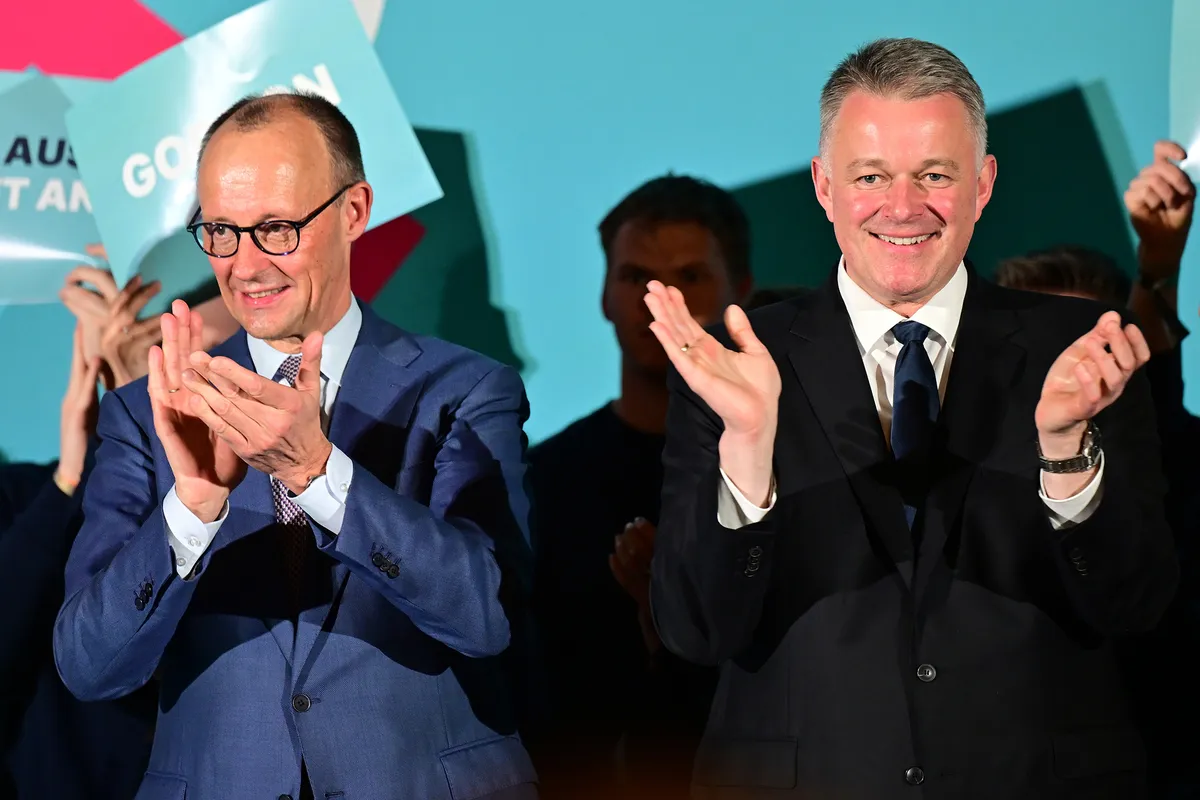
Friedrich Merz got the win he needed. His Christian Democratic Union took 30.8 percent of the vote in Rhineland-Palatinate on Sunday, dislodging the Social Democrats from a state premiership they had held since 1991. The SPD pulled 26 percent — a nearly ten-point collapse from five years ago.
Gordon Schnieder, the CDU's lead candidate and brother of federal Transport Minister Patrick Schnieder, claimed victory on election night and promised a policy reset on education, security, and the economy. He is expected to replace outgoing SPD Premier Alexander Schweitzer atop a new CDU-led grand coalition, replicating the federal government's setup at the state level.
For Merz, it was a much-needed result. Two weeks earlier, his party blew a commanding lead in neighboring Baden-Württemberg and lost to the Greens by less than a percentage point. That defeat rattled the CDU's base and undercut Merz's standing barely ten months into his chancellorship. Rhineland-Palatinate steadied the ship — but the broader picture remains far from settled.
AfD Doubles Its Vote, Sets Western Record
The real story out of Sunday's election was the Alternative for Germany. The right-wing party surged to 19.5 percent, more than doubling the 8.3 percent it earned in the same state in 2021. No western German state has ever handed the AfD a result that high.
Alice Weidel, one of the party's national leaders, called it a "great success" and said the AfD would press forward as the country's leading opposition force. "Voters appreciate the work we've done as opposition party," Weidel said. "We will continue on this path so that we can join the government in the next election."
The eleven-point jump dwarfed every other party's movement on the board. The CDU gained roughly three points. The Left Party picked up a couple. Every governing party — the SPD, Greens, and Free Democrats — lost ground. The FDP dropped below the five-percent threshold entirely and will no longer sit in the state parliament.
Rhineland-Palatinate follows an almost identical AfD performance in Baden-Württemberg, where the party also captured around 20 percent. Taken together, the two results bury the notion that AfD support is an eastern phenomenon. The party is gaining traction in the industrial west, in states with BASF plants and U.S. military bases, among voters who five years ago backed mainstream parties without hesitation.
Schnieder and the CDU leadership moved quickly to reaffirm the so-called firewall — the postwar consensus that no mainstream party will govern alongside the AfD. "It would spell the downfall of this country if we were to bring the AfD on board here," Schnieder said. AfD co-leader Tino Chrupalla pushed back, demanding the CDU explain how it intended to govern conservatively while refusing to work with the only party gaining conservative voters at scale.
SPD Hits the Wall
Sunday was another brutal night for the Social Democrats. Rhineland-Palatinate was supposed to be friendly territory. The SPD had run the state for 35 years. Schweitzer, the incumbent, polled well ahead of Schnieder on personal favorability. None of it mattered.
The loss came two weeks after the SPD scraped 5.5 percent in Baden-Württemberg — the worst showing in that state's postwar history and a result that barely cleared the threshold for parliamentary representation. On the same Sunday as the Rhineland-Palatinate vote, Munich's long-serving SPD mayor, Dieter Reiter, lost a runoff to a Green candidate, ending the party's near-continuous hold on the Bavarian capital stretching back to 1948.
Finance Minister Lars Klingbeil, who also serves as SPD national leader, did not try to dress it up. "I know this result will spark personnel debates," he told ARD. He took responsibility, said the results "hurt," and ruled out resigning — pledging instead to work with Merz on a reform package centered on income tax changes. The party's general secretary called it a "bitter setback."
Nationally, the SPD hit bottom in the February 2025 federal election under Olaf Scholz, pulling 16.4 percent — its worst result in over a century. Nothing since has reversed the slide.
Voters Focused on the Economy
Rhineland-Palatinate is a state of about four million people, known for steep river valleys lined with vineyards and home to heavy industry, chemicals giant BASF, and several U.S. military installations, including Ramstein Air Base. It is not a state accustomed to political earthquakes.
But voter surveys on election night pointed to a clear shift in priorities. Economic concerns and social security dominated. Climate and environmental issues, which ranked high in 2021, dropped significantly — though they still placed ahead of immigration as an election topic.
Germany has now endured multiple consecutive years of stagnation. Manufacturing is contracting. The Iran war has introduced fresh anxiety over energy costs. Merz took office promising to reboot the economy, but ten months in, satisfaction with his coalition government remains low.
Jens Spahn, the CDU's parliamentary group leader, stuck to the economic message. "We need growth again in Germany after three years of recession and stagnation," he said. "That is the defining issue for the nation."
The Road to September
Rhineland-Palatinate was the second of five state elections this year. Three more follow after the summer break — in Berlin, Mecklenburg-Western Pomerania, and Saxony-Anhalt. The eastern contests will test whether anyone can slow the AfD's momentum.
In Saxony-Anhalt, polling puts the AfD within reach of an outright majority. If that holds, the party would control a state government for the first time since it was founded in 2013. The SPD, meanwhile, is polling near the five-percent line in that same state — fighting not for power but for survival.
Nationally, the CDU and AfD are locked near 25 percent apiece. Weidel has already sharpened her attacks on Merz in the Bundestag. "While you go on and on about world politics, German industry is collapsing," she told the chancellor earlier this week. "The exodus is in full swing."
Merz faces a governing landscape with no easy path. His coalition partner is in freefall. The opposition to his right is growing. The economy has not turned. And the firewall — the one structural barrier between the AfD and real power — depends entirely on the willingness of mainstream parties to keep holding the line, even as the voters behind it continue to walk away.
Author

We cover the world’s chaos so you don’t have to scroll twelve feeds to understand it.
Sign up for Atlas newsletters.
Stay up to date with curated collection of our top stories.