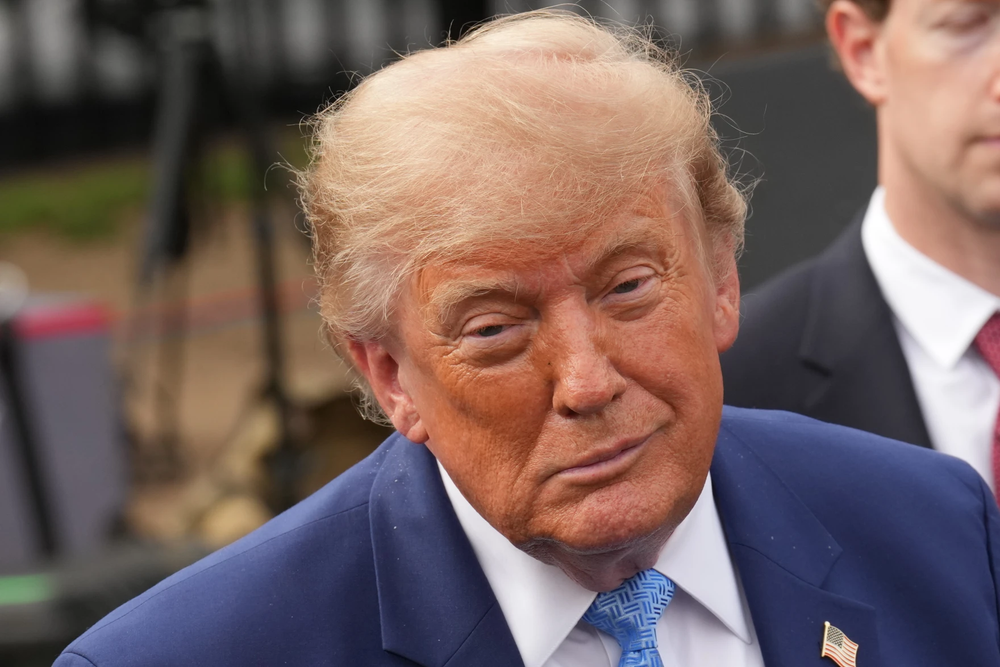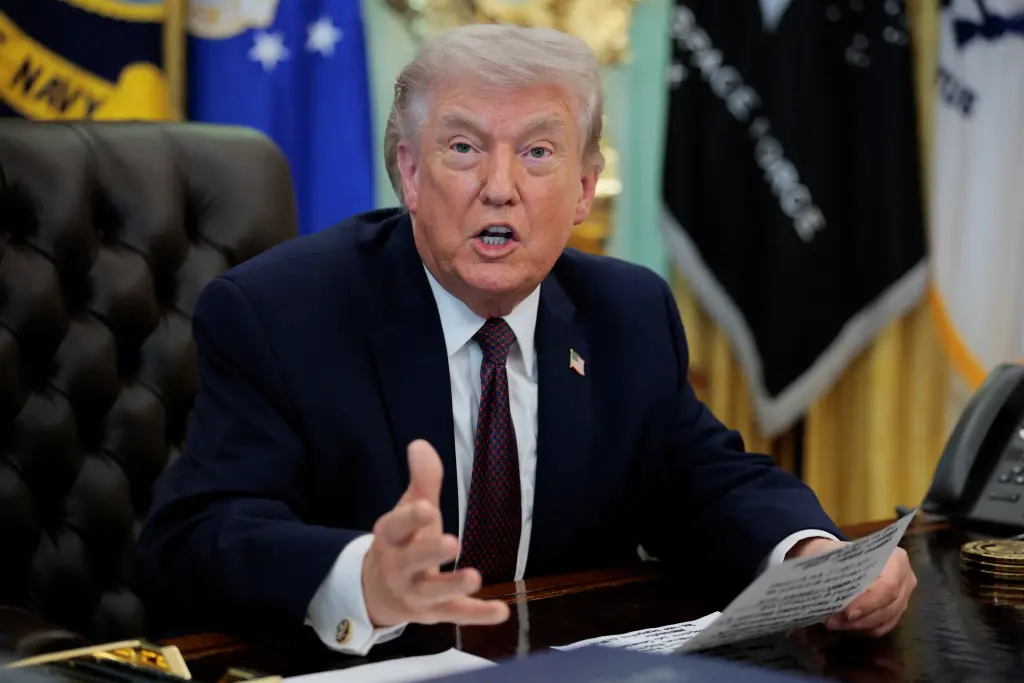
President Trump signed an executive order Tuesday directing the federal government to create lists of verified U.S. citizens eligible to vote in each state and instructing the U.S. Postal Service to send absentee ballots only to people on those lists. The order represents the most aggressive use of executive authority over American elections in modern history and is expected to face immediate legal challenge.
"The cheating on mail-in voting is legendary. It's horrible, what's gone on," Trump said at the signing ceremony in the Oval Office. "I think this will help a lot with elections."
The order arrives seven months before the November midterm elections, in which Republicans are defending narrow majorities in both the House and Senate. It bypasses Congress, where the president's preferred legislation — the SAVE America Act, which would require documentary proof of citizenship to register to vote — has passed the House but stalled in the Senate, where it lacks the 60 votes needed to advance.
Trump dismissed the prospect of legal challenges. "I don't know how it can be challenged," he said. "You may find a rogue judge. You get a lot of rogue judges, very bad, bad people, very bad judges. But that's the only way that can be changed, and hopefully we'll win an appeal."
Marc Elias, a prominent Democratic elections attorney, announced within minutes that he intended to sue. "If Trump signs an unconstitutional Executive Order to take over voting, we will sue. I don't bluff and I usually win," he wrote on social media.
What the Order Does
The executive order has several components. It directs the Department of Homeland Security, working with the Social Security Administration, to compile a "state citizenship list" for each state using federal citizenship and naturalization records, Social Security data, and other government databases. Those lists would identify confirmed U.S. citizens who are 18 or older and reside in each state.
The lists must be transmitted to the states no fewer than 60 days before each regularly scheduled federal election. Individuals and states would be allowed to access, update, or correct records.
The order then directs the Postmaster General to initiate rulemaking requiring all mail-in and absentee ballots transmitted by the Postal Service to be placed in secure envelopes marked as "Official Election Mail" with unique Intelligent Mail barcodes for tracking. The USPS would be required to send ballots only to individuals enrolled on a state-specific mail-in and absentee participation list.
Attorney General Pam Bondi is directed to prioritize investigating and prosecuting election officials, individuals, or other entities that distribute federal ballots to ineligible voters. The order also threatens to withhold federal funds from states and localities that do not comply.
The Department of Homeland Security has 90 days to establish the system for compiling and transmitting the citizenship lists — putting the deadline around the end of June. It is unclear how the Postal Service, a chronically underfunded agency, would absorb the mandate to police election mail.
The Constitutional Question
The U.S. Constitution assigns the power to set the "times, places and manner" of elections to state legislatures, with Congress holding authority to override those rules. The president is not mentioned. Election law experts say that distinction is the order's central vulnerability.
David Becker, founder of the nonpartisan Center for Election Innovation & Research, said he expected the courts to block the order quickly. "The Constitution clearly gives the power to regulate these issues related to mail ballots to the states," he said. "The president has been excluded by the framers from dictating election policy to the states."
Two key figures involved in discussions around the executive order have histories tied to the 2020 election. Kurt Olsen, now director of election security and integrity at the White House, and Heather Honey, who holds a senior role at the Department of Homeland Security, were both involved in failed efforts to overturn the 2020 results. Their participation in the order's development was confirmed by a person familiar with the preparations.
Trump signed a related executive order in March 2025 that sought to impose documentary proof-of-citizenship requirements to register to vote and cut funding to states that count mail ballots received after Election Day. Courts blocked several provisions of that order.
Trump's Own Use of Mail-In Voting
The president has long maintained that mail-in voting is insecure and riddled with fraud, claims he has used since his 2020 loss to President Biden. His own Justice Department concluded in 2020 that there was no evidence of fraud sufficient to change the election outcome. A 2025 Brookings Institution report found that cases of mail voting fraud occurred in roughly 4 out of every 10 million ballots cast.
Trump himself voted by mail last week in a Florida special election. Asked about the apparent contradiction, he said it was necessary because of his duties as president.
"Because of the fact that I am president of the United States, I did a mail-in ballot for elections that took place in Florida because I should be here instead of being in the beautiful sunshine," Trump told reporters. He added that people who are traveling, disabled, or ill should be permitted to vote by mail.
At Tuesday's signing ceremony, he repeated his false claim that he won the 2020 election. "I won three times. I won three times convincingly," Trump said.
What Comes Next
The order's practical effect on the 2026 midterms depends on whether it survives the courts — and how quickly those cases move. The 90-day window for DHS to build the citizenship list system would expire around the end of June. Primary elections are already underway in some states, and many have well-established absentee ballot procedures that predate the order.
States have traditionally controlled their own voter rolls and set their own rules for absentee voting. The order does not explicitly preempt state law, but its directive to the Postal Service — a federal agency — to withhold ballots from voters not on federal lists would effectively override state systems in practice. States that refuse to comply face the threat of losing federal funding.
Democrats have framed the order as voter suppression aimed at disenfranchising eligible citizens ahead of a difficult midterm cycle for Republicans. The party has pointed to evidence that mail-in voting increases turnout among elderly, disabled, and rural voters who may have difficulty reaching polling places.
Republicans have argued the measures are necessary to prevent noncitizens from voting in federal elections, a practice that is already illegal under existing law. The SAVE America Act, which Trump continues to push, would go further by requiring documentary proof of citizenship — such as a passport or birth certificate — to register.
Commerce Secretary Howard Lutnick, who attended the signing ceremony, said the order puts the responsibility on states to ensure that mail-in ballots are "safe, secure and accurate."
Trump has signaled in recent months that he views federal control over elections as desirable. In a February interview on a conservative podcast, he suggested nationalizing voting procedures in certain jurisdictions. "The Republicans should say: 'We want to take over. We should take over the voting in at least — many, 15 places,'" he said.
Author

We cover the world’s chaos so you don’t have to scroll twelve feeds to understand it.
Sign up for Atlas newsletters.
Stay up to date with curated collection of our top stories.