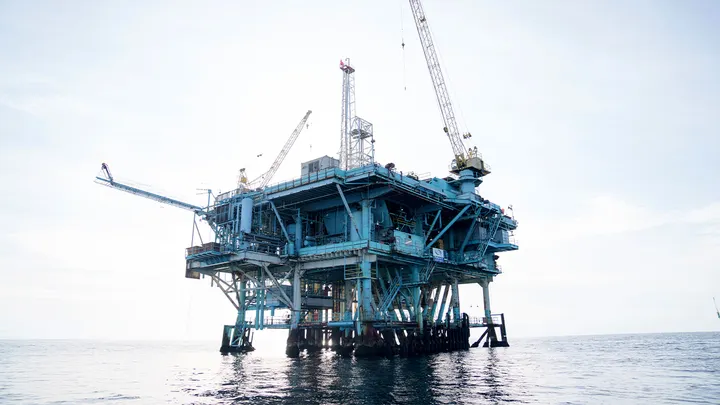
Energy Secretary Chris Wright on March 13 directed Houston-based Sable Offshore Corp. to restore operations at the Santa Ynez Unit and Santa Ynez Pipeline System off the coast of Santa Barbara, invoking the Defense Production Act — a Cold War-era law that grants the executive branch broad authority over domestic industry in the name of national security. The order came as oil prices climbed past $98 a barrel, the highest level since Russia's 2022 invasion of Ukraine, and as the ongoing U.S.-Israeli war against Iran has effectively shut down the Strait of Hormuz, the chokepoint through which 20 percent of the world's oil supply normally travels.
Trump signed a separate executive order Friday delegating expanded authorities under the Defense Production Act to Wright, providing the legal mechanism for the directive. The Energy Department framed the move in explicit terms: more than 60 percent of the oil refined in California currently comes from overseas, with a significant share arriving through the now-blocked strait.
"Today's order will strengthen America's oil supply and restore a pipeline system vital to our national security and defense, ensuring that West Coast military installations have the reliable energy critical to military readiness," Wright said in a statement.
The Santa Ynez System
The Santa Ynez Unit consists of three offshore platforms operating in federal waters, an onshore pipeline system, and the Las Flores Canyon Processing Facility, which connects offshore production to interstate pipelines through the Las Flores Pipeline System to Pentland Station. The Energy Department said the facility can produce approximately 50,000 barrels of oil per day — representing a 15 percent increase to California's current in-state production — and could replace nearly 1.5 million barrels of foreign crude each month.
The system has been offline since 2015, when a pipeline rupture spilled more than 100,000 gallons of crude oil near Refugio State Beach in Santa Barbara County. Roughly 21,000 gallons reached the Pacific Ocean, killing thousands of birds and marine mammals. The incident resulted in a $23.3 million settlement and shut down 138 square miles of fisheries for several weeks. Sable Offshore purchased the platforms, pipelines, and onshore processing facility in 2024 and has been working to restart operations since.
California has blocked that effort through a series of regulatory and legal actions. The California Coastal Commission fined Sable $18 million, citing defiance of stop-work orders. State Attorney General Rob Bonta sued Sable in October over alleged water discharge violations. The Santa Barbara County District Attorney filed separate criminal charges in September alleging environmental violations. A state judge earlier this year ruled that Sable still needed a waiver from the state fire marshal before restarting the pipeline, citing a federal consent decree from the 2015 spill.
In December, the U.S. Transportation Department's Pipeline and Hazardous Materials Safety Administration moved to assert federal oversight over the pipeline, approving Sable's restart plan. California sued that federal agency as well. Wright's directive now enters that unresolved legal landscape with the full weight of the Defense Production Act behind it.
Newsom's Response
California Gov. Gavin Newsom came out against the order the same day it was issued, describing it as an illegal attempt to override active court orders and calling the national security rationale a pretext.
"This is an attempt to illegally restart a pipeline whose operators are facing criminal charges and prohibited by multiple court orders from restarting," Newsom said in a statement. "California will not stand by while the Trump administration attempts to sacrifice our coastal communities, our environment, and our $51 billion coastal economy. The Trump administration and Sable are defying multiple court orders, and we will see them back in court."
Newsom also disputed the energy argument directly, noting that Sable's potential output would represent roughly 0.05 percent of total global oil production. Since oil prices are set on the global market, he argued, restarting the pipeline would have no meaningful effect on pump prices in California or nationally.
Ryan Cummings, chief of staff at the Stanford Institute for Economic Policy Research, echoed that assessment. While nearby offshore oil would likely be more economical for California refiners to process, "we shouldn't expect that to really flow through to consumers in any meaningful way in California, and certainly not in the United States," Cummings said.
California's average price for a regular gallon of gasoline stood at $5.416 as of March 14, compared to the national average of approximately $3.60. State lawmakers have warned in recent months that the combination of California's higher excise taxes, climate program fees, and mandated fuel blend requirements could push prices past $8 a gallon without action.
The Broader Energy Context
The directive fits within a series of energy-related moves the administration has made since Operation Epic Fury began February 28. The Energy Department also announced an emergency exchange from the Strategic Petroleum Reserve and temporarily lifted sanctions on Russian oil stranded in tankers at sea, with Brent crude briefly touching $119.50 per barrel in the days after the war started before retreating.
California presents a particular vulnerability in that scenario. Unlike virtually every other state, California is largely disconnected from the interstate crude pipeline network that moves American oil to refineries elsewhere in the country. The state once supplied close to 40 percent of U.S. oil production. Decades of policy changes targeting fossil fuels have steadily reduced that figure, while demand has remained among the highest in the nation. The Energy Department's directive specifically prioritizes routing Sable's production through the Las Flores Pipeline System and into interstate infrastructure to improve efficiency and reduce the state's dependence on foreign imports.
Sable's shares jumped as much as 34 percent on the news of the directive. The company did not immediately respond to requests for comment. The legal challenges from California — including the ongoing lawsuit over federal pipeline jurisdiction — ensure that the fight over whether Sable actually resumes production will continue in court even as the administration moves forward with the order.
Author

We cover the world’s chaos so you don’t have to scroll twelve feeds to understand it.
Sign up for Atlas newsletters.
Stay up to date with curated collection of our top stories.